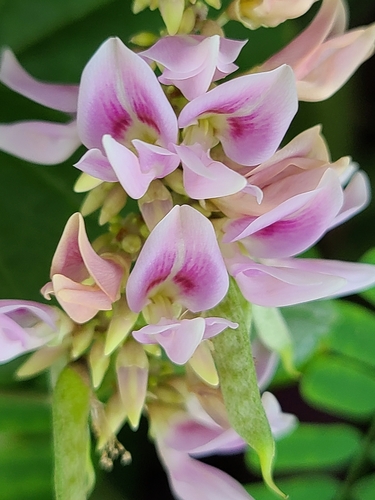
Gymnocladus dioicus
(L.) K. Koch.
Kentucky Coffee tree, Chicot

(c) Andrew Conboy, some rights reserved (CC BY)

(c) Andrew Conboy, some rights reserved (CC BY)

(c) Andrew Conboy, some rights reserved (CC BY)
What to Eat
Edible parts: Seeds - coffee, Caution
The fully ripe seeds are roasted and ground as a coffee substitute, requiring roasting for at least 3 hours at 285°C.
Known Hazards
Where to Find It
It is a temperate plant. It is native to C. & E. United States. It grows from 90-600 m altitude. It grows best in deep rich soils. It can tolerate severe climates. It can grow in a range of soils. It suits hardiness zones 4-8. Arboretum Tasmania.
Australia, Canada, Central Asia, North America, Slovenia, Tajikistan, Tasmania, USA,
How to Identify
A tree. It grows to 21 m high and 15 m wide. The trunk can be 60 cm across. It loses its leaves for much of the year. The leaves are large and compound. They are 1 m long. Young leaves are pinkish bronze. The leaf is made up of about 70 leaflets on 3-7 pairs of branches. The leaflets are oval and 5 cm long. The flowers are small, greenish-white and star shaped. They have a scent. They occur as many branched clusters at the ends of branches. The plants are separately male and female. They are pollinated by insects. Female plants produce fruit as reddish brown pods which hang down. The pods can be 25 cm long. The husk is hard and leathery. The seeds are about 2 cm long and slightly flattened. There are only a few seeds in each pod. They are in a sticky sweet pulp. The seeds have been roasted and ground as coffee.
How to Grow
Plants are grown from seed. The tough seed coat must be broken to allow water to enter before seed can germinate. It can also be grown from shoots from the roots.
Production
It is slow growing. Trees can live for 75 years.
Notes
There are only 2 Gymnocladus species. Also as Caesalpinaceae.
Names & Synonyms
Rogovilar
References (17)
- Beckstrom-Sternberg, Stephen M., and James A. Duke. "The Foodplant Database." http://probe.nalusda.gov:8300/cgi-bin/browse/foodplantdb.(ACEDB version 4.0 - data version July 1994)
- Bodkin, F., 1991, Encyclopedia Botanica. Cornstalk publishing, p 522
- Coombes, A.J., 2000, Trees. Dorling Kindersley Handbooks. p 195
- Cundall, P., (ed.), 2004, Gardening Australia: flora: the gardener's bible. ABC Books. p 662
- Dendrologie 1:5. 1869
- Etherington, K., & Imwold, D., (Eds), 2001, Botanica's Trees & Shrubs. The illustrated A-Z of over 8500 trees and shrubs. Random House, Australia. p 361
- Facciola, S., 1998, Cornucopia 2: a Source Book of Edible Plants. Kampong Publications, p 68
- Farrar, J.L., 1995, Trees of the Northern United States and Canada. Iowa State University press/Ames p 212
- Hibbert, M., 2002, The Aussie Plant Finder 2002, Florilegium. p 117
- Kermath, B. M., et al, 2014, Food Plants in the Americas: A survey of the domesticated, cultivated and wild plants used for Human food in North, Central and South America and the Caribbean. On line draft. p 403
- Little, E.L., 1980, National Audubon Society Field Guide to North American Trees. Alfred A. Knopf. p 524
- MacKinnon, A., et al, 2009, Edible & Medicinal Plants of Canada. Lone Pine. p 70
- Moerman, D. F., 2010, Native American Ethnobotany. Timber Press. p 252
- Plants for a Future database, The Field, Penpol, Lostwithiel, Cornwall, PL22 0NG, UK. http://www.scs.leeds.ac.uk/pfaf/
- Schuler, S., (Ed.), 1977, Simon & Schuster's Guide to Trees. Simon & Schuster. No. 125
- World Checklist of Useful Plant Species 2020. Royal Botanic Gardens, Kew (As Guilandina bonduc)
- Young, J., (Ed.), 2001, Botanica's Pocket Trees and Shrubs. Random House. p 423