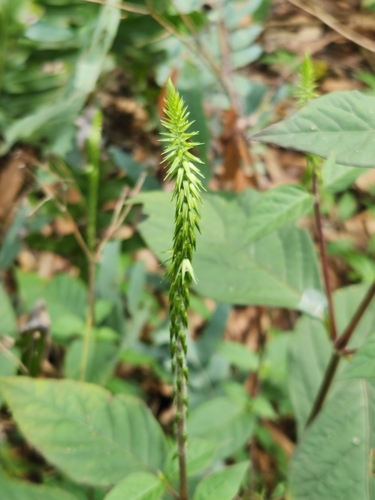
Atriplex portulacoides
L.
Sea purslane
AmaranthaceaeLeaves

iNaturalist · cc-by-nc
(c) cccrll, some rights reserved (CC BY-NC), uploaded by cccrll
(c) cccrll, some rights reserved (CC BY-NC), uploaded by cccrll

iNaturalist · cc-by-nc-sa
(c) Valter Jacinto | Portugal, some rights reserved (CC BY-NC-SA)
(c) Valter Jacinto | Portugal, some rights reserved (CC BY-NC-SA)

iNaturalist · cc-by
(c) Matt Lavin, some rights reserved (CC BY)
(c) Matt Lavin, some rights reserved (CC BY)
What to Eat
Edible parts: Leaves
The leaves are eaten raw in salads, cooked as a potherb, or used for pickles.
Where to Find It
It is a temperate and subtropical plant. It grows on salt marshes and along the edges of pools and drains.
Africa, Britain, Europe, France, Greece, Ireland, Italy, Mediterranean, Portugal, Spain,
Countries: Andorra, Albania, Angola, Austria, Bosnia & Herzegovina, Belgium, Burkina Faso, Bulgaria, Burundi, Benin, Botswana, Belarus, Congo (DRC), Central African Republic, Congo (Republic), Switzerland, Cote d'Ivoire, Cameroon, Cape Verde, Cyprus, Czechia, Germany, Djibouti, Denmark, Algeria, Estonia, Egypt, Eritrea, Spain, Ethiopia, Finland, France, Gabon, United Kingdom, Ghana, Gambia, Guinea, Equatorial Guinea, Greece, Guinea-Bissau, Croatia, Hungary, Ireland, Israel, Iceland, Italy, Kenya, Comoros, Lebanon, Liechtenstein, Liberia, Lesotho, Lithuania, Luxembourg, Latvia, Libya, Morocco, Monaco, Moldova, Montenegro, Madagascar, North Macedonia, Mali, Mauritania, Malta, Mauritius, Malawi, Mozambique, Namibia, Niger, Nigeria, Netherlands, Norway, Poland, Portugal, Romania, Serbia, Russia, Rwanda, Seychelles, Sudan, Sweden, Slovenia, Slovakia, Sierra Leone, San Marino, Senegal, Somalia, South Sudan, Sao Tome & Principe, Syria, Eswatini, Chad, Togo, Tunisia, Turkey, Tanzania, Ukraine, Uganda, South Africa, Zambia, Zimbabwe
How to Identify
A small shrub. It is spreading and can form roots where the stems touch the ground. The leaves are a silvery colour. They are thick and fleshy and are usually opposite. They are oblong and do not have teeth. The flowers are small and greenish-yellow.
Notes
Also put in the family Chenopodiaceae.
Names & Synonyms
Chenopodium portulacoides (L.) Thunb.Halimione portulacoides (L.) AellenHalimus portulacoides (L.) Dumort.Obione portulacoides (L.) Moq.
References (10)
- Bircher, A. G. & Bircher, W. H., 2000, Encyclopedia of Fruit Trees and Edible Flowering Plants in Egypt and the Subtropics. AUC Press. p 47
- Biscotti, N. et al, 2018, The traditional food use of wild vegetables in Apulia (Italy) in the light of Italian ethnobotanical literature. Italian Botanist 5:1-24
- Blamey, M and Grey-Wilson, C., 2005, Wild flowers of the Mediterranean. A & C Black London. p 40 (As Halimione portulacoides)
- Facciola, S., 1998, Cornucopia 2: a Source Book of Edible Plants. Kampong Publications, p 77 (As Halimione portulacoides)
- Irving, M., 2009, The Forager Handbook, A Guide to the Edible Plants of Britain. Ebury Press p 192 (As Halimione portulacoides)
- Kremer, B.P., 1995, Shrubs in the Wild and in Gardens. Barrons. p 120. (As Halimione portulacoides)
- Mabey, R., 1973, Food for Free. A Guide to the edible wild plants of Britain, Collins. p 91 (As Halimione portulacoides)
- Michael, P., 2007, Edible Wild Plants and Herbs. Grub Street. London. p 214 (As Halimione portulacoides)
- Plants for a Future database, The Field, Penpol, Lostwithiel, Cornwall, PL22 0NG, UK. http://www.scs.leeds.ac.uk/pfaf/ (As Halimione portulacoides)
- Verh. Naturf. Ges. Basel 49:126. 1938 (As Halimione portulacoides)