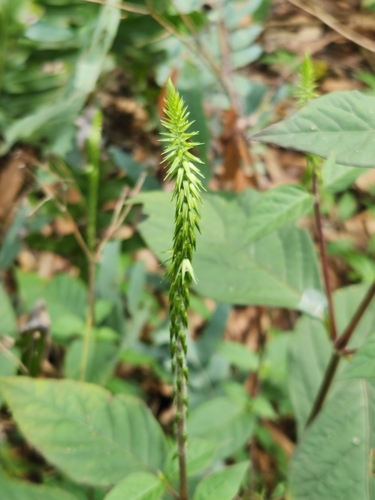
Halosarcia indica
(Willd.) Paul G. Wilson
Brown-headed glasswort, Marsh Samphire

(c) Russell Cumming, some rights reserved (CC BY-NC)

(c) Russell Cumming, some rights reserved (CC BY-NC)

(c) Russell Cumming, some rights reserved (CC BY-NC)
What to Eat
Edible parts: Branches, Leaves, Vegetable
The young branches and leaves are eaten raw, cooked as a pot herb, or pickled. The outer corky layer is removed before cooking. The plant is characteristically sour and can be eaten cooked or raw. The ash can be used as a salt substitute.
Where to Find It
A tropical plant. It can grow in salty soil. It grows in seasonally waterlogged places. It grows on tidal mud flats. It grows on tropical coasts. It can grow in dry areas. It grows in areas with a rainfall between 100-600 mm per year. It can grow on the land ward side of mangroves that are occasionally flooded. It can grow in arid places.
Africa, Asia, Australia, East Africa, India, Indochina, Kenya, Madagascar, Malaysia, Mozambique, Pakistan, SE Asia, Somalia, Sri Lanka, Tanzania, Vietnam, Zambia,
How to Identify
A soft succulent herb. It grows about 40 cm high. It keeps growing from year to year. It grows near the waters edge. It spreads 1-1.5 m wide. The branches lie along the ground and the young branches are slender. It forms loose open mats. The stems have joints. The leaves are reduced to scales. The segments are 1 cm long by 0.6 cm wide and barrel shaped. They are grey or red. The spikes are 2 cm long. The flowers are mainly female. The flowers are in clusters of 3. The fruit are spongy with a horny outer surface.
How to Grow
Plants can be grown from seed or cuttings.
Medicinal Uses
Used traditionally as a famine food.
Other Information
It is a famine food. It is only a minor food.
Notes
There are 25 Halosarcia species. Most are in Australia. Also put in the family Chenopodiaceae.
Names & Synonyms
Bholado, Ciri-ciri, Jadu palang, Koyaloo, Koyalu, Koyya pippali, Koyya-pippili, Machola, Machul, Machur, Muchul, Oomarie keeray, Queiloo, Pavala poondoo, Samphire, Subhar, Suvar, Umari, Umari keerai
References (25)
- Ambasta S.P. (Ed.), 2000, The Useful Plants of India. CSIR India. p 56 (As Arthrocnemum indicum and Salicornia brachiata)
- Bircher, A. G. & Bircher, W. H., 2000, Encyclopedia of Fruit Trees and Edible Flowering Plants in Egypt and the Subtropics. AUC Press. p 42 (As Arthrocnemum indicum)
- Cooper W & Cooper W T, 1994, Fruits of the Rain Forest. RD Press p 156
- Edible and Useful Native Plants (off internet)
- Elliot, W.R., & Jones, D.L., 1990, Encyclopedia of Australian Plants suitable for cultivation. Vol 5. Lothian. p 248
- Flora of Australia, Volume 4, Phytolaccaceae to Chenopodiaceae, Australian Government Publishing Service, Canberra (1984) p 298
- Flora of Pakistan. www.eFlora.org (As Arthrocnemum indicum)
- Grubben, G. J. H. and Denton, O. A. (eds), 2004, Plant Resources of Tropical Africa 2. Vegetables. PROTA, Wageningen, Netherlands. p 310
- Hedrick, U.P., 1919, (Ed.), Sturtevant's edible plants of the world. p 589 (As Salicornia brachiata)
- Joshi, A., et al, 2018, Halophytes of Thar Desert: Potential source of nutrition and feedstuff. International Journal of Bioassays 8.1 (2018) pp. 5674-5683 (As Arthrocnemum indicum)
- Kenneally, K.E., Edinger, D. C., and Willing T., 1996, Broome and Beyond, Plants and People of the Dampier Peninsula, Kimberley, Western Australia. Department of Conservation and Land Management. p 84
- Lazarides, M. & Hince, B., 1993, Handbook of Economic Plants of Australia, CSIRO. p 128
- Low, T., 1992, Bush Tucker. Australia’s Wild Food Harvest. Angus & Robertson. p 137
- Martin, F.W. & Ruberte, R.M., 1979, Edible Leaves of the Tropics. Antillian College Press, Mayaguez, Puerto Rico. p 182 (As Arthrocnemum indicum)
- Melzer, R. & Plumb, J., 2011, Plants of Capricornia. Belgamba, Rockhampton. p 517
- Paczkowska, G. & Chapman, A.R., 2000, The Western Australian Flora. A Descriptive Catalogue. Western Australian Herbarium. p 204
- Pham-Hoang Ho, 1999, An Illustrated Flora of Vietnam. Nha Xuat Ban Tre. p 725 (As Arthrocnemum indicum)
- Royal Botanic Gardens, Kew (1999). Survey of Economic Plants for Arid and Semi-Arid Lands (SEPASAL) database. Published on the Internet; http://www.rbgkew.org.uk/ceb/sepasal/internet [Accessed 7th April 2011] (As Arthrocnemum indicum)
- Shah, G.L., 1984, Some economically important plant of Salsette Island near Bombay. J. Econ. Tax. Bot. Vol. 5 No. 4 pp 753-765 (As Arthrocnemum indicum)
- SHORTT, (As Salicornia brachiata and Salicornia indica)
- Singh, H.B., Arora R.K.,1978, Wild edible Plants of India. Indian Council of Agricultural Research, New Delhi. p 39 (As Arthrocnemum indicum and Salicornia brachiata)
- Thiselton-Dywer, W.T., (Ed.), 1913, Flora of Tropical Africa. Vol VI-section 1. Reeve, p 86 (As Arthrocnemum indicum)
- WATT (As Arthrocnemum indicum and Salicornia brachiata)
- Wheeler, J.R.(ed.), 1992, Flora of the Kimberley Region. CALM, Western Australian Herbarium, p 101
- Williams, K.A.W., 1999, Native Plants of Queensland Volume 4. Keith A.W. Williams North Ipswich, Australia. p 218