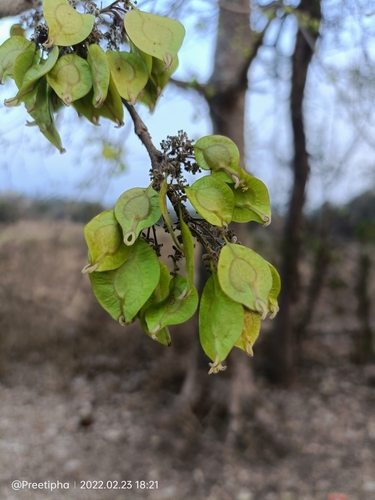
Hemiptelea davidii
(Hance) Planchon
Thorny elm

(c) Jane Charlen, some rights reserved (CC BY-NC), uploaded by Jane Charlen

(c) Tim Edelsten, some rights reserved (CC BY-NC), uploaded by Tim Edelsten
What to Eat
Edible parts: Leaves, Fruit, Leaves - drink, Seeds - oil
Young leaves are edible cooked and are traditionally mixed with rice dumplings. The tender leaves can also be brewed into a pleasant beverage.
Where to Find It
It is a temperate plant. It grows in north and east China. It grows below 2,000 m above sea level.
Asia, China, Korea, Mongolia,
How to Identify
A tree. It loses its leaves during the year. It grows 5-8 m high. The branches have hairs and spines. The spines are 2-10 cm long. The leaves are narrowly oval and 2-6 cm long. The flowers are joined with 1-4 in a group. The fruit is a small nutlet. It has a wing on the upper half.
How to Grow
Propagation: Ideally, harvest seed as soon as it ripens but before it has fully dried on the plant, and sow immediately in a cold frame. Stored seed needs stratification and should be sown as soon as possible after that. Prick seedlings into individual pots once large enough to handle and grow on under glass for at least the first winter. Plant out into permanent positions in late spring or early summer after the last expected frosts. Seed can be stored in cool, dry conditions.
Medicinal Uses
The plant is regarded as demulcent, diuretic, febrifuge, and lenitive.
Other Uses
Plants are grown as a hedge in China. Bark fibre is used in manufacturing staple rayon and sacks. An oil is extracted from the seeds, though no information is available on whether it is edible or what specific uses it serves. The wood is hard and used for making utensils.
Wikipedia
Source ↗A deciduous tree reaching 15 m (49ft 3in) tall. Hardy to UK zone 3. Flowers in April with seeds ripening September to October. Hermaphroditic. Suited to light sandy, medium loamy, and heavy clay soils with mildly acid to basic pH. Grows in semi-shade or full sun and prefers moist soil conditions.
Names & Synonyms
Har-a sanduu
References (7)
- Compt. Rend. Hebd. Seances Acad. Sci. 74:131. 1872
- Flora of China @ efloras.org Volume 5
- https://en.wikipedia.org/wiki/List of wild edible plants in Mongolian cuisine
- Hu, Shiu-ying, 2005, Food Plants of China. The Chinese University Press. p 353
- Lee, Y. M., 2014, Important Plants of East Asia II: Endemic Plant Stories. East Asia Biodiversity Conservation Network p 84
- Plants for a Future database, The Field, Penpol, Lostwithiel, Cornwall, PL22 0NG, UK. http://www.scs.leeds.ac.uk/pfaf/
- Sachula, et al, 2020, Wild edible plants collected and consumed by the locals in Daqinggou, Inner Mongolia, China. Journal of Ethnobiology and Ethnomedicine (2020) 16:60