Allocasuarina decaisneana
(F. Muell.) L. Johnson
Desert oak

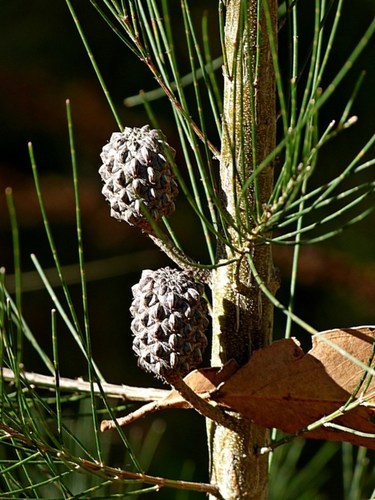
(c) Geoff Warn, some rights reserved (CC BY-NC), uploaded by Geoff Warn

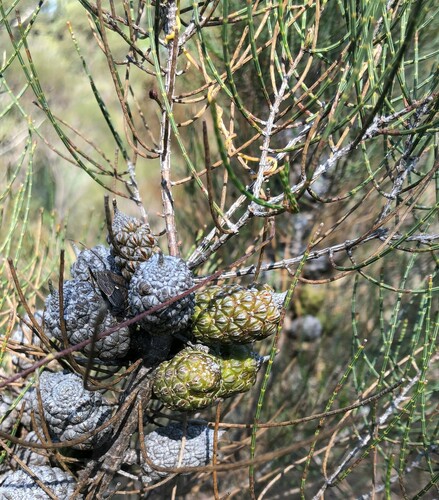
(c) Maryse Neukomm, some rights reserved (CC BY-NC), uploaded by Maryse Neukomm

(c) Wayne Martin, some rights reserved (CC BY-NC), uploaded by Wayne Martin
What to Eat
Edible parts: Exudate, Seeds, Gum
The tree was useful to Indigenous Australian peoples who used it as a source of water. Water can be collected from tree hollows but surface roots could also be broken off in sections to provide potable water by draining the root when held vertically or by directly sucking the water out. The Aborigines also used the hard wood of the trees for firewood and for making weapons and other implements, and they used the seeds for food. A 10,000 year-old boomerang made from Allocasuarina wood was found in Wyrie Swamp, near Millicent, South Australia.
Where to Find It
It grows in extreme environments. It grows in low rainfall red dunes in Central Australia. It can grow in arid places.
Australia*,
How to Identify
It grows to 10-15 m tall. It has deep roots. The trunk is straight. The bark is corky and deeply furrowed. The small branches hang downwards and are grey-green. The seed 'cones" are large.
Wikipedia
Source ↗Allocasuarina decaisneana, commonly known as desert oak, desert sheoak, or kurkara by the Anangu peoples, is a species of flowering plant in the family Casuarinaceae and is endemic to Central Australia. It is a dioecious tree that typically grows to a height of 10–16 m (33–52 ft) and has long, drooping branchlets, the leaves reduced to scales in whorls of four, the mature fruiting cones 28–95 mm (1.1–3.7 in) long containing winged seeds (samaras) 8.5–17 mm (0.3–0.7 in) long.
Notes
There are 58 Allocasuarina species.
Names & Synonyms
References (9)
- Cancilla, D., 2018, Ethnobotanical and Ethnozoological Values Desktop Assessment - Eliwana Project. p 38
- Cherikoff V. & Isaacs, J., The Bush Food Handbook. How to gather, grow, process and cook Australian Wild Foods. Ti Tree Press, Australia p 42, 188
- Doran, J.C., & Turnbull, J.W. (Eds), 1997, Australian Trees and Shrubs: species for land rehabilitation and farm plantings in the tropics. ACIAR Monograph No 24. p 351
- Elliot, W.R., & Jones, D.L., 1982, Encyclopedia of Australian Plants suitable for cultivation. Vol 2. Lothian. p 481
- Flora of Australia, Volume 3, Hamamelidales to Casuarinales, Australian Government Publishing Service, Canberra (1989) p 127, 128
- Holliday, I., 1989, A Field Guide to Australian Trees. Hamlyn. p 42
- Latz, P., 1996, Bushfires and Bushtucker. IAD. p 122
- Low, T., 1992, Bush Tucker. Australia’s Wild Food Harvest. Angus & Robertson. p 88
- Young, J., (Ed.), 2001, Botanica's Pocket Trees and Shrubs. Random House. p 82