Allocasuarina verticillata
(Lam.) L. Johnson
Mountain she oak, Drooping she oak

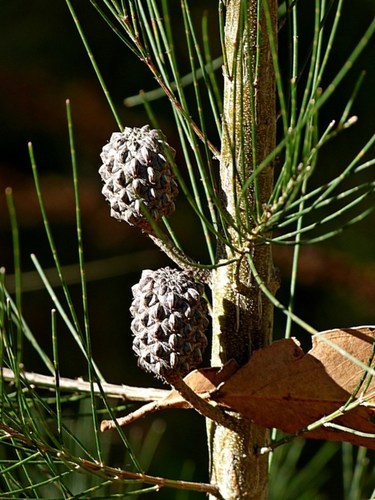
(c) deborod, some rights reserved (CC BY-NC), uploaded by deborod

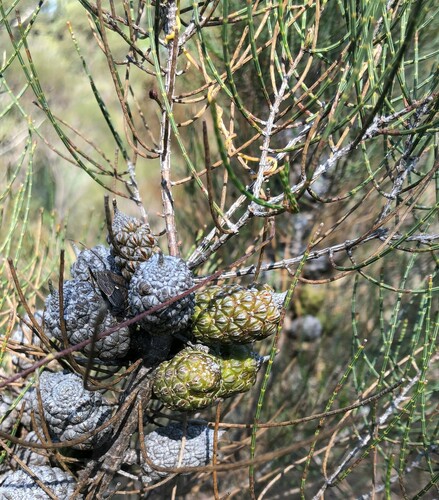
(c) Nicola Baines, some rights reserved (CC BY-NC), uploaded by Nicola Baines

(c) Nathan Johnson, some rights reserved (CC BY-NC-SA)
What to Eat
Edible parts: Resin ?, Cones, Shoots
The soft young cones and young shoots are eaten.
Where to Find It
It is a temperate plant. It grows on most types of soil. It can tolerate some waterlogging. It often grows on coastal cliffs. It suits hardiness zone 8-10. Arboretum Tasmania. National Arboretum Canberra.
Australia*, Tasmania*,
How to Identify
A small tree. It grows up to 8 m high. It has many branches. It has a weeping habit. Male and female flowers are on separate trees. Male flowers are brown and on the ends of small branches. The fruit are woody cones. They are 2.5-4.5 cm long and 2-3 cm across.
How to Grow
Plants are easily grown from seed.
Wikipedia
Source ↗Allocasuarina verticillata, commonly known as drooping sheoak, is a species of flowering plant in the family Casuarinaceae and is endemic to south-eastern Australia. It is a small dioecious tree that has drooping branchlets up to 400 mm (16 in) long, the leaves reduced to scales in whorls of nine to thirteen, the mature fruiting cones 20–50 mm (0.8–2 in) long containing winged seeds (samaras) 7–12 mm (0.3–0.5 in) long.
Names & Synonyms
Brakbruk, Gneering, Wayetuck
References (15)
- Cundall, P., (ed.), 2004, Gardening Australia: flora: the gardener's bible. ABC Books. p 129
- Dashorst, G.R.M., and Jessop, J.P., 1998, Plants of the Adelaide Plains & Hills. Botanic Gardens of Adelaide and State Herbarium. p 46
- De Angelis, D., 2005, Aboriginal Plant Use of the Greater Melbourne Area. La Trobe University Environment Collective
- Etherington, K., & Imwold, D., (Eds), 2001, Botanica's Trees & Shrubs. The illustrated A-Z of over 8500 trees and shrubs. Random House, Australia. p 87
- Flora of Australia, Volume 3, Hamamelidales to Casuarinales, Australian Government Publishing Service, Canberra (1989) p 144, 145
- Gilfedder, L et al, 2003, The Nature of the Midlands. Midlands Bushweb. PO Box 156 Longford, Tasmania. p 104
- Harris, S., Buchanan, A., Connolly, A., 2001, One Hundred Islands: The Flora of the Outer Furneaux. Tas Govt. p 103
- Hastings Advance Community College, 2017, Uses for Native Plants of the Mornington Peninsula. 86pp. p 15
- Holliday, I., 1989, A Field Guide to Australian Trees. Hamlyn. p 48
- J. Adelaide Bot. Gard. 6:79. 1982
- Lazarides, M. & Hince, B., 1993, Handbook of Economic Plants of Australia, CSIRO. p 14
- Tasmanian Herbarium Vascular Plants list p 21
- Whiting, J. et al, 2004, Tasmania's Natural Flora. Tasmania's Natural Flora Editorial Committee PO Box 194, Ulverstone, Tasmania, Australia 7315 p 47
- World Checklist of Useful Plant Species 2020. Royal Botanic Gardens, Kew
- www.fsd.monash.edu.au/files/bethgottpamphley_po.pdf