Alstroemeria haemantha
Ruiz. & Pav.
Peruvian Lily, Purple-spot Parrot-lily

(c) Eitel Carlos Thielemann Pinto, some rights reserved (CC BY-NC)
(c) Marcin Dyderski, some rights reserved (CC BY-NC)

(c) Cody Hinchliff, some rights reserved (CC BY-NC)
What to Eat
Edible parts: Root
The cooked root is a source of starch. It is very nutritious but has a rather bland flavour.
Known Hazards
Where to Find It
It grows naturally on well-drained rocky hillsides in Chile. It requires a moist well drained soil and a warm situation.
Australia, Chile, Peru*, South America,
How to Identify
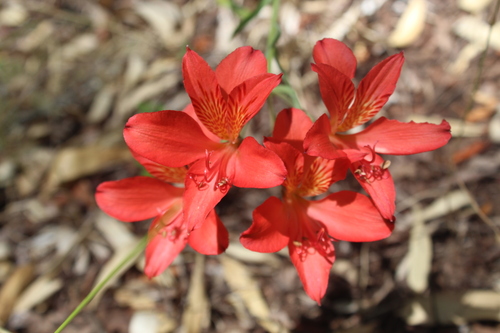
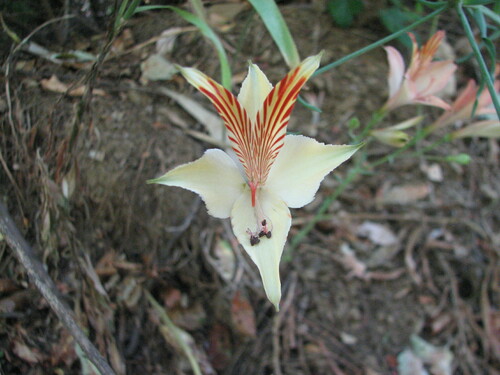
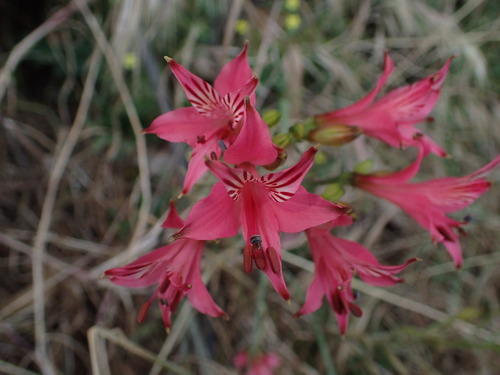
A perennial plant 100 cm high and spreads 100 cm wide. The stem is erect. The leaves are long and sword shaped. The flowers are funnel shaped. The flowers are reddish-yellow with green tips. They can have purple spots. They grow in clusters at the top of the plant.
How to Grow
An easily grown plant, it requires a fertile, moisture retentive well-drained soil and a warm situation in sun or semi-shade. Prefers a dry sheltered border and a peaty loam. Plants succeed in maritime gardens. Hardy to between -10 and -15°c. The roots should be planted 15 - 20cm deep in late summer to autumn and then be well mulched to protect them from severe winter weather. This species is closely related to A. ligtu. A somewhat invasive plant, spreading by means of fleshy roots to form large patches. Somewhat intolerant of root disturbance, the roots are fleshy and brittle.
Propagation: Seed — best sown in individual pots in a cold frame as soon as ripe, though seedlings can be transplanted successfully if moved carefully while small. Pre-soak stored seed for 12 hours in warm water, warm stratify for 4 weeks at 25°C, then reduce temperature to 10°C. Excising a small piece of the seed near the embryo after warm stratification helps speed germination. Plant out approximately 20cm deep into permanent positions in late summer or autumn. Division in April or October, taking care as the plant resents root disturbance — ensure each portion has a growth bud.
Medicinal Uses
None known.
Other Uses
None known.
Wikipedia
Perennial herb reaching 90 cm tall with hermaphrodite flowers blooming June to July. Hardy to UK zone 9 and frost-hardy. Grows in light sandy to medium loamy, well-drained soils across mildly acidic to mildly alkaline pH ranges. Tolerates semi-shade or full sun, prefers moist conditions, and withstands maritime exposure.
Notes
There are about 50-80 Alstroemeria species. They occur in South America especially in cool mountain regions.
Names & Synonyms
References (6)
- Bircher, A. G. & Bircher, W. H., 2000, Encyclopedia of Fruit Trees and Edible Flowering Plants in Egypt and the Subtropics. AUC Press. p 21
- Bodkin, F., 1991, Encyclopedia Botanica. Cornstalk publishing, p 71
- Fl. peruv. 3:60. 1802
- Hedrick, U.P., 1919, (Ed.), Sturtevant's edible plants of the world. p 46
- Lamberton, K (Ed.), 2004, The Australian gardening encyclodepia. Murdoch Books, NSW Australia. p 161
- Plants for a Future database, The Field, Penpol, Lostwithiel, Cornwall, PL22 0NG, UK. http://www.scs.leeds.ac.uk/pfaf/