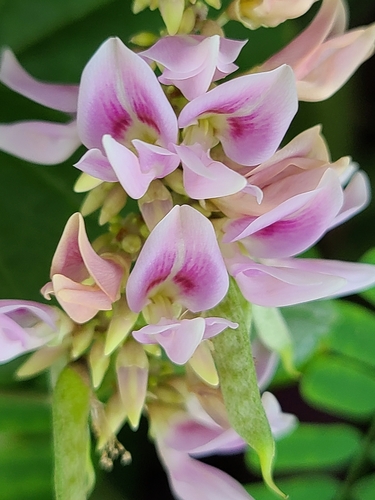
Senegalia fleckii
(Schinz) Boatwr.
Blade thorn, Sand-veld acacia

(c) Christine Sydes, some rights reserved (CC BY-NC), uploaded by Christine Sydes
(c) Christine Sydes, some rights reserved (CC BY-NC), uploaded by Christine Sydes
(c) Adrian Wilson, some rights reserved (CC BY-NC), uploaded by Adrian Wilson
What to Eat
Edible parts: Gum, Vegetable
The gum can be eaten as a vegetable.
Where to Find It
It is a tropical plant. It often forms thickets on sandy soil. It grows on sand dunes. It is drought resistant. It can tolerate some frost. It grows between 400-1,450 m above sea level. It can grow in arid places.
Africa, Angola, Botswana, Central Africa, East Africa, Namibia, South Africa, Southern Africa, Zambia, Zimbabwe,
How to Identify
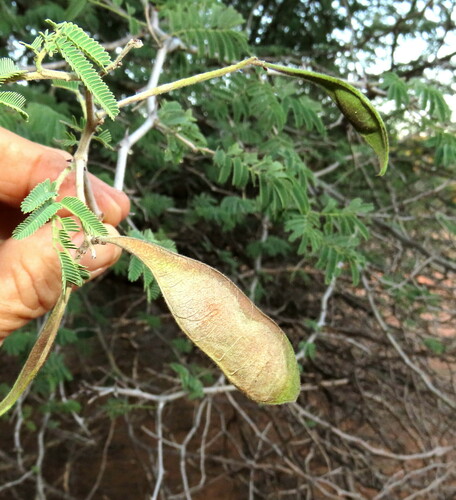
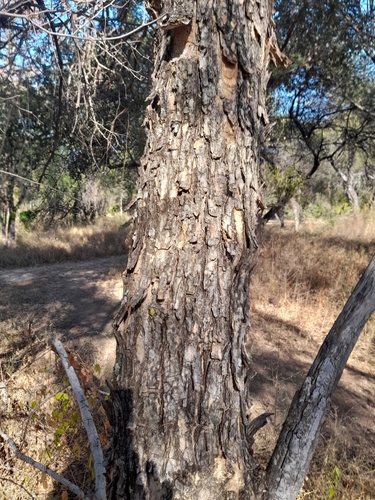
It is a shrub. Often is has several stems. It loses many of its leaves during the year. It grows up to about 2.5-6 m tall. The bark on the trunk can peel off in papery pieces. The thorns are hooked and sharp. They occur in pairs. The thorns have a swollen base. The leaves are 5-8 cm long. They have flat raised gland at the base of the leaf. The leaves have 6-14 pairs of side branches and about 10-30 pairs of leaflets. These are hairy. The leaflets are fine and grey. The flowers are pale yellow and in spikes about 8 cm long. The pods are flat and papery. They are grey or brown and about 9 cm long. They have many glands which look like red spots.
How to Grow
Plants can be grown from seeds. Seeds germinate fairly easily in 5-15 days.
Other Information
Probably minor.
Notes
There are about 1,350 Acacia species. Over 1,000 occur in Australia. Also as Mimosaceae.
Names & Synonyms
Bladdoring, Kane, Mhahu, Mohahu, Mofafu, Mwalala, Sand-veld acacia
References (18)
- Fowler, D. G., 2007, Zambian Plants: Their Vernacular Names and Uses. Kew. p 32 (As Acacia fleckii)
- Fox, F. W. & Young, M. E. N., 1982, Food from the Veld. Delta Books. p 201 (As Acacia fleckii)
- Grivetti, L. E., 1980, Agricultural development: present and potential role of edible wild plants. Part 2: Sub-Saharan Africa, Report to the Department of State Agency for International Development. p 79 (As Acacia fleckii)
- Grubben, G. J. H. and Denton, O. A. (eds), 2004, Plant Resources of Tropical Africa 2. Vegetables. PROTA, Wageningen, Netherlands. p 559 (As Acacia fleckii)
- http://aflora.africa.kyoto-u.ac.jp (As Acacia fleckii)
- ILDIS Legumes of the World http:www;ildis.org/Legume/Web (As Acacia fleckii)
- Lee, 1979, (As Acacia fleckii)
- Mannheimer, C. A. & Curtis. B.A. (eds), 2009, Le Roux and Muller's Field Guide to the Trees and Shrubs of Namibia. Windhoek: Macmillan Education Namibia. p 94 (As Acacia fleckii)
- Mem. Herb. Boissier 1:108. 1900 (As Acacia fleckii)
- Palgrave, K.C., 1996, Trees of Southern Africa. Struik Publishers. p 237 (As Acacia fleckii)
- Palmer, E and Pitman, N., 1972, Trees of Southern Africa. Vol. 2. A.A. Balkema, Cape Town p 758 (As Acacia fleckii)
- Peters, C. R., O'Brien, E. M., and Drummond, R.B., 1992, Edible Wild plants of Sub-saharan Africa. Kew. p 126 (As Acacia fleckii)
- Roodt, V., 1998, Trees & Shrubs of the Okavango Delta. Medicinal Uses and Nutritional value. The Shell Field Guide Series: Part 1. Shell Botswana. p 161 (As Acacia fleckii)
- Royal Botanic Gardens, Kew (1999). Survey of Economic Plants for Arid and Semi-Arid Lands (SEPASAL) database. Published on the Internet; http://www.rbgkew.org.uk/ceb/sepasal/internet [Accessed 26th April 2011] (As Acacia fleckii)
- Ruiters-Welcome, A. K., 2019, Food plants of southern Africa. Ph.D. thesis. Univ. of Johannesburg p 55 (As Acacia fleckii)
- Tanaka, 1980, (As Acacia fleckii)
- van Wyk, Ben-Erik, 2019, The diversity and multiple uses of southern African legumes. Australian Systematic Botany, 2019, 32, 519–546
- World Checklist of Useful Plant Species 2020. Royal Botanic Gardens, Kew