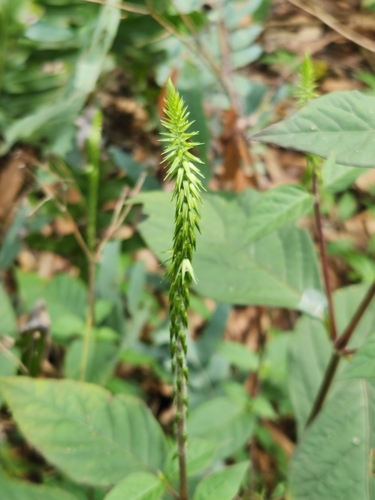
Alternanthera nodiflora
R. Br.
Joyweed

(c) Anne Lawton, some rights reserved (CC BY-NC), uploaded by Anne Lawton
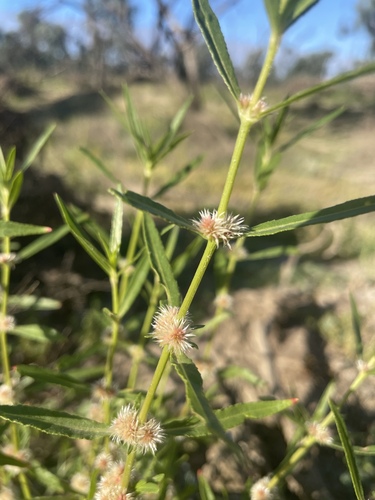
(c) Vermilingua_pygmaeus, some rights reserved (CC BY-NC), uploaded by Vermilingua_pygmaeus

(c) Kym Nicolson, some rights reserved (CC BY), uploaded by Kym Nicolson
What to Eat
Edible parts: Leaves, Vegetable
The leaves are used as a vegetable, though it is typically eaten as a famine food.
Where to Find It
It is a tropical or warm climate plant. It grows on moist alluvial sand and clay. It grows in wet grassland savannah and in flooded rice fields. Tasmania Herbarium.
Africa, Asia, Australia*, Botswana, Burkina Faso, Côte d'Ivoire, East Africa, Gambia, Ghana, Guinea, Guinée, Guinea-Bissau, India, Ivory Coast, Malawi, Mozambique, Myanmar, Nigeria, SE Asia, Senegal, South Africa, Southern Africa, Tanzania, Tasmania, West Africa, Zambia, Zimbabwe,
How to Identify
An annual herb. It can be erect, lie along the ground or curve upwards. It grows 2-100 cm high. It has a woody rootstock. The flowers are white.
Wikipedia
Source ↗Alternanthera nodiflora (common name common joyweed) is a species of flowering plant in the family Amaranthaceae. It is endemic to Australia, growing in all mainland states. It is naturalised in Tasmania, over much of Africa, in Japan, and in Myanmar.
Other Information
It is usually a famine food.
Notes
There are 200 Alternanthera species. It is a threatened plant in Tasmania.
Names & Synonyms
Bocha, Borovoro, Kanabaw, Mahlare
References (14)
- Burkill, H. M., 1985, The useful plants of west tropical Africa, Vol. 1. Kew.
- Elliot, W.R., & Jones, D.L., 1982, Encyclopedia of Australian Plants suitable for cultivation. Vol 2. Lothian. p 181
- Fowler, D. G., 2007, Zambian Plants: Their Vernacular Names and Uses. Kew. p 6
- Hussey, B.M.J., Keighery, G.J., Cousens, R.D., Dodd, J., Lloyd, S.G., 1997, Western Weeds. A guide to the weeds of Western Australia. Plant Protection Society of Western Australia. p 78
- Jardin, C., 1970, List of Foods Used In Africa, FAO Nutrition Information Document Series No 2.p 53
- Lazarides, M. & Hince, B., 1993, Handbook of Economic Plants of Australia, CSIRO. p 16
- Martin, F.W. & Ruberte, R.M., 1979, Edible Leaves of the Tropics. Antillian College Press, Mayaguez, Puerto Rico. p 173
- Paczkowska, G. & Chapman, A.R., 2000, The Western Australian Flora. A Descriptive Catalogue. Western Australian Herbarium. p 136
- Prodr. 417. 1810
- Ruiters-Welcome, A. K., 2019, Food plants of southern Africa. Ph.D. thesis. Univ. of Johannesburg p 10
- Shackleton, S. E., et al, 1998, Use and Trading of Wild Edible Herbs in the Central Lowveld Savanna Region, South Africa. Economic Botany, Vol. 52, No. 3, pp. 251-259
- Terra, G.J.A., 1973, Tropical Vegetables. Communication 54e Royal Tropical Institute, Amsterdam, p 20
- Welcome, A. K. & Van Wyk, B.-E., 2019, An inventory and analysis of the food plants of southern Africa. South African Journal of Botany 122 (2019) 136–179
- Wheeler, J.R.(ed.), 1992, Flora of the Kimberley Region. CALM, Western Australian Herbarium, p 110