Alternanthera versicolor
Regel
Pink cress

Wikimedia Commons - Bois, D.; Frederick Warne (Firm); Herincq, B.; Step, Edward; Watson, William
What to Eat
Edible parts: Leaves, Vegetable
The young leaves are added fresh to salads or boiled as a pot herb, typically served with fish or meat dishes.
Where to Find It
A tropical plant.
Africa, Asia, Australia, Central Africa, Central America, Gabon, Pacific, Philippines, SE Asia, West Africa,
How to Identify
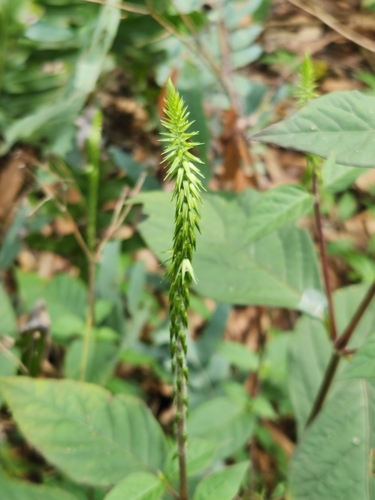
A slender herb. It can be erect or lie over. It has many branches. It is almost without hairs. The stems are reddish and 20-60 cm long. The leaves are broadly oval or spoon shaped. They have a long leaf stalk. The leaf blades are 1-6 cm long. They are green, red or purplish. The flower heads are in the axils of leaves. They occur singly without stalks and are oval. They are 5-8 mm long. They are slightly hairy.
Nutrition Score: 30/100
| Part | Moisture | kJ | kcal | Protein | Vit A | Vit C | Iron | Zinc |
|---|---|---|---|---|---|---|---|---|
| Leaves | 85.7 | 206 | 49 | 1.8 | — | — | 16 | — |
Notes
There are 200 Alternanthera species. It is often grown as an ornamental plant.
Names & Synonyms
Kutsarita, Lofai, Taguhug
References (7)
- Facciola, S., 1998, Cornucopia 2: a Source Book of Edible Plants. Kampong Publications, p 8
- Food Composition Tables for use in East Asia FAO http://www.fao.org/infoods/directory No. 354
- Lugod, G.C. and de Padua L.S., 1979, Wild Food Plants in the Philippines. Vol. 1. Univ. of Philippines Los Banos. p 12
- Martin, F.W. & Ruberte, R.M., 1979, Edible Leaves of the Tropics. Antillian College Press, Mayaguez, Puerto Rico. p 173
- Raponda-Walker, A & Sillans, R., 1961, Les Plantes Utiles du Gabon. Editions Paul Lechevalier, Paris. p 48
- Siemonsma, J. S. & Kasem Piluek, eds. 1993. Vegetables. In: Plant Resources of South-East Asia (PROSEA) 8:312
- Terra, G.J.A., 1973, Tropical Vegetables. Communication 54e Royal Tropical Institute, Amsterdam, p 20