Alysicarpus rugosus
(Willd.) DC.
Rough chainpea, Red moneywort
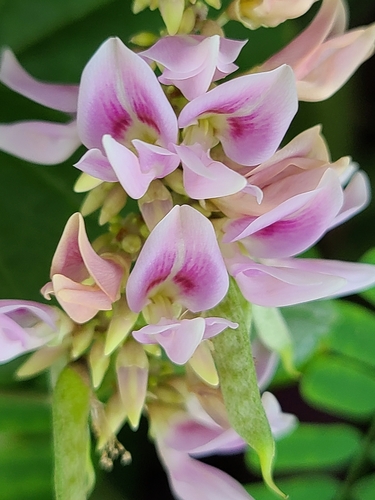
(c) tjeerd, some rights reserved (CC BY-NC), uploaded by tjeerd

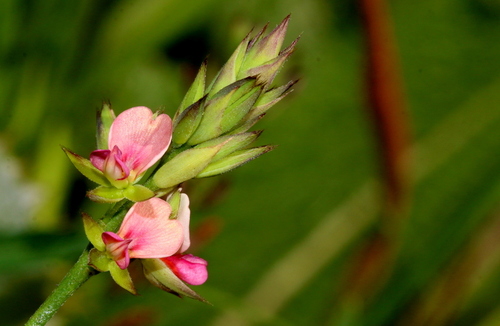
(c) Athol Ferguson, some rights reserved (CC BY-NC), uploaded by Athol Ferguson

(c) Athol Ferguson, some rights reserved (CC BY-NC), uploaded by Athol Ferguson
What to Eat
Edible parts: Seeds
Seeds are eaten.
Where to Find It
A tropical plant. It grows in seasonally waterlogged grassland. It flowers and fruits from January to June in Australia. In southern China it grows in moist places in dense forests between 600-1,200 m above sea level. In Yunnan.
Africa, Asia, Australia, Botswana, Burkina Faso, Cambodia, China, East Africa, Eritrea, Eswatini, Guinea, Guinée, Guinea-Bissau, Himalayas, India, Indochina, Indonesia, Laos, Madagascar, Malaysia, Mali, Mozambique, Myanmar, Namibia, Nepal, Pakistan, SE Asia, Senegal, Sierra Leone, South Africa, Southern Africa, Swaziland, Taiwan, Thailand, Vietnam, West Africa, Zambia, Zimbabwe,
How to Identify
An erect herb or shrub. It has a woody rootstock. It grows up to 40-60 cm tall. The leaves are sword shaped. They are 2-5 cm long by 0.7-1.5 cm wide. The ends of the leaves are blunt. The flowers are at the end of the branch. It has a pea like flower. There are yellow and mauve colours on the flower. The pod is 1 cm long by 0.3 cm wide. The pod is constricted between the seeds. These sections break off. They have marks across them. The seed is dark brown and oval. It is 1.5-2 mm long by 1.5 mm wide.
How to Grow
Alysicarpus rugosus is a plant of the tropical zone, where it is found at elevations up to 1,400 metres. It grows best in areas where annual daytime temperatures are within the range 22 - 30°c, but can tolerate 18 - 36°c. It is not tolerant of frost.. It prefers a mean annual rainfall in the range 900 - 1,400mm, but tolerates 600 - 1,500mm. Requires a sunny position. Grows best on well-drained, sandy loam to clay soils, it is poorly adaptated to acid-infertile soils. Prefers a pH in the range 6 - 7, tolerating 5.5 - 8. In single species plots, annual dry matter yields of 3,000 - 7,500 kilos per hectare have been recorded. This species has a symbiotic relationship with certain soil bacteria; these bacteria form nodules on the roots and fix atmospheric nitrogen. Some of this nitrogen is utilized by the growing plant but some can also be used by other plants growing nearby.
Propagation: Like many species within the family Fabaceae, once they have been dried for storage the seeds of this species may benefit from scarification before sowing in order to speed up and improve germination. This can usually be done by pouring a small amount of nearly boiling water on the seeds (being careful not to cook them!) and then soaking them for 12 - 24 hours in warm water. By this time they should have imbibed moisture and swollen - if they have not, then carefully make a nick in the seedcoat (being careful not to damage the embryo) and soak for a further 12 hours before sowing.
Medicinal Uses
Leaf and root extracts are used in the treatment of coughs and fevers.
Other Uses
An annual ley legume, it can be used for cut and carry and green manure
Names & Synonyms
Butqua nham, Sheora, Shevra, Zhou suo lian jia dou
References (14)
- Ambasta S.P. (Ed.), 2000, The Useful Plants of India. CSIR India. p 33
- Dobriyal, M. J. R. & Dobriyal, R., 2014, Non Wood Forest Produce an Option for Ethnic Food and Nutritional Security in India. Int. J. of Usuf. Mngt. 15(1):17-37
- Flora of Pakistan. www.eFloras.org
- Fowler, D. G., 2007, Zambian Plants: Their Vernacular Names and Uses. Kew. p 80
- GAMMIE,
- GUPTA & KANODIA,
- Huang Puhua; H. Ohashi, FABACEAE (Draft), Trib. Desmodieae (Bentham) Hutchinson. Flora of China.
- Paczkowska, G . & Chapman, A.R., 2000, The Western Australian Flora. A Descriptive Catalogue. Western Australian Herbarium. p 416
- Pham-Hoang Ho, 1999, An Illustrated Flora of Vietnam. Nha Xuat Ban Tre. p 935
- Prodr. 2:353. 1825
- Singh, H.B., Arora R.K.,1978, Wild edible Plants of India. Indian Council of Agricultural Research, New Delhi. p 83
- Swaziland's Flora Database http://www.sntc.org.sz/flora (As subsp. perennirufus)
- WATT.
- Wheeler, J.R.(ed.), 1992, Flora of the Kimberley Region. CALM, Western Australian Herbarium, p 367