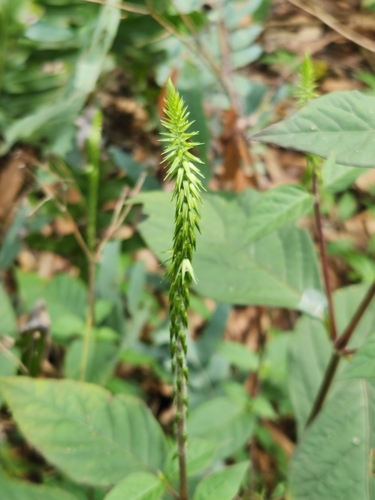
Amaranthus blitoides
S. Watson
Mat amaranth

(c) jrebman, some rights reserved (CC BY-NC), uploaded by jrebman

(c) Andre Hosper, some rights reserved (CC BY), uploaded by Andre Hosper

(c) Sam Kieschnick, some rights reserved (CC BY), uploaded by Sam Kieschnick
What to Eat
Edible parts: Seeds, Leaves
Both leaves and seeds are edible, though their value differs considerably. The seeds are the stronger offering — relatively large for a wild amaranth at around 1.3–1.6mm in diameter, dull rather than shiny, but nutritious and versatile. They can be toasted, boiled into porridge, or ground into flour for use in bread, mush, or as a soup flavoring, and are easily collected in useful quantities. The leaves are edible raw or cooked and are rich in vitamins and minerals, but fresh leaves have a harsh, acrid taste with an underlying spinach-like quality. Boiling softens the bitterness, though the result may still be unappealing to some. Unlike spinach, boiled leaves are not slimy and hold their texture. Dried leaves can be stored for winter use. Cooking the seeds whole makes them very gelatinous, and since the small size makes it hard to crush all of them in the mouth, some will pass through the digestive system unassimilated. The seed is rich in starch.
Known Hazards
Where to Find It
A temperate plant. In Argentina it grows between 2,900-3,000 m above sea level.
Africa, Alaska, Argentina, Asia, Central Asia, Chile, China, Europe, Mediterranean, Mexico, Morocco, Myanmar, North Africa, North America, SE Asia, Slovenia, South Africa, Southern Africa, South America, Tajikistan, Turkey, Türkiye, USA,
How to Identify
A herb. It grows 15-50 cm tall. The stems are greenish white. Stems divided from the base. The leaves are dense and 1-3 cm long by 3-10 mm wide. The leaf base is wedge shaped. The flowers are in clusters in the axils of leaves. The seeds are about 2 mm across.
How to Grow
Prefers a well-drained, fertile soil in a sunny position. Requires a hot sheltered position if it is to do well. Plants should not be given inorganic fertilizers; see notes above on toxicity. There is some confusion over the correct name for this species; some authorities consider it part of A. graecizans, while others regard it as a distinct species. Most, if not all, members of this genus photosynthesize by a more efficient method than most plants. Called the 'C4 carbon-fixation pathway', this process is particularly efficient at high temperatures, in bright sunlight, and under dry conditions. Habitat: Found in disturbed sites, agricultural fields, roadsides, and open ground. Especially common in lowland areas but adaptable to mid-elevations. Native to central North America, it is now spread across much of the continent and into Europe. Blooms in summer; seeds ripen in late summer to autumn. Growth Habit: Low-lying, sprawling plant forming mats close to the ground. Responds well to summer heat.
Propagation: Sow seed in late spring in situ. For an earlier start, sow in a greenhouse and transplant after the last expected frosts. Germination is usually rapid and good in warm soil; a drop in overnight temperature aids germination. Cuttings of growing plants root easily.
Medicinal Uses
None known.
Other Uses
Yellow and green dyes can be obtained from the whole plant. A glue is also made from the plant — likely derived from the starch in the seeds.
Wikipedia
Source ↗Amaranthus blitoides, commonly called mat amaranth, prostrate pigweed, procumbent pigweed, prostrate amaranth, or matweed, is a glabrous annual plants species. It usually grows up to 0.6 m, though it may grow up to 1 m (3 feet). It flowers in the summer to fall. It is believed to have been a native of the central and possibly eastern United States, but it has naturalized in almost all of temperate North America. It has also naturalized in South America and Eurasia. Some authorities list it as an invasive species.
Notes
There are about 60 Amaranthus species.
Names & Synonyms
Bei mei xian, Blitou, Hinka-nwe, Hin-nu-nwe, Koksor, Phat-khun-khaik, Razprostrti ščir, Saqta
References (12)
- Bao Bojian; Steve Clemants, Thomas Borsch, Amaranthaceae [Draft], Flora of China
- Beckstrom-Sternberg, Stephen M., and James A. Duke. "The Foodplant Database." http://probe.nalusda.gov:8300/cgi-bin/browse/foodplantdb.(ACEDB version 4.0 - data version July 1994)
- Ertug, F, Yenen Bitkiler. Resimli Türkiye Florası -I- Flora of Turkey - Ethnobotany supplement
- Kaya, O. M., et al, 2020, An ethnobotanical research in Sanhurfa central district and attached Villages (Turkey). Indian Journal of Traditional Knowledge. Vol. 19(1) pp 7-23
- Nassif, F., & Tanji, A., 2013, Gathered food plants in Morocco: The long forgotten species in Ethnobotanical Research. Life Science Leaflets 3:17-54
- Plants for a Future database, The Field, Penpol, Lostwithiel, Cornwall, PL22 0NG, UK.
- Proc. Amer. Acad. Arts 12:273. 1877
- Ruiters-Welcome, A. K., 2019, Food plants of southern Africa. Ph.D. thesis. Univ. of Johannesburg p 10
- Saunders, C.F., 1948, Edible and Useful Wild Plants. Dover. New York. p 53
- Weche-Ebeling, P., et al, 1995, Value of Some Wild Amaranthus Species (Amaranthaceae) of Nuevo Leon, Mexico. Economic Botany 49(4): 423-430
- Welcome, A. K. & Van Wyk, B.-E., 2019, An inventory and analysis of the food plants of southern Africa. South African Journal of Botany 122 (2019) 136–179
- www.eFloras.org Flora of China