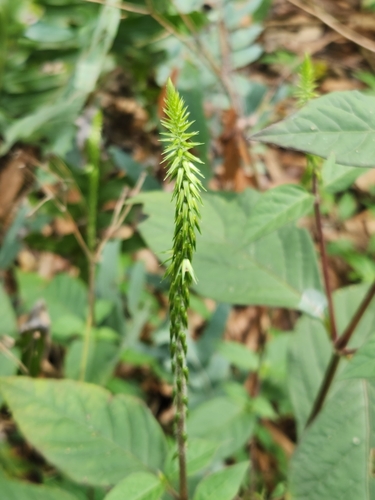
Amaranthus campestris
Willd.
Love lies bleeding

Wikimedia Commons - Adrián Cerón

Wikimedia Commons - Patrick Alexander from Las Cruces, NM

Wikimedia Commons - Patrick Alexander from Las Cruces, NM
What to Eat
Edible parts: Leaves, Seeds
Both the leaves and seeds are edible. Leaves are cooked and used as a pot-herb. The seed, though very small and fiddly, is highly nutritious. It can be cooked whole, becoming very gelatinous in the process, but it is difficult to crush all the tiny seeds in the mouth, meaning some will pass through the digestive system without being fully assimilated.
Known Hazards
Where to Find It
A tropical plant. It can grow on a range of well drained soils. It needs sun and moisture.
Asia, India, Indonesia, SE Asia,
How to Identify
Amaranthus campestris is a frost-tender annual with monoecious, wind-pollinated, self-fertile flowers. It grows in light, medium, or heavy soils preferring good drainage and mildly acid to basic pH. The plant requires full sun and moist soil, and cannot tolerate shade.
How to Grow
We have very little information on this species and do not know how well it will grow in Britain, though it should succeed as a spring-sown annual. The following notes are based on the general needs of the genus. Prefers a well-drained fertile soil in a sunny position. Requires a hot sheltered position if it is to do well. Plants should not be given inorganic fertilizers, see notes above on toxicity. Most if not all members of this genus photosynthesize by a more efficient method than most plants. Called the 'C4 carbon-fixation pathway', this process is particularly efficient at high temperatures, in bright sunlight and under dry conditions.
Propagation: Sow seed in late spring in situ. An earlier sowing can be made in a greenhouse, with plants moved outside after the last expected frosts. Germination is usually rapid and good in warm soil; a drop in temperature overnight aids germination. Cuttings of growing plants root easily.
Medicinal Uses
The plant is diuretic.
Other Uses
Yellow and green dyes can be obtained from the whole plant. The plant is also used as a dynamic accumulator.
Wikipedia
Amaranthus campestris is a frost-tender annual with monoecious, wind-pollinated, self-fertile flowers. It grows in light, medium, or heavy soils preferring good drainage and mildly acid to basic pH. The plant requires full sun and moist soil, and cannot tolerate shade.
Notes
There are about 60 Amaranthus species.
Names & Synonyms
Siru keeray, Teseri kura
References (4)
- Bircher, A. G. & Bircher, W. H., 2000, Encyclopedia of Fruit Trees and Edible Flowering Plants in Egypt and the Subtropics. AUC Press. p 22
- Hedrick, U.P., 1919, (Ed.), Sturtevant's edible plants of the world. p 47
- Plants for a Future database, The Field, Penpol, Lostwithiel, Cornwall, PL22 0NG, UK. http://www.scs.leeds.ac.uk/pfaf/
- SHORTT