Amaranthus graecizans
Linn.
Spreading pigweed, Mat Amaranth
(c) יאיר אור, some rights reserved (CC BY-NC-SA), uploaded by יאיר אור

(c) AndreaC, some rights reserved (CC BY-ND), uploaded by AndreaC
What to Eat
Edible parts: Seeds, Leaves, Vegetable
The leaves are cooked as a spinach. Nutritious with a very mild flavour, they are often mixed with stronger-tasting leaves to balance a dish. The seeds can be eaten raw or cooked and are rich in starch, making them a useful cereal substitute. Though very small, they are easy to harvest and highly nutritious. When cooked whole the seeds become very gelatinous, but because the small seeds are difficult to crush completely in the mouth, some will pass through the digestive system without being fully assimilated.
Known Hazards
Where to Find It
It is a Mediterranean and tropical plant. Tasmania Herbarium. In Ethiopia it grows from 900-2,380 m altitude. It can grow in arid places.
Africa, Albania, Angola, Australia, Asia, Balkans, Benin, Botswana, Burkina Faso, Burundi, Cameroon, Central Africa, Central African Republic, CAR, Central Asia, Chad, Congo, Côte d'Ivoire, Cyprus, East Africa, Eritrea, Ethiopia, Europe, Gambia, Ghana, Greece, Guinea, Guinée, Hawaii, India, Italy, Ivory Coast, Kenya, Madagascar, Malawi, Mali, Mauritania, Mediterranean, Middle East, Mozambique, Namibia, Niger, Nigeria, Oman, Pacific, Pakistan, Rwanda, Sahara, Sahel, Sao Tome and Principe, Saudi Arabia, Senegal, Somalia, South Africa, Southern Africa, Spain, St Helena, Sudan, Tajikistan, Tanzania, Tasmania, Turkey, Türkiye, Uganda, United Arab Emirates, UAE, West Africa, Yemen, Zambia, Zimbabwe,
How to Identify
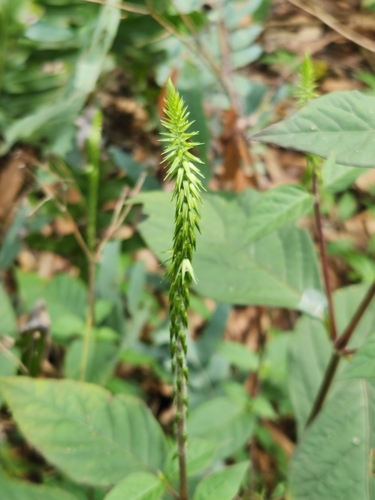
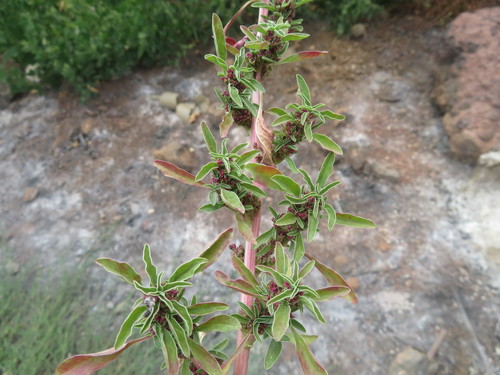
An annual plant growing up to 50 cm high. The plant is sprawling over the ground. It has a taproot. The branches do not have hairs. The flowering shoots are leafy. The flowers are in small clusters. They are greenish.
Nutrition Score: 42/100
| Part | Moisture | kJ | kcal | Protein | Vit A | Vit C | Iron | Zinc |
|---|---|---|---|---|---|---|---|---|
| Leaves - dry | 6.3 | 903 | — | 26.1 | — | — | 9.8 | 5 |
| Seeds | — | — | — | — | — | — | — | — |
How to Grow
Plants can be grown from seed if the soil is warm. Seeds are small and grow easily. They need to be planted near the soil surface. Cuttings of growing plants root easily.
Propagation: Sow seed in late spring directly in situ. For an earlier start, sow in a greenhouse and transplant after the last expected frosts. Germination is usually rapid and good when the soil is warm, and a drop in temperature overnight aids the process. Cuttings of growing plants root easily.
Medicinal Uses
None known
Other Uses
Yellow and green dyes can be obtained from the whole plant. The plant is also noted as a dynamic accumulator.
Wikipedia
Source ↗Amaranthus graecizans, the Mediterranean amaranth or short-tepalled pigweed, is an annual species in the botanical family Amaranthaceae. It is native to Africa, southern Europe, East Asia to India and Central Asia. It is naturalized in North America. More general common names include tumbleweed and pigweed.
Production
It grows after rain and the first leaves can be harvested after 12 days.
Other Information
It is a famine food.
Notes
There are about 60 Amaranthus species. Plant in Tasmania is probably Amaranthus graecizans subsp. silvestris.
Names & Synonyms
Annass, Boo, Bouamoa, Bouraboura ba, Boyo, Buuza, Chomachi, Cumadhe, Dhadah, Embooge, Eboga, Eboo, Ekiliton, Enie, Gana, Hamle tilian, Horoqota, Imbog, Kadringo, Ladah, M'Boa, Madighi, Mchicha pori, Morli, Ndelele, Nyabutongo, Obug, Obuga, Ocobo-lango, Ocoboro, Omvuga, Onvuga, Prostrate amaranth, Rasoota, Rasuta, Rwoga, Shin sag, Sirukeerai, Telele, Terere, Tseque, W'oa, Zabine, Zapina
References (70)
- Acipa, A. et al, 2013, Nutritional Profile of some Selected Food Plants of Otwal and Ngai Counties, Oyam District, Northern Uganda. African Journal or Food, Agriculture, Nutrition and Development. 13(2)
- Addis, G., et al, 2013, Dietary values of wild and semi-wild edible plants in Southern Ethiopia. African Journal of Food, Agriculture, Nutrition and Development. 13(2)
- Addis, G., Asfaw, Z & Woldu, Z., 2013, Ethnobotany of Wild and Semi-wild Edible Plants of Konso Ethnic Community, South Ethiopia. Ethnobotany Research and Applications. 11:121-141
- Agea, J. G., et al 2011, Wild and Semi-wild Food Plants of Bunyoro-Kitara Kingdom of Uganda: etc. Environmental Research Journal 5(2) 74-86
- Al-Fatimi, M. A., Wild Edible Plants Traditionally Collected and Used in Southern Yemen. Research Square. University of Aden.
- Ambasta S.P. (Ed.), 2000, The Useful Plants of India. CSIR India. p 34
- Anywar, G., et al, 2014, Wild Plants Used as Nutraceuticals from Nebbi District, Uganda. European Journal of Medicinal Plants 4(6): 641-660, 2014
- P. F. A. Ascherson & K. O. R. P. P. Graebner, Syn. Mitteleur. Fl. 5:309. 1914 (As Amaranthus angustifolius)
- Balemie, K., & Kebebew, F., 2006, Ethnobotanical study of wild edible plants in Derashe and Kucha Districts, South Ethiopia. Journal of Ethnobiology and Ethnomedicine.
- Beckstrom-Sternberg, Stephen M., and James A. Duke. "The Foodplant Database." http://probe.nalusda.gov:8300/cgi-bin/browse/foodplantdb.(ACEDB version 4.0 - data version July 1994)
- Biscotti, N. et al, 2018, The traditional food use of wild vegetables in Apulia (Italy) in the light of Italian ethnobotanical literature. Italian Botanist 5:1-24
- Burkill, H. M., 1985, The useful plants of west tropical Africa, Vol. 1. Kew.
- Costea, M., et al, 2003, The Identity of a Cultivated Amaranthus from Asia and a New Nomenclatural Combination. Economic Botany 57(4): 646-649 (As Amaranthus graecizans subsp. aschersonianus)
- Dalziel, J. M., 1937, The Useful plants of west tropical Africa. Crown Agents for the Colonies London.
- Della, A., et al, 2006, An ethnobotanical survey of wild edible plants of Paphos and Larnaca countryside of Cyprus. J. Ethnobiol. Ethnomed. 2:34
- Diarra, N. et al, 2016, Etude ethnobotanique des plantes alimentaires utilisées en période de soudure dans les régions Sud du Mali. Int. J. Biol. Chem. Sci. 10(1): 184-197
- Diouf, M., et al, Leafy Vegetables in Senegal. Bioversity webite
- Duguma, H. T., 2020, Wild Edible Plant Nutritional Contribution and Consumer Perception in Ethiopia. Hindawi International Journal of Food Science Volume 2020, Article ID 2958623, 16 pages
- Ertug, F, Yenen Bitkiler. Resimli Türkiye Florası -I- Flora of Turkey - Ethnobotany supplement
- Ethiopia: Famine Food Field Guide. http://www.africa.upenn.edu/faminefood/category1.htm
- Etkin, N.L. (Ed.), 1994, Eating on the Wild Side, Univ. of Arizona. p 72
- Facciola, S., 1998, Cornucopia 2: a Source Book of Edible Plants. Kampong Publications, p 8
- Fowler, D. G., 2007, Zambian Plants: Their Vernacular Names and Uses. Kew. p 6
- Gallagher, D. E., 2010, Farming beyond the escarpment: Society, Environment, and Mobility in Precolonial Southeastern Burkina Faso. PhD University of Michigan.
- Global Plants JSTOR
- Godfrey, J. et al, 2013, Harvesting, preparationand preservation of commonly consumed wild and semi-wild food plants in Bunyoro-Kitara Kingdom, Uganda. Int. J. Med. Arom. Plants. Vol.3 No.2 pp 262-282
- Goode, P., 1989, Edible Plants of Uganda. FAO p 26
- Goode, P., 1989, Edible Plants of Uganda. FAO p 36
- Goode, P., 1989, Edible Plants of Uganda. FAO p 39
- Grivetti, L. E., 1980, Agricultural development: present and potential role of edible wild plants. Part 2: Sub-Saharan Africa, Report to the Department of State Agency for International Development. p 70 (As Amaranthus angustifolius)
- Grubben, G. J. H. and Denton, O. A. (eds), 2004, Plant Resources of Tropical Africa 2. Vegetables. PROTA, Wageningen, Netherlands. p 76
- Harkonen, M. & Vainio-Mattila, K., 1998, Some examples of Natural Products in the Eastern Arc Mountains. Journal of East African Natural History 87:265-278
- Ichikawa, M., 1980, The Utilization of Wild Food Plants by the Suiei Dorobo in Northern Kenya. J. Anthrop. Soc. Nippon. 88(1): 25-48
- Jardin, C., 1970, List of Foods Used In Africa, FAO Nutrition Information Document Series No 2.p 54 (As Amaranthus angustifolius)
- Johns, T., Mhoro, E. B. and Sanaya, P., 1996, Food Plants and Masticants of the Batemi of Ngorongoro District, Tanzania. Economic Botany, Vol. 50, No. 1, pp. 115-121
- Karim, F. M. & Dakheel, A, J., 2006, Salt-tolerant plants of the United Arab Emirates. 2006. International Center for Biosaline Agriculture, Dubai, UAE.
- Kidane, B., et al, 2014, Wild and semi-wild leafy vegetables used by the Maale and Ari ethnic communities in southern Ethiopia. Genetic Resour Crop Evol. Springer. p 8
- Lazarides, M. & Hince, B., 1993, Handbook of Economic Plants of Australia, CSIRO. p 16
- Lulekal, E., et al, 2011, Wild edible plants in Ethiopia: a review on their potential to combat food insecurity. Afrika Focus - Vol. 24, No 2. pp 71-121
- Lyimo, M., et al, 2003, Identification and nutrient composition of indigenous vegetables of Tanzania. Plant Foods for Human Nutrition. 58: 85-92
- Magwede, K., van Wyk, B.-E., & van Wyk, A. E., 2019, An inventory of Vhavenḓa useful plants. South African Journal of Botany 122 (2019) 57–89
- Marshall, F., Agriculture and Use of Wild and Weedy Greens by the Piik ap Oom Okiek of Kenya. Economic Botany, Vo. 55, No. 1, pp. 32-47 (var. sylvestris)
- Masters, T., 2021, Traditional food plants of the upper Aswa River catchment of northern Uganda—a cultural crossroads. Journal of Ethnobiology and Ethnomedicine (2021) 17:24
- Maundu, P.M. & Grubben, G.J.H., 2004. Amaranthus graecizans L. [Internet] Record from Protabase. Grubben, G.J.H. & Denton, O.A. (Editors). PROTA (Plant Resources of Tropical Africa / Ressources végétales de l’Afrique tropicale), Wageningen, Netherlands. < http://database.prota.org/search.htm>. Accessed 13 October 2009.
- Maundu, P. et al, 1999, Traditional Food Plants of Kenya. National Museum of Kenya. p 59
- Mertz, O., Lykke, A. M., and Reenberg, A., 2001, Importance and Seasonality of Vegetable Consumption and Marketing in Burkina Faso. Economic Botany, 55(2):276-289
- Miller, A. G., Morris, M. & Stuart-Smith, S., 1988, Plants of Dhofar. The Southern Region of Oman, Traditional, Economic and Medicinal Uses. Sultanate of Oman. p 22
- Msuya, T. S., et al, 2010, Availability, Preference and Consumption of Indigenous Foods in the Eastern Arc Mountains, Tanzania, Ecology of Food and Nutrition, 49:3, 208-227
- Musinguzi, E., et al, 2006, Utilization of Indigenous Food Plants in Uganda: A Case Study of South-Western Uganda. AJFAND Vol. 6(2):
- Mutie, F. G., 2020, Conservation of Wild Food Plants and Their Potential for Combatting Food Insecurity in Kenya as Exemplified by the Drylands of Kitui County. Plants 2020, 9, 1017
- Mutie, F. M., et al, 2023, Important Medicinal and Food Taxa (Orders and Families) in Kenya, Based on Three Quantitative Approaches. Plants 2023, 12, 1145
- Ocho, D. L., et al, 2012, Assessing the levels of food shortage using the traffic light metaphor by analyzing the gathering and consumption of wild food plants, crop parts and crop residues in Konso, Ethiopia. Journal of Ethnobiology and Ethnomedicine 8:30
- Ojelel, S., et al, 2019, Wild edible plants used by communities in and around selected forest reserves of Teso-Karamoja region, Uganda. Journal of Ethnobiology and Ethnomedicine (2019) 15:3
- Peters, C. R., O'Brien, E. M., and Drummond, R.B., 1992, Edible Wild plants of Sub-saharan Africa. Kew. p 47
- Plants for a Future database, The Field, Penpol, Lostwithiel, Cornwall, PL22 0NG, UK
- Ramachandran,V. S., & Udhayavani, C., 2013, Knowledge and uses of wild edible plants by Paniyas and Kurumbas of Western Nilgiris, Tamil Nadu. Indian Journal of Natural Products and Resources. 4(4) December 2013, pp 412-418
- Rasingam, L., 2012, Ethnobotanical studies on the wild edible plants of Irula tribes of Pillur Valley, Coimbatore district, Tamil Nadu, India. Asian Pacific Journal of Tropical Biomedicine. (2012) S1493-S1497
- Rivera, D. et al, 2006, Gathered Mediterranean Food Plants - Ethnobotanical Investigations and Historical Development, in Heinrich M, Müller WE, Galli C (eds): Local Mediterranean Food Plants and Nutraceuticals. Forum Nutr. Basel, Karger, 2006, vol 59, pp 18–74
- Royal Botanic Gardens, Kew (1999). Survey of Economic Plants for Arid and Semi-Arid Lands (SEPASAL) database. Published on the Internet; http://www.rbgkew.org.uk/ceb/sepasal/internet [Accessed 24th March 2011]
- Ruiters-Welcome, A. K., 2019, Food plants of southern Africa. Ph.D. thesis. Univ. of Johannesburg p 10
- Rubaihayo, E. B., Conservation and use of traditional vegetables in Uganda. Bioversity International.
- Shumsky, S., et al, 2014, Institutional factors affecting wild edible plant (WEP) harvest and consumption in semi-arid Kenya. Land Use Policy 38(2014) 48-69
- Sp. pl. 2:990. 1753
- Tareen, N. M., et al, 2016, Ethnomedicinal Utilization of Wild Edible Vegetables in District Harnai of Balochistan Province - Pakistan. Pakistan Journal of Botany 48(3): 1159-1171
- Tredgold, M.H., 1986, Food Plants of Zimbabwe. Mambo Press. p 34
- Vainio-Mattila, K., 2000, Wild vegetables used by the Sambaa in the Usumbara Mountains, NE Tanzania. Ann. Bot. Fennici 37:57-67 (As Amaranthus graecizans subsp. thellungianus)
- Vernon, R., 1983, Field Guide to Important Arable Weeds of Zambia. Dept of Agriculture, Chilanga, Zambia. p 26
- Welcome, A. K. & Van Wyk, B.-E., 2019, An inventory and analysis of the food plants of southern Africa. South African Journal of Botany 122 (2019) 136–179
- World Checklist of Useful Plant Species 2020. Royal Botanic Gardens, Kew
- Zeven, A. C. & de West, J. M. J., 1982, Dictionary of cultivated plants and their regions of diversity. Wageningen. p 71 (As Amaranthus angustifolius)