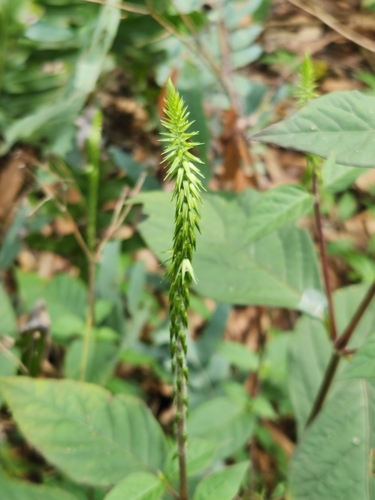
Amaranthus interruptus
R. Br.
Native Amaranth

gbif · cc-by
GBIF
GBIF

gbif · cc-by
GBIF
GBIF

gbif · cc-by
GBIF
GBIF
What to Eat
Edible parts: Seeds, Leaves
The leaves are eaten cooked.
Where to Find It
It is a tropical plant. It occurs in the northern parts of Australia and in Papua New Guinea and the Solomon Islands.
Australia*, Pacific, Papua New Guinea, PNG, Solomon Islands,
Countries: Australia, Fiji, Micronesia, Kiribati, Marshall Islands, Nauru, New Zealand, Papua New Guinea, Palau, Solomon Islands, Tonga, Tuvalu, Vanuatu, Samoa
How to Identify
A herb which can be erect or lying down. It can be 60-120 cm tall. The stems are angular. The plant often branches from the base upwards. The leaves are 1.5-4 cm long by 0.7-2 cm wide. The leaf stalk is 0.5-2.5 cm long. The side veins are prominent underneath. The flower cluster can be slightly branched at the base and at the top of the plant. Seed are 1 mm across and rather thick.
Notes
There are about 60 Amaranthus species.
Names & Synonyms
Euxolus interruptus (R. Br.)Moq.
References (10)
- Cancilla, D., 2018, Ethnobotanical and Ethnozoological Values Desktop Assessment - Eliwana Project. p 10
- Checklist of NT Vascular Plant Species. January 2003.
- Cherikoff V. & Isaacs, J., The Bush Food Handbook. How to gather, grow, process and cook Australian Wild Foods. Ti Tree Press, Australia p 42, 188
- French, B.R., 2010, Food Plants of Solomon Islands. A Compendium. Food Plants International Inc. p 64
- Kanis, A in Womersley, J.S., (Ed), 1978, Handbooks of the Flora of Papua New Guinea. Melbourne University Press. Vol 1. p 24
- Lazarides, M. & Hince, B., 1993, Handbook of Economic Plants of Australia, CSIRO. p 17
- Morley, B.D., & Toelken, H.R., (Eds), 1983, Flowering Plants in Australia. Rigby. p 83
- Paczkowska, G. & Chapman, A.R., 2000, The Western Australian Flora. A Descriptive Catalogue. Western Australian Herbarium. p 136
- Wheeler, J.R.(ed.), 1992, Flora of the Kimberley Region. CALM, Western Australian Herbarium, p 112
- World Checklist of Useful Plant Species 2020. Royal Botanic Gardens, Kew