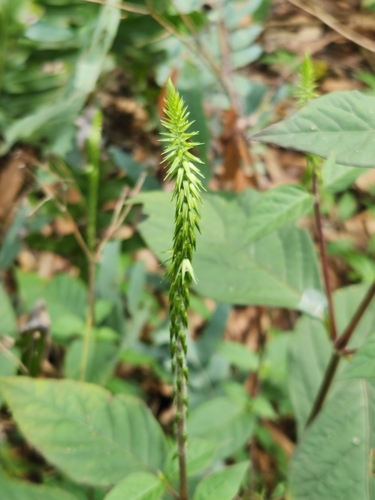
Amaranthus polygonoides
L.
Tropical amaranth

(c) krancmm, some rights reserved (CC BY-NC), uploaded by krancmm

(c) Sam Kieschnick, some rights reserved (CC BY)
What to Eat
Edible parts: Leaves, Vegetable
The young shoots and leaves are cooked and eaten as a vegetable, either fried or used in curries.
Where to Find It
It is a tropical plant. It grows from sea level up to 500 m altitude. It is best with a pH of 5.5-7.5, It grows best with a temperature between 23°-30°C.
Asia, Bahamas*, Belize, Central America, Dominican Republic, Haiti*, Honduras, India, Jamaica*, Lesser Antilles, Malaysia, Mexico*, North America, Northeastern India, Pakistan, SE Asia, South America*, Sri Lanka, Virgin Islands, West Indies*,
How to Identify
A small annual plant. It can be erect or lie over. It grows 10-50 cm high. It has soft spikes on young shoots. The leaves are narrowly oval and 3 cm long by 1.5 cm wide. The flowers are in congested clusters in the axils of leaves. The seeds are dark brown and shiny. They are lens shaped and 1 mm across.
Nutrition Score: 31/100
| Part | Moisture | kJ | kcal | Protein | Vit A | Vit C | Iron | Zinc |
|---|---|---|---|---|---|---|---|---|
| Leaves | 85.9 | — | — | 4.3 | 53 | — | 5 | — |
How to Grow
Plants can be grown from seeds. Seeds are best mixed with sand to enable an even distribution. They can be sown direct or transplanted.
Wikipedia
Source ↗Amaranthus polygonoides is a species of flowering plant found in North America and the Caribbean. It goes by the common name of tropical amaranth.
Production
The first harvest can begin after 2 weeks but is better after 5-7 weeks. Plants can be uprooted or the tops picked out. Yields of 30-60 tons per hectare are possible.
Notes
There are about 60 Amaranthus species. It is high in proVitamin A.
Names & Synonyms
Araikkirai, Dagalikeere soppu, Mati khutura, Punniyaku, Sirukeerai, Sirri kura, Tandulja, Walu tampala
References (12)
- Harisha, R. P. & Padmavathy, S., 2013, Knowledge and Use of Wild Edible Plants in Two Communities in Malai Madeshwara Hills, Southern India. International Journal of Botany 9(2): 64-72.
- Pl. jamaic. pug. 27. 1759
- Kuhnlein, H. V., et al, 2009, Indigenous Peoples' food systems. FAO Rome p 191
- Kuvar, S. D. & Shinde, R. D., 2019, Wild Edible Plants used by Kokni Tribe of Nasik District, Maharashtra. Journal of Global Biosciences. Volume 8, Number 2, 2019, pp. 5936-5945
- Macmillan, H.F. (Revised Barlow, H.S., et al), 1991, Tropical Planting and Gardening. Sixth edition. Malayan Nature Society. Kuala Lumpur. p 356
- Martin, F.W. & Ruberte, R.M., 1979, Edible Leaves of the Tropics. Antillian College Press, Mayaguez, Puerto Rico. p 173
- Patiri, B. & Borah, A., 2007, Wild Edible Plants of Assam. Geethaki Publishers. p 108
- Pegu, R., et al, 2013, Ethnobotanical study of Wild Edible Plants in Poba Reserved Forest, Assam, India. Research Journal of Agriculture and Forestry Sciences 1(3):1-10
- Plants of Haiti Smithsonian Institute http://botany.si.edu
- Rajapaksha, U., 1998, Traditional Food Plants in Sri Lanka. HARTI, Sri Lanka. p 34
- Rodriguez-Amaya, D. B., 1999, Carotenoides y Prepracion de Alimentos. University Estadual de Campinas, Brasil, Ph.D. thesis. p 19
- Terra, G.J.A., 1973, Tropical Vegetables. Communication 54e Royal Tropical Institute, Amsterdam, p 23