Amaranthus watsonii
Standl.
Sandhill Amaranth
(c) J. Fernando Pío León, some rights reserved (CC BY-NC), uploaded by J. Fernando Pío León

(c) Liselle Santos, some rights reserved (CC BY-NC), uploaded by Liselle Santos

(c) dvalov, some rights reserved (CC BY-NC), uploaded by dvalov
What to Eat
Edible parts: Seeds, Leaves
Both leaves and seeds of Watson's amaranth are edible. Young leaves can be eaten raw or cooked like spinach, with a mild amaranth flavour and only a faint earthy undertone; cooking improves texture and makes them suitable for soups, stews, or as a side vegetable. The leaves can contain oxalates and nitrates, though usually at levels too low to cause concern in a balanced diet; boiling reduces nitrate levels, but oxalates remain largely unaffected. The seeds are small, dark, and nutritious. They can be cooked whole — becoming very gelatinous in the process — though it is difficult to crush all of them in the mouth, meaning some will pass through the digestive system without being assimilated. They can also be toasted, boiled into porridge, or ground into flour for breads and seed cakes. Due to its scarcity in the United States, Watson's amaranth does not provide the abundance of seed harvest available from more common species such as A. retroflexus or A. palmeri, and it was not historically a major food source for southwestern foragers — other species such as Palmer's or Powell's amaranth were far more important for both seeds and leaves.
Known Hazards
Where to Find It
A tropical and subtropical plant. It does well in dry open soils. It needs a sunny position and a well-drained soil.
Central America, Mexico, North America, USA,
How to Identify
Amaranthus watsonii is a fast-growing frost-tender annual reaching 0.8 m (2ft 7in) tall by 0.2 m (0ft 8in) wide, hardy to UK zone 9. Adapts to light sandy, medium loamy, and heavy clay soils, including nutrient-poor soil, with good drainage preferred. Tolerates mildly acidic to alkaline pH, requires full sun, and tolerates both dry and moist conditions including drought. Wind-pollinated and self-fertile. Notable for attracting wildlife.
How to Grow
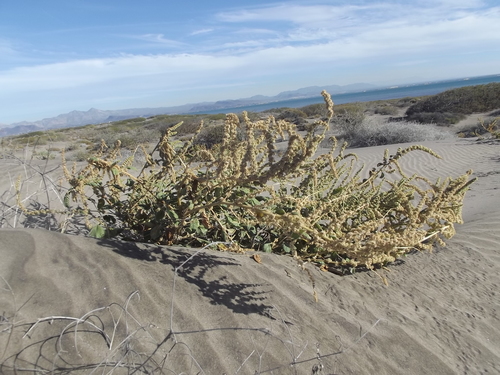
Prefers a well-drained, fertile soil in a sunny position. Requires a hot, sheltered position if it is to do well. Plants are particularly susceptible to attacks by leaf-chewing insects. Plants should not be given inorganic fertilizers; see notes above on toxicity. Most, if not all, members of this genus photosynthesize by a more efficient method than most plants. The 'C4 carbon-fixation pathway' is particularly efficient at high temperatures, in bright sunlight, and under dry conditions. It is an annual plant that grows primarily in the desert or dry shrubland biome. Habitat & Range: Watson’s amaranth is primarily native to Mexico, particularly sandy soils around the Sea of Cortez. In the U.S., it is limited to the Salton Sea area of southern California and the sandy regions of southwestern Arizona. Unlike most amaranths, it may bloom as early as late winter or early spring, depending on conditions. USDA Hardiness Zone: 8–11. Weed Potential: Low – not aggressive compared to other amaranths; its rarity in the U.S. limits its spread. Moisture: Drought-tolerant once established, though germination responds to seasonal rainfall. Habitat: Native primarily to northwestern Mexico (including the Baja California region and around the Sea of Cortez). Extends into the southern U.S. deserts, including parts of California (Salton Sea region) and southwestern Arizona. Found in sandy flats, coastal dunes, and disturbed desert soils. Unlike many amaranths, it can flower and set seed in late winter or early spring, capitalizing on cooler desert growing conditions.
Propagation: Sow seed in late spring in situ. An earlier sowing can be made in a greenhouse, with plants put out after the last expected frosts. Germination is usually rapid and good when the soil is warm, but poor in cool or cold soils. A drop in temperature overnight aids germination. Cuttings of growing plants root easily.
Medicinal Uses
None known.
Other Uses
Yellow and green dyes can be obtained from the whole plant.
Wikipedia
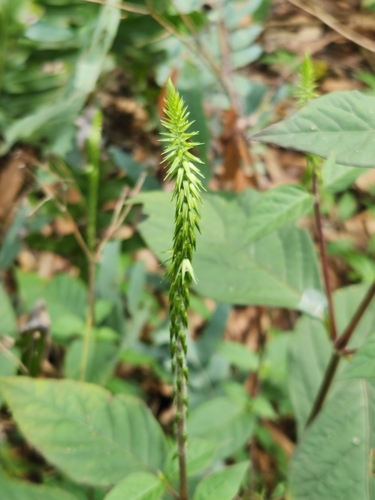
Source ↗Amaranthus watsonii is a species of amaranth known by the common name Watson's amaranth. It is native to the southwestern United States and northern Mexico, where it grows in sandy places such as deserts and beaches, and disturbed areas. It is also known as a rare introduced species in parts of Europe. This is an erect annual herb producing a glandular hairy stem to a maximum height of about a meter. The leaves are generally oval-shaped and up to 8 centimeters long, with a petiole of up to 9 centimeters. The species is dioecious, with male and female individuals producing different types of flowers. The inflorescence is a long spike cluster of flowers interspersed with spiny green glandular bracts. The fruit is a smooth capsule about 2 millimeters long that snaps in half to reveal a small shiny reddish black seed.
Notes
There are about 60 Amaranthus species. It is a C4 plant.
Names & Synonyms
Bigelow's Amaranth, Watson's Amaranth
References (5)
- Beckstrom-Sternberg, Stephen M., and James A. Duke. "The Foodplant Database." http://probe.nalusda.gov:8300/cgi-bin/browse/foodplantdb.(ACEDB version 4.0 - data version July 1994) (As Amaranthus torreyi)
- Bot. California 2:42. 1880 (As Amaranthus torreyi)
- Fern, K., 2012, Tropical Species Database http://theferns.info/tropical/
- Pio-Leon, J. F., et al, 2017, Prioritizing Wild Edible Plants of potential new crops based on Deciduous Forest traditional knowledge by a Rancher community. Botanical Sciences 95(1): 47-59
- Plants for a Future database, The Field, Penpol, Lostwithiel, Cornwall, PL22 0NG, UK. http://www.scs.leeds.ac.uk/pfaf/. (As Amaranthus torreyi)