Amelanchier basalticola
Piper
Dwarf Service-berry;
no rights reserved

(c) Ken A. Thompson, some rights reserved (CC BY-NC)

(c) Ken A. Thompson, some rights reserved (CC BY-NC)
What to Eat
Edible parts: Fruit
No specific records exist for this species, but the fruit is almost certainly edible both raw and cooked. The fruits measure 9–12mm in diameter and are rich in iron and copper.
Where to Find It
It is a temperate plant. It grows naturally on hillsides, from near sea level to the sub-alpine zone in North-western North America in Washington.
North America, USA,
How to Identify
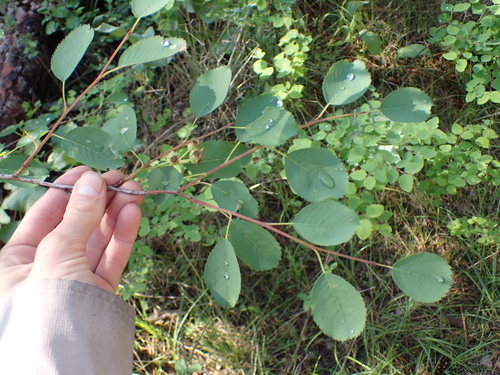
A deciduous shrub growing to 3 m tall and 3 m wide. Hardy to UK zone 5. Flowers in April with seeds ripening June to July. Hermaphroditic and bee-pollinated, self-fertile. Suitable for light sandy, medium loamy, and heavy clay soils in mildly acid to neutral pH. Grows in semi-shade or full sun and prefers moist soil.
How to Grow
Prefers a rich loamy soil in a sunny position or semi-shade but thrives in any soil that is not too dry or water-logged. Grows well in heavy clay soils. Prefers an acid or neutral soil. All members of this genus have edible fruits and, whilst this is dry and uninteresting in some species, in many others it is sweet and juicy. Many of the species have potential for use in the garden as edible ornamentals. The main draw-back to this genus is that birds adore the fruit and will often completely strip a tree before it is fully ripe. There is much difference of opinion in the naming of members of this genus, with many botanists viewing this species as no more than a form of A. alnifolia. It hybridizes freely with other members of the genus. Grafting onto seedlings of A. lamarckii or Sorbus aucuparia is sometimes practised in order to avoid the potential problem of hybridizing.
Propagation: Seed is best harvested green — when fully formed but before the seed coat hardens — and sown immediately in pots outdoors or in a cold frame. Stored seed obtained early in autumn can be given 4 weeks of warm stratification before overwintering outside, which should result in spring germination. Otherwise, germination can be very slow, potentially taking 18 months or more. Prick seedlings out into individual pots once large enough to handle and grow on in a sheltered outdoor position, planting out when they reach 20cm or taller. Where seed is plentiful, sow thinly in an outdoor seedbed and grow on for two years before transplanting to permanent positions in winter. Layering in spring takes around 18 months. Suckers can be divided in late winter, but they must have been growing for 2 years to have formed roots. Once rooted, they can be planted directly into permanent positions.
Medicinal Uses
None known.
Other Uses
None known.
Wikipedia
A deciduous shrub growing to 3 m tall and 3 m wide. Hardy to UK zone 5. Flowers in April with seeds ripening June to July. Hermaphroditic and bee-pollinated, self-fertile. Suitable for light sandy, medium loamy, and heavy clay soils in mildly acid to neutral pH. Grows in semi-shade or full sun and prefers moist soil.
Notes
There are about 25-30 Amelanchier species.
Names & Synonyms
References (1)
- Plants for a Future database, The Field, Penpol, Lostwithiel, Cornwall, PL22 0NG, UK. http://www.scs.leeds.ac.uk/pfaf/.
More from Rosaceae


