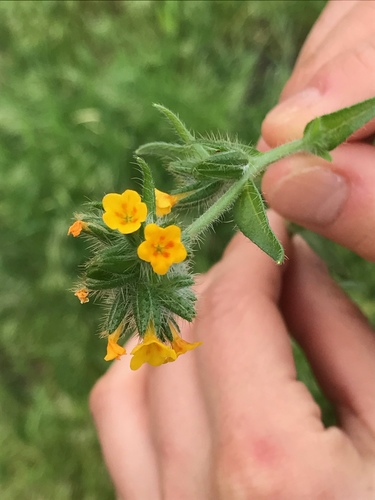
Pholisma sonorae
(Torr. ex A. Gray) Yatsk.
Sand Food

(c) Kenneth Lorenzen, some rights reserved (CC BY-NC), uploaded by Kenneth Lorenzen

(c) Kenneth Lorenzen, some rights reserved (CC BY-NC), uploaded by Kenneth Lorenzen
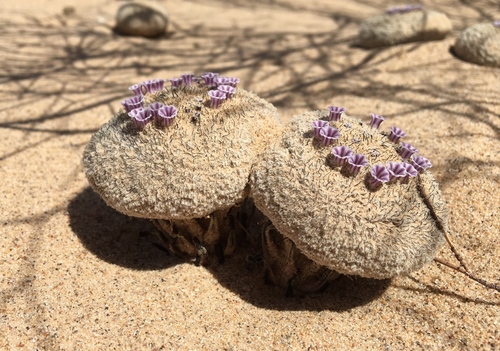
(c) Camden Bruner, some rights reserved (CC BY-NC-ND), uploaded by Camden Bruner
What to Eat
Edible parts: Underground stem, Roots
This was an important food item for certain desert-dwelling Native American peoples, including the Cocopah and the Hia C-eḍ O'odham.
Where to Find It
It is a subtropical plant. It grows in barren, sandy land. It grows in arid areas. It grows in the Sonora desert in Mexico.
Mexico, North America, USA,
How to Identify
A plant that grows on other plants. It is a leaf less plant. The thick stems are partly buried underground.
Wikipedia
Source ↗Pholisma sonorae, commonly known as sandfood, is a rare and unusual species of flowering plant endemic to the Sonoran Deserts to the west of Yuma, Arizona in the California Yuha, Mojave Desert and Colorado Desert, and south in the Yuma Desert, where it is known from only a few locations.
Other Information
It is an emergency or famine food.
Notes
It has also been put in the family Lennoaceae.
Names & Synonyms
Camote de los medanos
References (10)
- Beckstrom-Sternberg, Stephen M., and James A. Duke. "The Foodplant Database." http://probe.nalusda.gov:8300/cgi-bin/browse/foodplantdb.(ACEDB version 4.0 - data version July 1994) (As Ammobroma sonorae)
- Bircher, A. G. & Bircher, W. H., 2000, Encyclopedia of Fruit Trees and Edible Flowering Plants in Egypt and the Subtropics. AUC Press. p 23 (As Ammobroma sonorae)
- Felger, R. S. 1980, Vegetation and Flora of the Gran Desierti, Sonora, Mexico. Desert Plants 2(2). Arizona-Sonora Desert Museum. p 9 (As Ammobroma sonorae)
- Hedrick, U.P., 1919, (Ed.), Sturtevant's edible plants of the world. p 49 (As Ammobroma sonorae)
- Heywood, V.H., Brummitt, R.K., Culham, A., and Seberg, O. 2007, Flowering Plant Families of the World. Royal Botanical Gardens, Kew. p 189
- Lim, T. K., 2015, Edible Medicinal and Non Medicinal Plants. Volume 9, Modified Stems, Roots, Bulbs. Springer p 8
- Moerman, D. F., 2010, Native American Ethnobotany. Timber Press. p 393
- Phytologia 52:74. 1982
- Saunders, C.F., 1948, Edible and Useful Wild Plants. Dover. New York. p 39 (As Ammobroma sonorae)
- Smith, N., Mori, S.A., et al, 2004, Flowering Plants of the Neotropics. Princeton. p 211