Ormocarpum cochinchinense
(Lour.) Merr.
Kalava
no rights reserved, uploaded by 葉子
no rights reserved, uploaded by 葉子
no rights reserved, uploaded by 葉子
What to Eat
Edible parts: Leaves
Young leaf tips are cooked and eaten as a vegetable.
Where to Find It
A tropical plant. It grows along the beach and in mud flats. It also comes up in old gardens. It mostly occurs naturally below about 30 m altitude. It is planted in gardens up to 500 m altitude.
Asia, Australia, China, Fiji, Indonesia, Pacific, Papua New Guinea, PNG, SE Asia, Torres Strait, Yap,
How to Identify
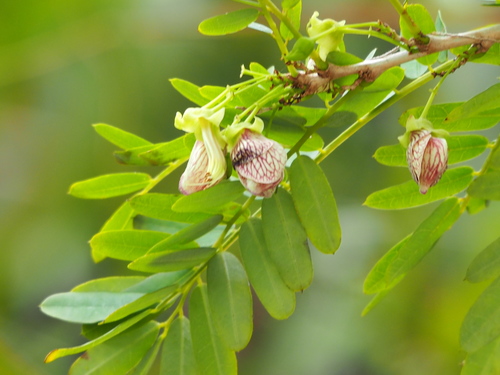
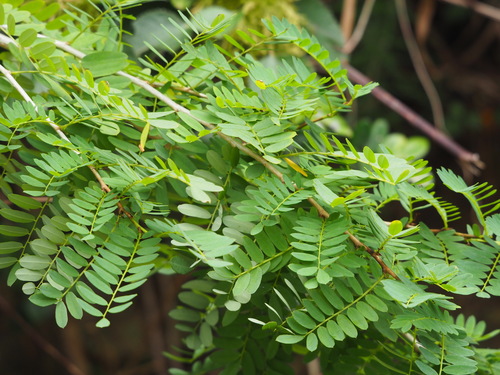
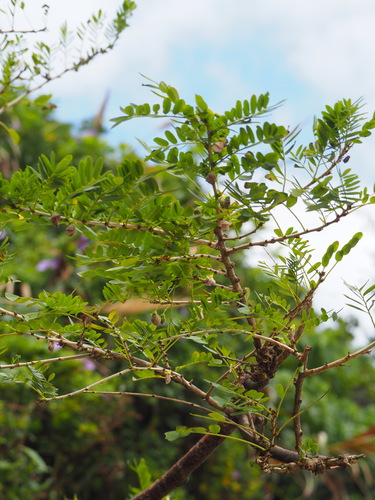
A small leguminous shrub or tree up to 7.5 m tall with light brown bark which strips off showing a greener bark underneath. The leafy shoots are hairy. When the plant flowers it has a flower like a bean and a pale yellowish green in colour with reddish veins. It produces a pod which is up to 9 cm long and jointed in a chain of 2 to 8 seeds. The seeds are small 5 mm and bean shaped. Flowers and pods are rare. It is a legume.
How to Grow
In gardening situations it is normally grown from cuttings.
Other Information
In Papua New Guinea, it is mostly grown and used in the Gulf Province and along the South Coast or by people from there. It is grown in the Gazelle Peninsula.
Notes
There are 20 Ormocarpum species.
Names & Synonyms
Kat, Kumbong, Waubuk, Webon, Wombiakat
References (9)
- Altschul, S.V.R., 1973, Drugs and Foods from Little-known Plants. Notes in Harvard University Herbaria. Harvard Univ. Press. Massachusetts. no. 1760 (As Ormocarpum orientale)
- French, B.R., 1986, Food Plants of Papua New Guinea, A Compendium. Asia Pacific Science Foundation p 71 (As Ormocarpum orientale)
- Habitat Management Profile – Saibai Island. Appendix C. Preliminary List of Useful Plants for Saibai Island. p 116 (As Ormocarpum orientale)
- Leach, G. J., 1988, Bush Food Plants of the Blackwater and Karawari Rivers Area, East Sepik Province, Papua New Guinea. Science in New Guinea 14(2). p 103 (As Ormocarpum orientale)
- Peekel, P.G., 1984, (Translation E.E.Henty), Flora of the Bismarck Archipelago for Naturalists, Division of Botany, Lae, PNG. p 231, 230 (As Ormocarpum orientale)
- Smith, A.C., 1985, Flora Vitiensis Nova, Lawaii, Kuai, Hawaii, Volume 3 p 256 (As Ormocarpum orientale)
- Verdcourt, B., 1979, Manual of New Guinea Legumes. Botany Bulletin No 11, Division of Botany, Lae, Papua New Guinea. p 364 (As Ormocarpum orientale)
- World Checklist of Useful Plant Species 2020. Royal Botanic Gardens, Kew p 322
- www.manoa.hawaii.edu/botany/plants of micronesia. (As Ormocarpum cochinchinense)




