Osteomeles subrotunda
K. Koch
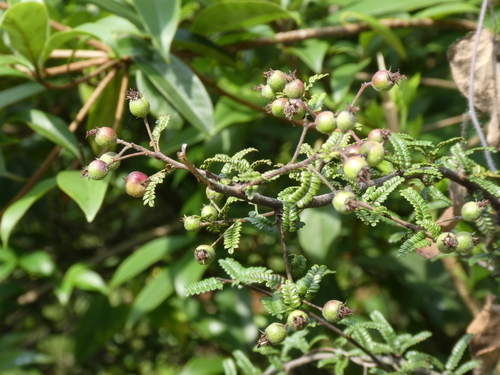
(c) Aaron Liston, some rights reserved (CC BY), uploaded by Aaron Liston
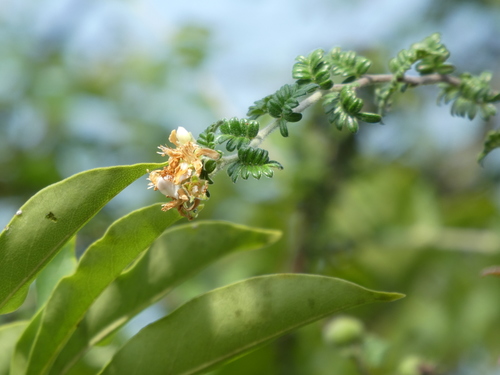
(c) Aaron Liston, some rights reserved (CC BY), uploaded by Aaron Liston
What to Eat
Edible parts: Fruit
The fruit is edible and measures 6–12mm in diameter. No further details are available.
Where to Find It
It is a tropical plant. It grows in mixed forests and scrub on mountain summits in southern China between 200-500m above sea level.
Asia, China, Japan, Ryuku,
How to Identify
A shrub. It keeps its leaves throughout the year. It grows 2 m tall. The leaves have 7-15 pairs of leaflets. The leaflets are narrowly oval and 4-6 mm long by 2-3 mm wide. They have grey hairs underneath. There are many flowers in a group. The flowers are 1 cm across. The fruit are bluish-black and a flattened round shape. They are 6-12 mm across.
How to Grow
Succeeds a sheltered position in full sun in any well-drained soil. Plants usually require protection outside the mildest areas of Britain, they are hardy to about -5°c. They can be grown on a sunny wall in colder parts of the country. Plants sold under this name are often O. schweriniae microphylla.
Propagation: Seed requires a period of cold stratification and can be sown in late autumn in a cold frame. Once large enough to handle, prick seedlings out into individual pots and grow on in a greenhouse for at least their first winter. Plant out into permanent positions in late spring or early summer, after the last expected frosts. Cuttings of half-ripe wood, 5–8cm with a heel, can be taken in July or August and rooted in a frame, then potted up in autumn and overwintered in a greenhouse — with a fair to good success rate. Layering is also an option.
Medicinal Uses
None known
Other Uses
No uses known.
Wikipedia
Source ↗Osteomeles subrotunda is a species of plant native to China and the Ryukyu Islands of Japan. It has edible fruits that can be eaten raw. The fruit has a sweet flavor. It is grown as an ornamental plant. It is also used in bonsai.
Production
In southern China plants flower in April to June and fruit July to September.
Names & Synonyms
References (3)
- Ann. Mus. Bot. Lugduno-Batavum 1:250. 1864
- Flora of China @ efloras.org Volume 9
- Plants for a Future database, The Field, Penpol, Lostwithiel, Cornwall, PL22 0NG, UK. http://www.scs.leeds.ac.uk/pfaf/
More from Rosaceae


