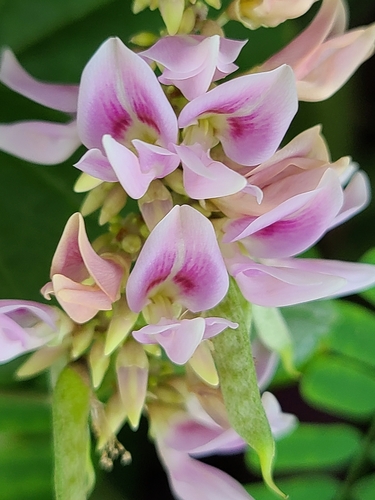
Vachellia hebeclada
(DC.) Kyal. & Boatwr.
Candle acacia, Candle-pod acacia

(c) Tony Benn, some rights reserved (CC BY-NC), uploaded by Tony Benn

(c) Riana Fourie, some rights reserved (CC BY-NC), uploaded by Riana Fourie

(c) Riana Fourie, some rights reserved (CC BY-NC), uploaded by Riana Fourie
What to Eat
Edible parts: Gum, Pods, Fruit, Seeds - coffee
The seeds are roasted and used as a coffee substitute or roasted and ground for eating. The pods are occasionally eaten and serve as a famine food. The gum is eaten as a snack.
Known Hazards
Where to Find It
It is a tropical plant. It grows in hot dry areas. It is sensitive to frost. It grows between 750-2,950 m above sea level. It can tolerate wind and drought. It grows in areas with a rainfall above 100 mm. It can tolerate a 6-11 month dry season. It can grow in arid places.
Africa, Angola, Botswana, Central Africa, East Africa, Namibia, South Africa, Southern Africa, Zambia, Zimbabwe,
How to Identify
A shrub or small tree. It grows up to 7 m high. It branches near ground level. It often forms thickets. The bark is dark grey. It is cracked along its length and flakes off. The small branches are covered with hairs. It has spines which can be straight or hooked. They can be up to 3.5 cm long. The leaves are compound. They have 2-9 pairs of leaf stalks each with 7-16 pairs of leaflets. The leaflets are 2-7 mm long by 1-2 mm wide. They are small and feathery. The flowers are cream-white balls. The fruit is a hard woody pod. It is 4-15 cm long by 1.4-4 cm wide. It is straight and swollen and sausage like. It is covered with grey hairs. The pod has wrinkles and ridges spiralling around it. The pods stand upright. There are 3 subspecies.
How to Grow
Plants can be grown from seeds. The seeds are removed from the pod and have boiling water poured over them then left to soak for 24 hours. They are then planted in rich soil. It can be cut back and will re-grow.
Propagation: The seed of most, if not all, members of this genus has a hard seedcoat and may benefit from scarification before sowing to speed up germination. This can usually be done by pouring a small amount of nearly boiling water on the seeds (being careful not to cook them!) and then soaking them for 12 - 24 hours in warm water. By this time they should have imbibed moisture and swollen - if they have not, then carefully make a nick in the seedcoat (being careful not to damage the embryo) and soak for a further 12 hours before sowing. Acacia seeds that have matured fully on the bush and have been properly dried have a hard seed coat and can be stored in closed containers without deterioration for 5 - 10 years or more in dry conditions at ambient temperatures. It is best to remove the aril, which attracts weevils and can lead to moulds forming. The arils are easilyremoved by placing the seeds in water and rubbing them between the hands, then drying the seeds and winnowing them.
Medicinal Uses
No medicinal uses mentioned in the data.
Other Uses
A gum is obtained from the stems. It has possible commercial, non-food uses. The greyish-brown seeds are sometimes used as beads in necklaces. The powdered root, mixed with oil, is used as a hair dressing. The dark-brown wood is very hard and durable. It is not usually available in any but small dimensions, but is used for making various small articles.
Production
It is slow growing.
Other Information
The pods are a famine food.
Notes
There are about 1,350 Acacia species. Over 1,000 occur in Australia. It is the host to a Terfezia sp. truffle. Also as Mimosaceae. Also as Mimosaceae.
Names & Synonyms
Chiwonza, Omutoka, Setshi
References (17)
- Bircher, A. G. & Bircher, W. H., 2000, Encyclopedia of Fruit Trees and Edible Flowering Plants in Egypt and the Subtropics. AUC Press. p 4 (As Acacia hebeclada)
- Cat. pl. horti monsp. 73. 1813 (As Acacia hebeclada)
- Fowler, D. G., 2007, Zambian Plants: Their Vernacular Names and Uses. Kew. p 32 (As Acacia hebeclada)
- Fox, F. W. & Young, M. E. N., 1982, Food from the Veld. Delta Books. p 200 (As Acacia hebeclada)
- ILDIS Legumes of the World http:www;ildis.org/Legume/Web (As Acacia hebeclada)
- Mannheimer, C. A. & Curtis. B.A. (eds), 2009, Le Roux and Muller's Field Guide to the Trees and Shrubs of Namibia. Windhoek: Macmillan Education Namibia. p 96 (As Acacia hebeclada)
- Palgrave, K.C., 1996, Trees of Southern Africa. Struik Publishers. p 240 (As Acacia hebeclada)
- Palmer, E and Pitman, N., 1972, Trees of Southern Africa. Vol. 2. A.A. Balkema, Cape Town p 700 (As Acacia hebeclada)
- Peters, C. R., O'Brien, E. M., and Drummond, R.B., 1992, Edible Wild plants of Sub-saharan Africa. Kew. p 126 (As Acacia hebeclada)
- Rodin, 1985, (As Acacia hebeclada)
- Roodt, V., 1998, Trees & Shrubs of the Okavango Delta. Medicinal Uses and Nutritional value. The Shell Field Guide Series: Part 1. Shell Botswana. p 163 (As Acacia hebeclada)
- Royal Botanic Gardens, Kew (1999). Survey of Economic Plants for Arid and Semi-Arid Lands (SEPASAL) database. Published on the Internet; http://www.rbgkew.org.uk/ceb/sepasal/internet [Accessed 26th April 2011] (As Acacia hebeclada)
- Ruiters-Welcome, A. K., 2019, Food plants of southern Africa. Ph.D. thesis. Univ. of Johannesburg p 62
- Tanaka, 1980, (As Acacia hebeclada)
- van Wyk, Ben-Erik, 2019, The diversity and multiple uses of southern African legumes. Australian Systematic Botany, 2019, 32, 519–546
- Welcome, A. K. & Van Wyk, B.-E., 2019, An inventory and analysis of the food plants of southern Africa. South African Journal of Botany 122 (2019) 136–179
- World Checklist of Useful Plant Species 2020. Royal Botanic Gardens, Kew