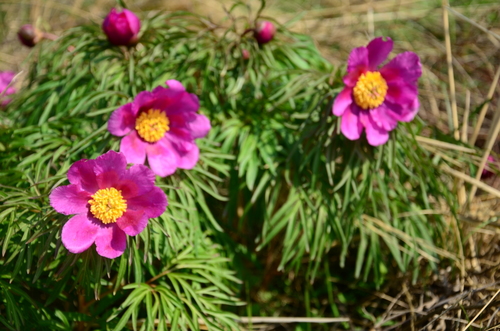
Paeonia emodi
Wall. ex Royle
Himalayan peony
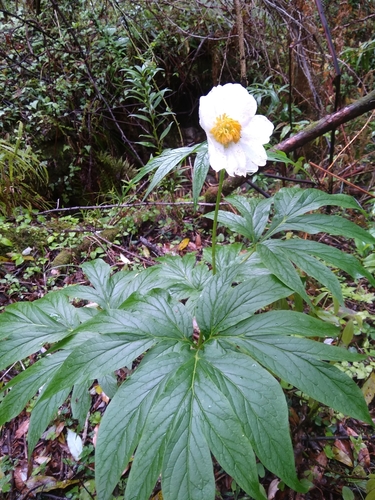
(c) SHYAM PHARTYAL, some rights reserved (CC BY-NC), uploaded by SHYAM PHARTYAL
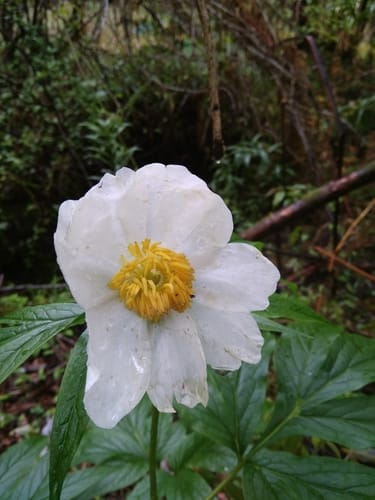
(c) SHYAM PHARTYAL, some rights reserved (CC BY-NC)
What to Eat
Edible parts: Leaves
Young shoots are eaten cooked.
Where to Find It
It grows in scrub and forest between 1800-2500 metres in western China. It can grow in a range of soils but cannot tolerate waterlogging nor very dry conditions. It does best with light shade. Plants can withstand frost.
Afghanistan, Asia, Australia, China, Himalayas, India, Myanmar, Nepal, Northeastern India, Pakistan, SE Asia, Sikkim, Slovenia,
How to Identify
A perennial herb. It grows up to 1 m high. The leaves can have 15 segments. The leaves are 9-13 cm long and 2-4 cm wide.
How to Grow
Requires a deep rich soil, preferably neutral or slightly alkaline, doing quite well in sun or light shade. It is best grown amongst shrubs, doing better when given some shade. Plants are tolerant of a wide range of soil conditions, but will not survive if the soil becomes waterlogged or is too dry. This species is lime tolerant. Plants grown on sandy soils tend to produce more leaves and less flowers, whilst those growing on clay take longer to become established but produce better blooms. Many gardeners have difficulties growing this plant in their gardens, though it thrives in the outdoor beds at the Royal Botanical Gardens, Edinburgh. Probably giving it the protection of shrubs or a woodland edge is likely to be most successful. Plants are hardy to about -20°c. A very ornamental and long-lived plant, specimens can survive in the garden for at least 50 years. Members of this genus are rarely if ever troubled by browsing deer or rabbits. A very greedy plant inhibiting the growth of nearby plants, especially legumes. Strongly resents root disturbance, taking some time to recover after being divided. Peony species are usually self-fertile, though they will also hybridise with other species if these flower nearby at the same time. Plants take 4 - 5 years to flower from seed. They generally breed true from seed.
Propagation: Seed — best sown as soon as it is ripe in a cold frame. Fresh seed produces a root around 6 weeks after sowing, with shoots forming in spring. Stored seed is much slower and may take 18 months or more to germinate, so sow as soon as possible. Because roots are very sensitive to disturbance, many growers leave seedlings in their pots for 2 growing seasons before potting on, which allows a more robust root system to develop. If doing this, sow thinly and apply regular liquid feeds during the growing season. Alternatively, prick seedlings into individual pots as soon as they are large enough to handle and grow on in a cold frame for at least two growing seasons before planting out in spring. Divide with great care in spring or autumn, ensuring each portion has a leaf bud. Standing the lifted root in shade for several hours makes it less brittle and easier to divide. Divisions with several buds generally flower in the second year; those with only one or two buds will take considerably longer.
Medicinal Uses
The tubers are useful for treating hysteria, convulsions, colic, uterine diseases, and obstructions of the bile duct, and are given to children as a blood purifier. The seeds are cathartic and emetic. An infusion of the dried flowers is useful in treating diarrhoea. A tea made from the dried crushed petals of various peony species has been used as a cough remedy and as a treatment for haemorrhoids and varicose veins.
Other Uses
No other uses are known.
Wikipedia
Source ↗Paeonia emodi is a robust herbaceous perennial plant that winters with buds underground (a hemicryptophyte), has large white flowers and large, deeply incised leaves. It belongs to the family Paeoniaceae. Its local vernacular names include mamekhor or mamekh (Punjabi), ood-e-saleeb (Urdu) meaning "with-a-cross", ood salap (Hindi), mid (in Kashmir) and 多花芍药 (duo hua shao yao) meaning "multi-flower peony" (in Chinese). In English it is sometimes called Himalayan peony. It is among the tallest of the herbaceous peony species, and, while cold-hardy, it grows better in warm, temperate climates. It is a parent of the popular hybrid 'White Innocence', which reaches 1+1⁄2 m.
Production
Plants take 4-5 years to flower from seed. Plants can live for 50 years.
Notes
The plant has medicinal uses. There are about 30 Paeonia species.
Names & Synonyms
Bhuma madrya, Chandra, Hetto, Himalajska potonika, Mamekh, Mid, Ud-salap, Udslap
References (15)
- Ambasta, S.P. (Ed.), 2000, The Useful Plants of India. CSIR India. p 421
- Aryal, K. P., et al, 2018, Diversity and use of wild and non-cultivated edible plants in the Western Himalaya. Journal of Ethnobiology and Ethnomedicine (2018) 14:10
- Bodkin, F., 1991, Encyclopedia Botanica. Cornstalk publishing, p 756
- Brickell, C. (Ed.), 1999, The Royal Horticultural Society A-Z Encyclopedia of Garden Plants. Convent Garden Books. p 743
- Davis, S.D., Heywood, V.H., & Hamilton, A.C. (eds), 1994, Centres of plant Diversity. WWF. Vol 1 or 2. p 99
- Dobriyal, M. J. R. & Dobriyal, R., 2014, Non Wood Forest Produce an Option for Ethnic Food and Nutritional Security in India. Int. J. of Usuf. Mngt. 15(1):17-37
- Flora of Pakistan. www.eFloras.org
- GUPTA,
- http://www.botanic-gardens-ljubljana.com/en/plants
- Ill. bot. Himal. Mts. 1(2):57. 1834
- Misra, S. et al, 2008, Wild leafy vegetables: A study of their subsistence dietetic support to the inhabitants of Nanda Devi Biosphere reserve, India. Journal of Ethnobiology and Ethnomedicine. 4:15
- Plants for a Future database, The Field, Penpol, Lostwithiel, Cornwall, PL22 0NG, UK. http://www.scs.leeds.ac.uk/pfaf/
- Singh, H.B., Arora R.K.,1978, Wild edible Plants of India. Indian Council of Agricultural Research, New Delhi. p 32
- Sundriyal, M., et al, 1998, Wild edibles and other useful plants from the Sikkim Himalaya, India. Oecologia Montana 7:43-54
- Sundriyal, M., et al, 2004, Dietary Use of Wild Plant Resources in the Sikkim Himalaya, India. Economic Botany 58(4) pp 626-638