Pandanus tectorius
(Solander) Parkinson
Coastal Pandanus, Beach pandanus, Screwpine

(c) dannyhou, some rights reserved (CC BY-NC)

(c) Deb Rudis, some rights reserved (CC BY-NC), uploaded by Deb Rudis

(c) kdonbo, some rights reserved (CC BY-NC)
What to Eat
Edible parts: Nuts, Leaves, Fruit, Flowers, Spice
The fruit is edible. Some varieties and cultivars contain significant amounts of calcium oxalate, and thus need thorough cooking before being consumed. Other cultivars contain very little to no calcium oxalate and can be eaten raw. It is an important food source in the atolls of Micronesia and Polynesia, with the fruit commonly eaten raw or turned into a dried paste (such as mokwan in the Marshall Islands or te tuae in Kiribati) or flour. It is also one of the traditional foods of Maldivian cuisine. The fibrous nature of the fruit also serves as a natural dental floss. It is also used in Samoan culture as a ula fala, a necklace made out of the dried fruit painted in red and worn by the matai during special occasions and functions. Australian Aboriginal peoples extracted the slender, edible seeds. This seed, and the fruit, was an important food. The tree's leaves are often used as flavoring for sweet dishes. It is also used in Sri Lankan cookery, where the leaves are used to flavor a variety of curries. Leaves were used by the Polynesians to make baskets, mats, outrigger canoe sails, thatch roofs, and grass skirts. The fragrant male flowers are used in perfumery and are also distilled to make kewra. A large shrub or small tree of immense cultural, health, and economic importance in the Pacific, it is second only to coconut on atolls. It grows wild mainly in semi-natural vegetation in littoral habitats throughout the tropical and subtropical Pacific, where it can withstand drought, strong winds, and salt spray. It propagates readily from seed, but it is also widely propagated from branch cuttings by local people for farms and home gardens. It grows fairly quickly, and all parts are used, from the nutritious fruits of edible varieties to the poles and branches in construction to the leaves for weaving and garlands. The plant is prominent in Pacific culture and tradition, including local medicine. Hundreds of cultivated varieties are known by their local names and characteristics of fruits, branches, and leaves. At present, there is evidence that this diversity is declining, with certain varieties becoming difficult to find. The reasons include less replanting, deforestation, fire, flagging interest by the new generation, and rapid population growth leading to urbanization.
Known Hazards
Where to Find It
A tropical plant. It grows in the lowlands. It grows on the sandy edges of mangroves and along rivers. They are very common along the seashore throughout the islands of the Philippines. They are never found very far inland. It usually grows from sea level to 20 m altitude. In Samoa it grows to 300 m altitude. It usually grows in places with an average annual temperature range of 24-28°C. The rainfall is usually between 1500-4000 mm per year. It can grow in soils with a pH between 6-10. It can grow in salty soils. It grows on coral atolls. It suits hardiness zones 11-12. In XTBG Yunnan.
American Samoa, Andamans, Asia, Australia*, Bougainville, British Indian Ocean Terr., BIOT, Cambodia, Caroline Islands, Central America, China, Colombia, Cook Islands, East Timor, Fiji, FSM, Guam, Guatemala, Hawaii, India, Indochina, Indonesia, Kiribati, Kosrae, Malaysia, Maldives, Mariana Islands, Marquesas, Marshall Islands, Micronesia, Myanmar, Nauru, New Caledonia, New Zealand, Nuie, Pacific*, Pakistan, Palau, Papua New Guinea, PNG, Philippines, Pohnpei, Rotuma, Samoa, SE Asia, Solomon Islands, South America, Sri Lanka, Taiwan, Thailand, Timor-Leste, Tokelau, Tonga, Torres Strait, Tuvalu, USA, Vanuatu, Vietnam, Wallis & Futuna, Yap,
How to Identify
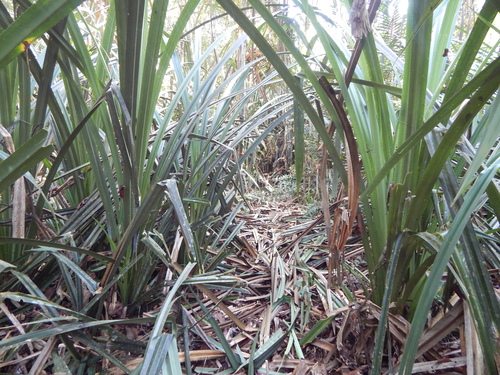
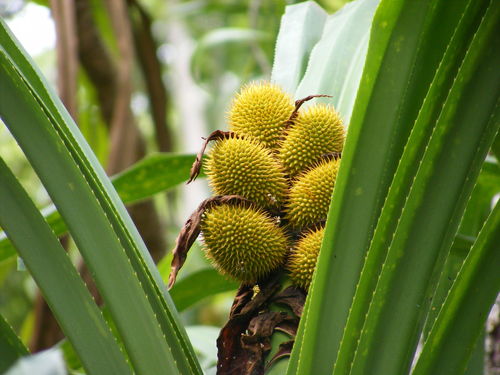
An erect branched shrub 3 to 5 m high. It can be 14 m tall. The trunk has several prop roots. The stems are prickly. The leaves are spirally crowded towards the ends of branches and covered with waxy powder. They are up to 1.5 m long and 3 to 5 cm wide. The edge of the leaf and the midrib have sharp spiny teeth pointing towards the end of the leaf. Male and female flowers occur on separate trees. Male flowers have showy white bracts. The female plants produce woody, pineapple like fruit. The fruit are alone and hang down. They are rounded and 20 cm long. They are composed of 50 to 75 fibrous fleshy fruit with a stone in the centre. They are somewhat angular. There are hundreds of local named varieties. There is tremendous variation in this plant. Some leaves do not have spines and the shape and size of the fruit varies. (See the many synonyms!)
Nutrition Score: 1/100
| Part | Moisture | kJ | kcal | Protein | Vit A | Vit C | Iron | Zinc |
|---|---|---|---|---|---|---|---|---|
| Fruit | 80 | — | — | 0.4 | — | — | — | — |
How to Grow
Plants are normally self sown. They can be grown from fresh seed. They are best sown in waterlogged soil. The preferred kinds are grown from cuttings. Cuttings of 30-40 cm are suitable. Seeds can float on ocean currents and still germinate after several months. It is used as a hedge or fence.
Propagation: Seed - pre-soak for 24 hours. To speed germination, soak the drupes in cool tap water for 5 days, changing the water every day. Viable drupes will float, so do not discard them. Alternatively, remove the fleshy part of the drupe, laying it on the planting medium, and burying it half way. Keep the potting mix moist. Germination takes about 2 months. Suckers during the growing season. Cuttings of lateral shoots. Plants can be propagated from large cuttings. Stems with aerial or prop roots are selected; about 2/3 of the leaves are trimmed off to reduce water loss; and the stems rooted in a sandy soil.
Medicinal Uses
The aerial roots yield a decoction that is used as a beverage in the treatment of blennorrhoea. This decoction, combined with urethral injections of the sap of the base of the banana plant, is said to be a rapid cure for this malady. The bark is scraped in Zingiber leaf and the juice extracted into a cup. This liquid is drunk as a sedative for patients with mental health problems. A decoction of the roots is used to treat haemorrhoids. A small portion of the young root is heated over a fire then crushed on a smooth stone - the extracted juice is applied to the bites or wounds caused by any fish, beings said to ease the pain and promote healing. The leaves, especially the basal white section of young leaves, are used in treatments for cold/flu, hepatitis, dysuria, asthma, boils and cancer. The male flowers are said to have aphrodisiac properties.
Other Uses
The leaves are used to make a wide range of products, including hats, mats, baskets, clothing, sails etc. There is a thornless variety that is used to produce fibres for thatch, cordage etc. The chief use of this plant is in the production of the fibre used in manufacturing sabutan hats. Hats made of sabutan are strong and durable, and in texture more nearly resemble the Panama hat than any other kind manufactured in the Philippines. The unbleached hats are a light green colour, and the chief objection to them is that they do not bleach readily. Good sabutan hats, however, command high prices in the Philippines. Sleeping mats of excellent quality are made from sabutan fibres either in natural or dyed shades. The leaves are used to weave traditional floor mats, as well as in the construction of traditional houses (thatch for walls and roofing). A roof made from pandanus leaves is said to last about 15 years, while one of coconut leaves may last only 3 years. The roots are made into skipping ropes and basket handles. String or cordage is made from the cleaned and dried prop roots. An extract of the fruit is used as an ingredient in commercial cosmetic preparations as a humectant. A material (resin/gum?) obtained from the trunk is used as a glue and as a caulking for boats. When the flesh is removed from the inner end end of a dried fruit section, fibrous bristles are exposed. These can be used as a brush, with the hard, woody outer end acting as a handle. A brush can be made by beating the tips of aerial roots to expose the fibres - the base of the root can be used as a handle. A black dye used in weaving is prepared from the roots. Charcoal made from pandanus is used in various mixtures to dye and waterproof canoes. An essential oil is obtained from the male flowers. It is used in perfumery, cosmetics, hair oils, soaps etc. The highly fragrant male flowers are used as a decoration and to scent coconut oil. An exquisite, uniquely Pacific perfume is made from the aromatic fruits of selected traditional cultivated varieties. The leaves are used for wrapping cigars whereas flowers are taken as tobacco substitute. The trunks are used in the construction of traditional houses and also for making ladders and as the masts of traditional canoes. The soft trunks have been used for making fishing rafts. Their wood is used for making various small items. The trunks of male trees are hard and solid, with a yellow interior containing dark brown fibre bundles. The male wood is very strong, but brittle, meaning that it can suddenly break under a heavy load. It is also a difficult wood to split. Trunks of female trees are hard on the outside, but soft, pithy, or juicy in the interior. They have been used as water pipes after removing the soft interior. Slats made from the clean, dried aerial/prop roots are used for walls of houses and food cupboards. The discarded, dried woody fruit sections are highly prized as a fuelwood for cooking because they are slow burning and therefore preferred for barbecues. The trunk and branches are also occasionally used as fuelwood, but generally only where other fuelwood is scarce, Pandanus tectorius has a wide range of applications in agroforestry and perennial gardens. It is very tolerant of strong, salt-laden winds and can be used near the coast to provide protection for other food crops. In addition, it will succeed on sand dunes and is planted there to stabilize the dunes. The plant can also be used as a living fence or hedge to mark boundaries etc. Pandanus works well in ally cropping systems, where it also serves to protect the other crops from the wind. The plant produces a good bulk of organic matter and are known to raise fertility and organic matter levels in sandy, coralline soils. The leaves are often used as a mulch or for producing compost.
Wikipedia
Source ↗Pandanus tectorius is a species of Pandanus (screwpine) that is native to Malesia, Papuasia, eastern Australia, and the Pacific Islands. It grows in the coastal lowlands typically near the edge of the ocean. Common names in English include thatch screwpine, Tahitian screwpine, hala tree (pū hala in Hawaiian) and pandanus. The fruit is edible and sometimes known as hala fruit.
Production
Plants grow slowly. It produces 8-12 fruit per year.
Other Information
It is enjoyed as a food in Pacific island nations such as Kiribati. It is cultivated.
Notes
There are about 600 Pandanus species. They grow in the tropics. (It is similar to and often confused with Pandanus odoratissimus which occurs in India and is being grown elsewhere). The darker yellow fleshed kinds have high proVitamin A carotenoids.
Names & Synonyms
Ajbwirok, Akgak, Anewetak, Bali, Beach screw pine, Binu, Boa kashikeyo, Bob, Bop, Ceenu, Choy, Deipw, Dua go, Epo, Fa, Fach, Fafa, Fala, Falahola, Far, Fara, Fasa, Hala, Hedan, Kafu, Kassadh, Kebar, Keora, Kepar, Kipal, Kipar, Kukuvalu, Kusargh, Lamchiek, Laufala, Liolol, Lou'akau, Mane, Mengkuang duri, Mengkuang laut, Mengkuang layer, Mogili, Mweng, Nicobar breadfruit, Ongor, Ongorraked, Pandan darat, Pandan laut, Pandan pantai, Pandan todak, Pandan wangi, Pandan-dagat, Pandang, Pibis, Rumchek, Striped screwpine, Tchob, Tchoi, Te kaina, Toei-daang, Toei-hom, Txeno, Vadra, Veitch screw-pine, Voivoi, Wip
References (86)
- Barrau, J., 1976, Subsistence Agriculture in Polynesia and Micronesia. Bernice P. Bishop Museu, Bulletin 223 Honolulu Hawaii. Kraus reprint. p 35
- Bhargava, N., 1983, Ethnobotanical Studies of the Tribes of Andaman and Nicobar Islands, India. 1. Onge. Economic Botany 37(1): 110-119
- Blench, R., 2004, Fruits and Arboriculture in the Indo-Pacific Region. Indo-Pacific Prehistory Association Bulletin 24. (Taipei Papers Volume 2) p 39
- Bodkin, F., 1991, Encyclopedia Botanica. Cornstalk publishing, p 758 (Also as Pandanus pedunculatus), p 759 (As Pandanus veitchii)
- Borrell, O.W., 1989, An Annotated Checklist of the Flora of Kairiru Island, New Guinea. Marcellin College, Victoria Australia. p 40
- Bradacs, G., 2008, Ethnobotanical Survey and Biological Screening of Medicinal Plants from Vanuatu. PhD thesis Frankurt University. p 101
- Brickell, C. (Ed.), 1999, The Royal Horticultural Society A-Z Encyclopedia of Garden Plants. Convent Garden Books. p 745
- Burkill, I.H., 1966, A Dictionary of the Economic Products of the Malay Peninsula. Ministry of Agriculture and Cooperatives, Kuala Lumpur, Malaysia. Vol 2 (I-Z) p 1678
- Cabalion, P. and Morat, P., 1983, Introduction le vegetation, la flore et aux noms vernaculaires de l'ile de Pentcoste (Vanuatu), In: Journal d'agriculture traditionnelle et de botanique appliquee JATBA Vol. 30, 3-4
- Clarke, W.C. & Thaman, R.R., 1993, Agroforestry in the Pacific Islands: Systems for sustainability. United Nations University Press. New York. p 250
- Cowie, I, 2006, A Survey of Flora and vegetation of the proposed Jaco-Tutuala-Lore National Park. Timor-Lests (East Timor) www.territorystories.nt/gov.au p 52
- Cronin, L., 1989, The Concise Australian Flora. Reed. p 254
- Cundall, P., (ed.), 2004, Gardening Australia: flora: the gardener's bible. ABC Books. p 978
- Elevitch, C.R.(ed.), 2006, Traditional Trees of the Pacific Islands: Their Culture, Environment and Use. Permanent Agriculture Resources, Holualoa, Hawaii. p 563
- Elliot, W.R., & Jones, D.L., 1997, Encyclopedia of Australian Plants suitable for cultivation. Vol 7. Lothian. p 156
- Engel, D.H., & Phummai, S., 2000, A Field Guide to Tropical Plants of Asia. Timber Press. p 183
- Englberger, L. et al, 2003, Pacific pandanus fruit: an ethnographic approach to understanding an overlooked source of provitamin A carotenoids. Asia Pacific J. Clin Mutr 2003; 12(1): 38-44
- Englberger, L., et al, 2005, Carotenoid content of pandanus fruit cultivars and other foods of the republic of Kiribati. Public health nutrition 9(5), 631-643
- Etherington, K., & Imwold, D., (Eds), 2001, Botanica's Trees & Shrubs. The illustrated A-Z of over 8500 trees and shrubs. Random House, Australia. p 510
- Facciola, S., 1998, Cornucopia 2: a Source Book of Edible Plants. Kampong Publications, p 165
- Flora of Pakistan. www.eFloras.org
- Franklin, J., Keppel, G., & Whistler, W., 2008, The vegetation and flora of Lakeba, Nayau and Aiwa Islands, Central Lau Group, Fiji. Micronesica 40(1/2): 169–225, 2008
- French, B.R., 1986, Food Plants of Papua New Guinea, A Compendium. Asia Pacific Science Foundation p 160
- French, B.R., 2010, Food Plants of Solomon Islands. A Compendium. Food Plants International Inc. p 181
- Friday, J. B., 2005, Forestry and Agroforestry Trees of East Timor. http://www.ctahr.hawaii.edu/forestry/data/Timor/Timor trees.html
- Gard. Chron. 1868:349. 1868 (As Pandanus veitchii)
- Greig, D., 1996, Flowering Natives for Home Gardens. Angus & Robertson. p 277 (As Pandanus pedunculatus)
- Habitat Management Profile – Saibai Island. Appendix C. Preliminary List of Useful Plants for Saibai Island. p 117
- Haslam, S., 2004, Noosa's Native Plants. Noosa Integrated Catchment Assn. Inc. p 31
- Hedrick, U.P., 1919, (Ed.), Sturtevant's edible plants of the world. p 460 (As Pandanus pedinculatus)
- Hibbert, M., 2002, The Aussie Plant Finder 2002, Florilegium. p 218
- Holliday, I., 1989, A Field Guide to Australian Trees. Hamlyn. p 278 (As Pandanus pedunculatus)
- INFOODS:FAO/INFOODS Databases
- Jackes, B.R., 2001, Plants of the Tropics. Rainforest to Heath. An Identification Guide. James Cook University. p 72
- Jackes, B. R., 2010, Plants of Magnetic Island. 3rd Edition. James Cook University, Australia. p 28
- J. voy. South Seas 46. 1773 (ex Z.[J.P. Duroi], Naturforscher (Berlin) 4:250. 1774)
- Kitalong, A. H., DeMeo, R. A., & Holm, T., 2013, A Field Guide to the Native Trees of Palau. 2nd edition. USDA p128
- Kiple, K.F. & Ornelas, K.C., (eds), 2000, The Cambridge World History of Food. CUP p 434, p 1859 (As Pandanus veitchii)
- Kuo, W. H. J., (Ed.) Taiwan's Ethnobotanical Database (1900-2000), http://tk.agron.ntu.edu.tw/ethnobot/DB1.htm
- Lebot, V. & Sam, C., Green desert or ‘all you can eat’? How diverse and edible was the flora of Vanuatu before human introductions?. Terra australis 52 p 409
- Leiper, G & Houser, J., Mutooroo. Plant Use by Australian Aboriginal People. Assembly press, Queensland. (As Pandanus pedunculatus)
- Lepofsky, D., 1992, Arboriculture in the Mussau Islands, Bismarck Archipelago. Economic Botany, Vol 46, No. 2, pp. 192-211
- Llamas, K.A., 2003, Tropical Flowering Plants. Timber Press. p 307
- Lord, E.E., & Willis, J.H., 1999, Shrubs and Trees for Australian gardens. Lothian. p 97 (As Pandanus pedunculatus)
- Lord, E.E., & Willis, J.H., 1999, Shrubs and Trees for Australian gardens. Lothian. p 97
- Low, T., 1991, Wild Food Plants of Australia. Australian Nature FieldGuide, Angus & Robertson. p 42
- Low, T., 1992, Bush Tucker. Australia’s Wild Food Harvest. Angus & Robertson. p 55
- Lyle, S., 2006, Discovering fruit and nuts. Land Links. p 310
- Martin, F.W. & Ruberte, R.M., 1979, Edible Leaves of the Tropics. Antillian College Press, Mayaguez, Puerto Rico. p 211
- Martin, F. W., et al, 1987, Perennial Edible Fruits of the Tropics. USDA Handbook 642 p 49
- Massal, E. and Barrau, J., 1973, Food Plants of the South Sea Islands. SPC Technical Paper No 94. Nounea, New Caledonia. p 28, 41
- McClatchey, W. C., 2012, Wild food plants of Remote Oceania. Acta Societatis Botanicorum Poloniae 81(4) 371-380
- Melzer, R., & Plumb, J., 2011, Plants of Capricornia. Belgamba, Rockhampton. p 46
- Monsalud, M.R., Tongacan, A.L., Lopez, F.R., & Lagrimas, M.Q., 1966, Edible Wild Plants in Philippine Forests. Philippine Journal of Science. p 529
- Morley, B.D., & Toelken, H.R., (Eds), 1983, Flowering Plants in Australia. Rigby. p 401
- Peekel, P.G., 1984, (Translation E.E.Henty), Flora of the Bismarck Archipelago for Naturalists, Division of Botany, Lae, PNG. p 38, 39, 40
- Perry, F., and Hay, R., 1982, Guide to Tropical and Subtropical Plants. Sun Books p 70
- Phon, P., 2000, Plants used in Cambodia. © Pauline Dy Phon, Phnom Penh, Cambodia. p 488
- PROSEA (Plant Resources of South East Asia) handbook, Volume 2, 1991, Edible fruits and nut. p 240 (Also as Pandanus fischerianus)
- Reddy, K.R., 1989, Additional Notes on the Wild Edible Plants of India. J. Econ. Tax. Bot. Vol. 13 No. 1 pp 125-127
- Roa, J. A. G. & Boada, D. S. G., 2018, Fundación para el Fortalecimiento de la Fruticultura y Plantas Alimenticias no Convencionales en Colombia.
- Roy, S. D., et al, 2009, Mangroves of Andaman and Nicobar Islands. ICAR p 48
- Ryan, M. (Ed.), 2003, Wild Plants of Greater Brisbane. Queensland Museum. p 29
- Selvam, V., 2007, Trees and shrubs of the Maldives. RAP Publication No. 2007/12 p 218
- Singh, H.B., Arora R.K.,1978, Wild edible Plants of India. Indian Council of Agricultural Research, New Delhi. p 68, 79
- Staples, G.W. and Herbst, D.R., 2005, A tropical Garden Flora. Bishop Museum Press, Honolulu, Hawaii. p 739 (Drawing), p 740 (As Pandanus fischerianus), (Also as Pandanus veitchii)
- Stone, B. C., Cultivated Pandanus in Kapingamarangi Atoll. Journal of the Polynesian Society 75(4):430-436 (As Pandanus fischerianus)
- Stone, B. C., 1970, The Flora of Guam. A Manual for the Identification of the Vascular Plants of the Island. Micronesica. Journal of the University of Guam. p 147 (As Pandanus fragrans)
- Sujanapal, P., & Sankaran, K. V., 2016, Common Plants of Maldives. FAO & Kerala FRI, p 191
- Sukarya, D. G., (Ed.) 2013, 3,500 Plant Species of the Botanic Gardens of Indonesia. LIPI p 745
- Thaman, R.R., 1976, The Tongan Agricultural System, University of the South Pacific, Suva, Fiji. p 414
- Thaman, R. R., 1987, Plants of Kiribati: A listing and analysis of vernacular names. Atoll Research Bulletin No. 296
- Thaman, R. R., et al, 1994, The Flora of Nauru. Atoll Research Bulletin No. 392. Smithsonian Institute p 65
- Thaman, R. R, 2016, The flora of Tuvalu. Atoll Research Bulletin No. 611. Smithsonian Institute p 50
- Topp, J. M. W., 1988, An Annotated Check List of the Flora of Diego Garcia, British Ocean Territory. Atoll Research Bulletin No. 313
- Townsend, K., 1994, Across the Top. Gardening with Australian Plants in the tropics. Society for Growing Australian Plants, Townsville Branch Inc. p 308 (As Pandanus pedunculatus)
- Ulian, T., et al, 2020, Unlocking plant resources to support food security and promote sustainable agriculture. Plants, People, Planet. 2020;2:421–445.
- Walter, A & Sam, C., 1995, Indigenous Nut Trees in Vanuatu: Ethnobotany and Variability. In South Pacific Indigenous Nuts. ACIAR Proceedings No 69. Canberra. p 57
- Walter, A. & Sam C., 2002, Fruits of Oceania. ACIAR Monograph No. 85. Canberra. p 216, 281
- Whistler, A. S., Edible vascular plants of the Line Islands. Pacific Health Dialog. Vol. 3 No. 2
- Whistler, W. A., 1988, Ethnotany of Tokelau: The Plants, Their Tokelau Names, and Their Uses. Economic Botany
- Whistler, W.A., 2004, Rainforest Trees of Samoa. Isle Botanica Honolulu, Hawaii. p 185
- World Checklist of Useful Plant Species 2020. Royal Botanic Gardens, Kew
- www.manoa.hawaii.edu/botany/plants of micronesia
- Yuncker, T.G., 1959, Plants of Tonga, Bernice P. Bishop Museum, Hawaii, Bulletin 220. p 48
- Zeven, A. C. & de West, J. M. J., 1982, Dictionary of cultivated plants and their regions of diversity. Wageningen. p 61 (As Pandanus spurius)