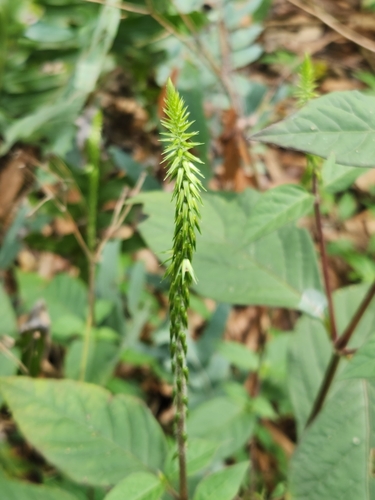
Pandiaka angustifolia
(Vahl) Hepper
AmaranthaceaeLeaves

iNaturalist · cc-by-nc-sa
(c) Marco Schmidt, some rights reserved (CC BY-NC-SA)
(c) Marco Schmidt, some rights reserved (CC BY-NC-SA)
What to Eat
Edible parts: Leaves
The leaves are eaten as a leafy green.
Where to Find It
A tropical plant. It grows in woodland and savannah.
Africa, Angola, Burkina Faso, Cameroon, Central Africa, Congo, East Africa, Guinea, Guinée, Guinea-Bissau, Malawi, Nigeria, Sierra Leone, West Africa,
Countries: Angola, Burkina Faso, Burundi, Benin, Botswana, Congo (DRC), Central African Republic, Congo (Republic), Cote d'Ivoire, Cameroon, Cape Verde, Djibouti, Algeria, Egypt, Eritrea, Ethiopia, Gabon, Ghana, Gambia, Guinea, Equatorial Guinea, Guinea-Bissau, Kenya, Comoros, Liberia, Lesotho, Libya, Morocco, Madagascar, Mali, Mauritania, Mauritius, Malawi, Mozambique, Namibia, Niger, Nigeria, Rwanda, Seychelles, Sudan, Sierra Leone, Senegal, Somalia, South Sudan, Sao Tome & Principe, Eswatini, Chad, Togo, Tunisia, Tanzania, Uganda, South Africa, Zambia, Zimbabwe
How to Identify
An annual herb. It is hairy and has long branches. It is 60-80 cm high. The leaves are opposite. They do not have leaf stalks. The leaves are 5-8 cm long by 0.6 cm wide. They are narrow. The flower spikes are 3 cm long. They are greenish-white.
Notes
There are 11 or 12 Pandiakia species in tropical Africa.
Names & Synonyms
Toa-toi
Achyranthes heudelotii MoquinGomphrena angustifolia VahlPandiakia benthamii (Lepr.) SchinzPandiakia heudelotii (Moq.) Hook.f.
References (3)
- Jardin, C., 1970, List of Foods Used In Africa, FAO Nutrition Information Document Series No 2.p 92 (As Pandiakia heudelotii)
- Martin, F.W. & Ruberte, R.M., 1979, Edible Leaves of the Tropics. Antillian College Press, Mayaguez, Puerto Rico. p 174 (As Pandiakia heudelotii)
- Thiselton-Dywer, W.T., (Ed.), 1913, Flora of Tropical Africa. Vol VI-section 1. Reeve, p 69 (As Pandiakia heudelotii)