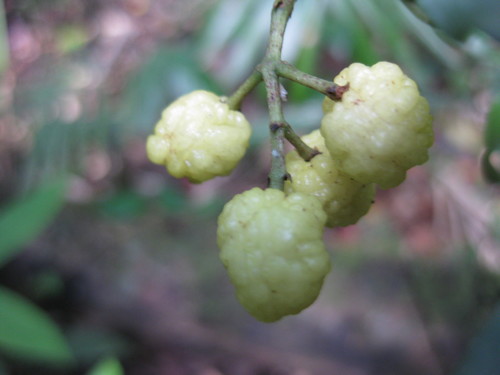
Paramignya trimera
(Oliver) Burkill
RutaceaeFruit

wikimedia · cc-by-sa
Wikimedia Commons - Thi Cam Mien Phi, Hoang Ha Chu, Ngoc Trieu Le et Duc Bach Nguyen
Wikimedia Commons - Thi Cam Mien Phi, Hoang Ha Chu, Ngoc Trieu Le et Duc Bach Nguyen

wikimedia · cc-by-sa
Wikimedia Commons - Thi Cam Mien Phi, Hoang Ha Chu, Ngoc Trieu Le et Duc Bach Nguyen
Wikimedia Commons - Thi Cam Mien Phi, Hoang Ha Chu, Ngoc Trieu Le et Duc Bach Nguyen
What to Eat
Edible parts: Fruit
The ripe fruit are eaten raw.
Where to Find It
A tropical plant. It grows in vine thickets near the coast. It needs well drained soils. It suits seasonally dry tropical regions.
Asia, Australia, Indonesia, Pacific, Philippines, SE Asia,
Countries: United Arab Emirates, Afghanistan, Armenia, Australia, Azerbaijan, Bangladesh, Bahrain, Brunei, Bhutan, China, Fiji, Micronesia, Georgia, Indonesia, Israel, India, Iraq, Iran, Jordan, Japan, Kyrgyzstan, Cambodia, Kiribati, North Korea, South Korea, Kuwait, Kazakhstan, Laos, Lebanon, Sri Lanka, Marshall Islands, Myanmar, Mongolia, Maldives, Malaysia, Nepal, Nauru, New Zealand, Oman, Papua New Guinea, Philippines, Pakistan, Palau, Qatar, Saudi Arabia, Solomon Islands, Singapore, Syria, Thailand, Tajikistan, Timor-Leste, Turkmenistan, Tonga, Turkey, Tuvalu, Taiwan, Uzbekistan, Vietnam, Vanuatu, Samoa, Yemen
How to Identify
A small shrub or climber. The stems have spines about 3 cm long which curve backwards. The leaves are 2-10 cm long by 1-6 cm wide. They are oval and with short stalks. They are shiny above and dull green underneath. The flowers are 0.7 cm across. There are 3 white petals. The flowers have a sweet scent. The fruit is about 1 cm across.
How to Grow
Plants can be grown from fresh seeds. It can possibly also be grown from cuttings.
Notes
There are about 20 Paramignya species. They grow in the tropics.
Names & Synonyms
Atalantia recurva Benth.
References (5)
- Elliot, W.R., & Jones, D.L., 1997, Encyclopedia of Australian Plants suitable for cultivation. Vol 7. Lothian. p 164
- Gard. Bull. Straits. Settlem. ser. 3, 5:213. 1931
- Kenneally, K.E., Edinger, D. C., and Willing T., 1996, Broome and Beyond, Plants and People of the Dampier Peninsula, Kimberley, Western Australia. Department of Conservation and Land Management. p 177
- Smith, N. M., 1991, Ethnobotanical Field Notes from the Northern Territory, Australia, J. Adelaide Bot. Gard. 14(1): 1-65
- Wheeler, J.R.(ed.), 1992, Flora of the Kimberley Region. CALM, Western Australian Herbarium, p 673