Parochetus communis
Buch.-Ham. ex. D. Don
Blue trefoil, Shamrock pea, Clover pea
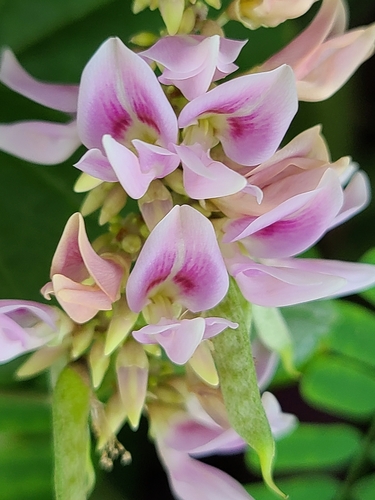
(c) Jonah Timms, some rights reserved (CC BY-NC), uploaded by Jonah Timms

(c) Dinesh Valke, some rights reserved (CC BY-SA)

(c) Dr. Alexey Yakovlev, some rights reserved (CC BY), uploaded by Dr. Alexey Yakovlev
What to Eat
Edible parts: Leaves, Roots, Flowers
The roots are boiled and eaten, while the flowers are used as a potherb in stir fries. The leaves are also edible.
Where to Find It
A tropical and subtropical plant. It grows naturally in mountains in Africa and Asia. It does best in moist, humus-rich soil. It can grow in sun or part shade. It can only tolerate light frost. In southern China it grows on the edges of woodlands and in grassland between 1,800-3,000 m above sea level. It suits hardiness zones 9-11. In Sichuan and Yunnan.
Asia, Africa, Australia, Bhutan, China*, East Africa, Himalayas, India, Indochina, Kenya, Malaysia, Myanmar, Nepal, SE Asia, Sikkim, Sri Lanka, Tasmania, Thailand, Tibet, Vietnam,
How to Identify
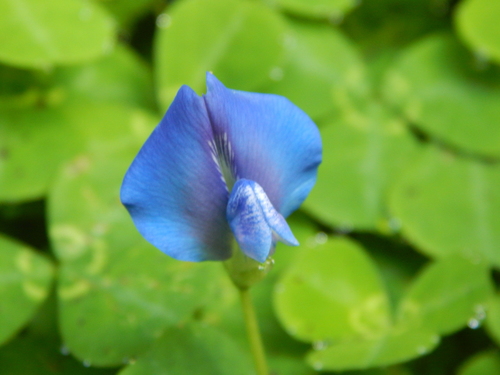
A creeping herb. It forms a ground cover. It grows 10 cm high and spreads 30 cm wide. It loses its leaves during the year. The leaflets are closely flattened. They are clover-like and divided into 3 leaflets. The leaves are 12 mm long. They are hairy underneath. The flowers are deep blue and like pea flowers. They are 12-25 mm wide. They occur singly or in pairs. The pods are 2.5 cm long.
How to Grow
It can be grown by seed or by division of the plant.
Medicinal Uses
Traditionally, the roots are boiled for consumption.
Production
It can spread quickly.
Notes
There is only one Parochetus species.
Names & Synonyms
A wo la qian, Bhattaula, Chemgi phul, Dhruma, Jangali badame jhar, Se-ngon, Sondau
References (10)
- Brickell, C. (Ed.), 1999, The Royal Horticultural Society A-Z Encyclopedia of Garden Plants. Convent Garden Books. p 751
- Ghimire, S. K., et al, 2008, Non-Timber Forest Products of Nepal Himalaya. WWF Nepal p 94
- Grivetti, L. E., 1980, Agricultural development: present and potential role of edible wild plants. Part 2: Sub-Saharan Africa, Report to the Department of State Agency for International Development. p 45
- Hibbert, M., 2002, The Aussie Plant Finder 2002, Florilegium. p 219 (As Parachetusil communis)
- Jardin, C., 1970, List of Foods Used In Africa, FAO Nutrition Information Document Series No 2.p 93
- Luo, B., et al, 2019, Wild edible plants collected by Hani from terraced rice paddy agroecosystem in Honghe Prefecture, Yunnan, China. Journal of Ethnobiology and Ethnomedicine 15:56
- Martin, F.W. & Ruberte, R.M., 1979, Edible Leaves of the Tropics. Antillian College Press, Mayaguez, Puerto Rico. p 200
- Peters, C. R., O'Brien, E. M., and Drummond, R.B., 1992, Edible Wild plants of Sub-saharan Africa. Kew. p 136 (As Parochetus africanus)
- Pham-Hoang Ho, 1999, An Illustrated Flora of Vietnam. Nha Xuat Ban Tre. p 979
- Prodr. fl. nepal 240. 1825