Parsonsia eucalyptophylla
F. Muell.
Gargaloo
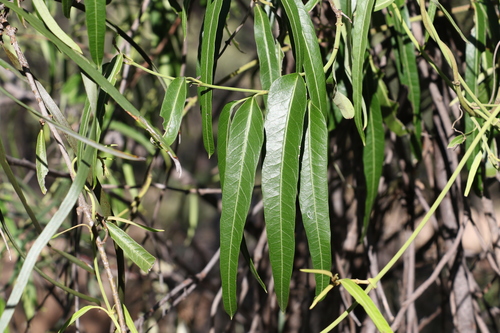
(c) Greg Tasney, some rights reserved (CC BY-SA), uploaded by Greg Tasney
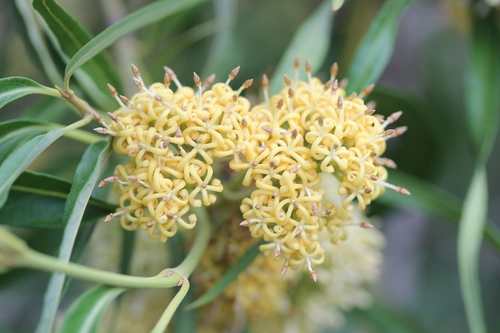
(c) Mick Drews, some rights reserved (CC BY-NC), uploaded by Mick Drews

(c) Ruth Palsson, some rights reserved (CC BY-SA)
Where to Find It
It grows in subtropical and warm temperate zones. It grows in inland Australia. It suits semi-arid regions and can grow in sun or light shade. It can tolerate frost. In tropical Queensland it grows from sea level to 650 m altitude.
Australia*,
How to Identify
A woody climber that attaches to the trunks of trees. It can also scramble over the ground. Young growth is soft and hairy. The stems are soft but become woody. The leaves are thick textured. They are sword shaped. They are 8-30 cm long by 0.5-2 cm wide. They are smooth and yellowish-green above but paler and hairy underneath. The flowers are pale. They occur as many together in clusters in the axils of leaves. The fruit are blunt follicles. These are 8 cm long by 1-2 cm wide.
How to Grow
Plants can be grown from seed or cuttings.
Wikipedia
Source ↗Parsonsia eucalyptophylla, whose common names are gargaloo and monkey vine, is a woody vine in the family Apocynaceae. It is native to the east coast states of Australia.
Notes
There are about 80-130 Parsonsia species.
References (5)
- Cooper, W. and Cooper, W., 2004, Fruits of the Australian Tropical Rainforest. Nokomis Editions, Victoria, Australia. p 49
- Elliot, W.R., & Jones, D.L., 1997, Encyclopedia of Australian Plants suitable for cultivation. Vol 7. Lothian. p 169
- Flora of Australia, Volume 28, Gentiales, Melbourne:CSIRO Australia, 1996. p 166, Fig 60 p 147, Fig 91 p 167, Map 197 p 298,
- Jones, D.L. & Gray, B., 1977, Australian Climbing Plants. Reed. p 127
- Lazarides, M. & Hince, B., 1993, Handbook of Economic Plants of Australia, CSIRO. p 182


