Passiflora edulis
Sims
Purple passionfruit
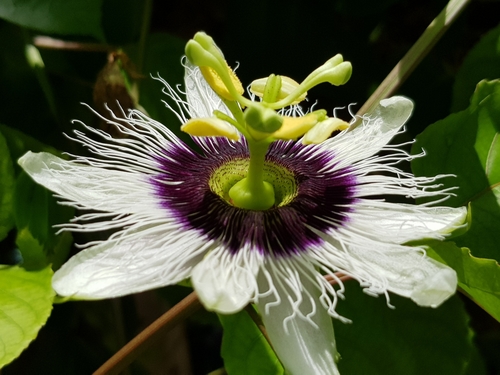
(c) Suhurab Mohamed, some rights reserved (CC BY-NC), uploaded by Suhurab Mohamed
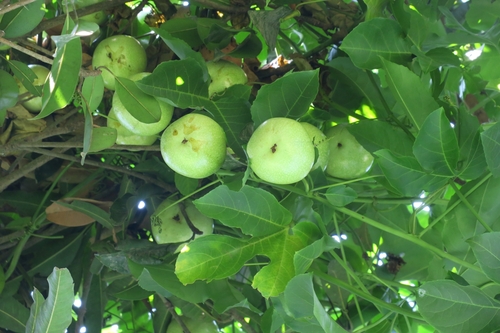
(c) Sascha Schumann, some rights reserved (CC BY-NC), uploaded by Sascha Schumann
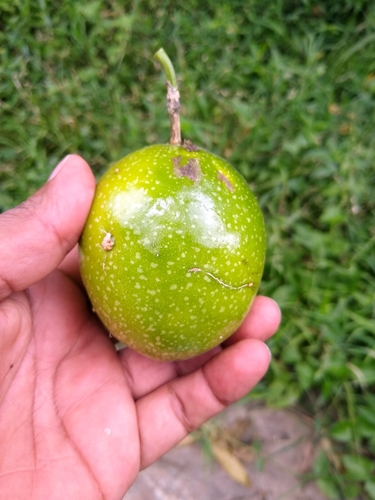
(c) Diego Manzano Méndez, some rights reserved (CC BY-NC), uploaded by Diego Manzano Méndez
What to Eat
Edible parts: Fruit, Seeds - oil, Leaves
The fruit can be eaten raw or cooked and has an agreeable, cooling taste similar to orange with a pleasant acidity. Ripe fruits are typically left to wrinkle on the vine to develop their full sweetness, then eaten fresh, juiced, made into syrup, or used in sauces and baked goods. Each fruit is about 5cm in diameter. An edible oil can also be pressed from the seeds. The plant is grown commercially in Australia and New Zealand.
Where to Find It
A subtropical plant. They are cultivated up to 2000 m altitude in the tropics. The purple variety grows in the highlands up to 3000 m. It can stand very light frosts. The yellow one grows in the lowlands. Its normal range is 700 to 2300 m. Often fruit set is poor in wet conditions. Wind breaks are important. Vines can tolerate very light frosts. If frosts are likely wrapping the stems near ground level with insulation paper can help protect the plant. Heavy rain at flowering can reduce fruit set through poor pollination. Soils should be fertile, moist and well drained. Plants cannot tolerate water-logging. A pH in the range 5.5-6.5 is best. In Nepal they grow between 1200-1700 m altitude. It grows satisfactorily between 20-30°C. It suits hardiness zones 8-11. In Yunnan.
Africa, Andes, Angola, Antigua and Barbuda, Antilles, Argentina, Asia, Australia, Bangladesh, Benin, Bolivia, Brazil*, Burkina Faso, Cameroon, Cape Verde, Caribbean, Central Africa, Central America, China, Colombia, Congo, Cook Islands, Costa Rica, Cuba, Dominican Republic, East Africa, East Timor, Ecuador, Eswatini, Ethiopia, Europe, Fiji, FSM, Gabon, Ghana, Guam, Guatemala, Guiana, Guianas, Guyana, Haiti, Hawaii, Himalayas, Honduras, India, Indochina, Indonesia, Israel, Jamaica, Japan, Kenya, Kiribati, Laos, Madagascar, Malawi, Malaysia, Maldives, Mediterranean, Mexico, Middle East, Mozambique, Myanmar, Nauru, Nepal, New Caledonia, New Zealand, Niger, Niue, Norfolk Island, North America, Northeastern India, Pacific, Panama, Papua New Guinea, PNG, Paraguay*, Peru, Philippines, Pohnpei, Portugal, Puerto Rico, Sahel, Samoa, Sao Tome and Principe, SE Asia, Sikkim, Slovenia, Solomon Islands, Somalia, South Africa, Southern Africa, South America, Sri Lanka, St Helena, Suriname, Swaziland, Taiwan, Tanzania, Tasmania, Thailand, Timor-Leste, Tonga, Tuvalu, Uganda, Uruguay, USA, Vanuatu, Venezuela, Vietnam, West Africa, West Indies, Zambia, Zimbabwe,
How to Identify
A vine which continues to grow for several years. The main vine becomes woody. Vines can be 6-7 m long. It climbs by tendrils. The leaves are shaped like the fingers on a hand with three lobes. They are 5-10 cm long. The vine can set flowers at each leaf. The flowers are white and often tinted purple. They are 5 cm across. The fruit are oblong and thickly dotted with purple when ripe. The skin is hard and they have a sweet smell. The flesh is orange. The seed occupy most of the inside with a small amount of flesh. The flesh is edible. The seeds are black. The flowers open in the morning. There are many named cultivated varieties.
Nutrition Score: 44/100
| Part | Moisture | kJ | kcal | Protein | Vit A | Vit C | Iron | Zinc |
|---|---|---|---|---|---|---|---|---|
| Fruit | 73.3 | 280 | 67 | 2.8 | 10 | 20 | 1.3 | 0.1 |
How to Grow
Plants are grown by seeds or cuttings. Seeds germinate in 15-45 days. Seedlings can be grafted. When the end shoots of the mother plant are the same thickness as the seedling stem, shoot tips 8 cm long can be used. The leaves should be removed from the cutting being used in the graft. An even light and high humidity allows these grafted plants to be ready in a few weeks. Plants are put in a hole 30 cm deep and which has had organic matter added. A spacing of 3-4 m apart is suitable. Plants need a trellis to climb over. Often a trellis 2 m high is used. Normally the side shoots are picked off until the vine reaches the trellis height. Then the tip is picked out to promote branching. Normally later pruning is not done. Putting mulch around the plant helps retain moisture and adds nutrients as well as controlling weeds. Hand pollination can improve fruit set. The fruit turns purple, wrinkles then drops off when ripe. Balanced fertiliser to promote healthy growth is important. Deficiencies of magnesium, iron, zinc, copper and boron can occur in some places. Pruning is important to keep vines vigorous.
Propagation: Pre-soak seed for 12 hours in warm water, then sow in late winter or early spring in a warm greenhouse. Seed sown in January and grown on quickly can flower and fruit within its first year. Germination takes 1–12 months at 20°C. Prick seedlings out into individual pots once large enough to handle. Plants intended for outdoor growing are best overwintered in the greenhouse during their first year, then planted out in late spring or early summer after the last expected frosts. Mulch roots well in late autumn for cold protection. Take cuttings of young shoots (15cm with a heel) in spring, or use leaf bud cuttings in spring. Cuttings of fully mature wood taken in early summer take about 3 months and have a high success rate.
Medicinal Uses
The fruit pulp is considered stimulant and tonic.
Other Uses
This vigorous climber makes an effective screen when grown over a fence or trellis.
Wikipedia
Source ↗Passiflora edulis, commonly known as passion fruit, is a vine species of passion flower. The fruit is a pepo, a type of botanical berry, round to oval, either yellow or dark purple at maturity, with a soft to firm, juicy interior filled with numerous seeds. The plant is native to the region of southern Brazil through Paraguay to northern Argentina. It is cultivated commercially in tropical and subtropical areas for its sweet, seedy fruit. This is both eaten and juiced, with the juice often added to other fruit juices to enhance aroma.
Production
Plants produce after about 12-18 months and keep producing well for 4 or 5 years. Good production is related to keeping the vine growing well by avoiding low temperatures and lack of water. Plants are pollinated by insects, so it is important to not kill these with insecticides. They can also self pollinate. Fruit mature between 60 and 100 days from pollination.
Other Information
It is a commonly cultivated food plant. Plants are common in the highlands of Papua New Guinea. The fruit are eaten but are not popular.
Notes
There are about 400 Passiflora species. It can become a self sown plant in cool moist areas. Fruit are high in folates 136μg/100.
Names & Synonyms
Aul aanp, Bai xiang guo, Bechawan, Begele, Bejabe, Buah negeri, Buah susu, Butunda, Chumbao trung, Farendal, Gandum-pat, Garandel, Garendal, Giranadela, Granadiglia, Granadilho, Grenadille, Gwate, Ji dan guo, Jumhoorimeyvaa, Koko, Kudamonotokeiso, Latabel, Liliko'i, Linmangkon, Louki, Mabosoboso, Magalendendele, Mak nod, Manthei, Maracuja-roxo, Maracuya, Maraflora, Markisa, Markoesa, Masaflora, Masaplora, Maseche, Matunda, Mkakaa, Mograndela, Mufurangandela, Munchi, Obutunda, Pasionaria, Pin-hme, Purpurgrenadille, Pwompwompw en wai, Qaranidila, Sapthei, Sawarot, Sita phal, Soh-brap, Tang, Thatput, Tikeiso
References (144)
- Abbiw, D.K., 1990, Useful Plants of Ghana. West African uses of wild and cultivated plants. Intermediate Technology Publications and the Royal Botanic Gardens, Kew. p 42
- Achigan-Dako, E, et al (Eds), 2009, Catalogue of Traditional Vegetables in Benin. International Foundation for Science.
- Ajesh, T. P., et al, 2012, Ethnobotanical Documentation of Wild Edible Fruits used by Muthuvan Tribes of Idukki, Kerala-India. International Journal of Pharma and Bio Sciences 3(3): 479-487
- Ambasta, S.P. (Ed.), 2000, The Useful Plants of India. CSIR India. p 433
- Anderson, E. F., 1993, Plants and people of the Golden Triangle. Dioscorides Press. p 217
- Arora, R. K., 2014, Diversity in Underutilized Plant Species - An Asia-Pacific Perspective. Bioversity International. p 80
- Barcelo, R., 2015, Phytochemical Screening and Antioxidant Activity of Edible Wild Fruits in Benguet, Cordillera Administrative Region, Philippines. Electronic Journal of Biology, 2015, Vol.11(3): 80-89
- Bernholt, H. et al, 2009, Plant species richness and diversity in urban and peri-urban gardens of Niamey, Niger. Agroforestry Systems 77:159-179
- Bianchini, F., Corbetta, F., and Pistoia, M., 1975, Fruits of the Earth. Cassell. p 174
- Blench, R., 2004, Fruits and Arboriculture in the Indo-Pacific Region. Indo-Pacific Prehistory Association Bulletin 24. (Taipei Papers Volume 2) p 39
- Bodkin, F., 1991, Encyclopedia Botanica. Cornstalk publishing, p 764
- Bortolotto, I. M., et al, 2018, Lista preliminar das plantas alimenticias nativas de Mato Grosso do Sul, Brasil. Iheringia, Serie Botanica, Porto Alegre, 73 (supl.):101-116
- Bot. Mag. 45: t. 1989. 1818
- Bourke, R. M., Altitudinal limits of 230 economic crop species in Papua New Guinea. Terra australis 32.
- Bourret, D., 1981, Bonnes-Plantes de Nouvelle-Caledonie et des Loyaute. ORSTOM. p 50
- Brack, P., et al, 2020, Frutas nativas do Rio Grande do Sul, Brasil: riqueza e potencial alimentício. Native fruits of Rio Grande do Sul, Brazil: richness and potential as food. Rodriguésia 71: e03102018.
- Brickell, C. (Ed.), 1999, The Royal Horticultural Society A-Z Encyclopedia of Garden Plants. Convent Garden Books. p 755
- Burkill, H. M., 1985, The useful plants of west tropical Africa, Vol. 4. Kew.
- Burkill, I.H., 1966, A Dictionary of the Economic Products of the Malay Peninsula. Ministry of Agriculture and Cooperatives, Kuala Lumpur, Malaysia. Vol 2 (I-Z) p 1704
- Chakraborty, S. & Chaturbedi, H. P., 2014, Some Wild Edible Fruits of Tripura- A Survey. Indian Journal of Applied research. (4) 9
- Cheifetz, A., (ed), 1999, 500 popular vegetables, herbs, fruits and nuts for Australian Gardeners. Random House p 214
- Chua-Barcelo, R. T., 2014, Ethnobotanical survey of edible wild fruits in Benguet, Cordillera administrative region, the Philippines. Asian Pac. J. Trop. Biomed. 4(Suppl. 1):S525-S538
- Cooper, W. and Cooper, W., 2004, Fruits of the Australian Tropical Rainforest. Nokomis Editions, Victoria, Australia. p 392
- Coronel, R.E., 1982, Fruit Collections in the Philippines. IBPGR Newsletter p 8
- Crandall, C & Crandall, B., 1996, Flowering Fruiting and Foliage vines. Sterling. p 92
- Cribb, A.B. & J.W., 1976, Wild Food in Australia, Fontana. p 67
- Cruz, I. M., et al, 2015, Edible fruits and seeds in the State of Mexico. Revista Mexicana de Ciencias Agricolas. Vol. 6. Num. 2 pp 331-346
- Cull, B.W., 1995, Fruit Growing in Warm Climates. Reed. p 141
- Cundall, P., (ed.), 2004, Gardening Australia: flora: the gardener's bible. ABC Books. p 991
- D'Ambrosio, U., & Puri, R. K., 2016, Foodways in transition: food plants, diet and local perceptions of change in a Costa Rican Ngäbe community. Journal of Ethnobiology and Ethnomedicine (2016) 12:3 p 27
- Darley, J.J., 1993, Know and Enjoy Tropical Fruit. P & S Publishers. p 96
- Facciola, S., 1998, Cornucopia 2: a Source Book of Edible Plants. Kampong Publications, p 166
- Flora of Australia, Volume 8, Lecythidales to Batales, Australian Government Publishing Service, Canberra (1982) p 154
- Flora of Australia Volume 49, Oceanic Islands 1, Australian Government Publishing Service, Canberra. (1994) p 127
- Flowerdew, B., 2000, Complete Fruit Book. Kyle Cathie Ltd., London. p 136
- Fongnzossie Fedoung, E., et al, 2020, Wild edible plants and mushrooms of the Bamenda Highlands in Cameroon: ethnobotanical assessment and potentials for enhancing food security. Journal of Ethnobiology and Ethnomedicine 16:12
- Fowler, D. G., 2007, Zambian Plants: Their Vernacular Names and Uses. Kew. p 52
- French, B.R., 1986, Food Plants of Papua New Guinea, A Compendium. Asia Pacific Science Foundation p 253
- French, B.R., 2010, Food Plants of Solomon Islands. A Compendium. Food Plants International Inc. p 247
- Gangte, H. E., et al, 2013, Wild Edible Plants used by the Zou Tribe in Manipur, India. International Journal of Scientific and Research Publications, Volume 3, Issue 5
- Gillaumin, R., 1954, Les Plantes utiles des Nouvelles-Hebrides (fin et complement) In: Journal d'agriculture tropicale et de botanique appliquee Vol. 1, No. 10-12 pp 453-460
- Giraldi, M. & Hanazaki, N., 2014, Use of Cultivated and Harvested Edible Plants by Caiçaras—What Can Ethnobotany Add to Food Security Discussions? Human Ecology Review, Volume 20, Number 2, 2014
- Gohre, A., et al, 2016, Plants from disturbed savannah vegetation and their usage by Bakongo tribes in Uíge, Northern Angola. Journal of Ethnobiology and Ethnomedicine (2016) 12:42
- Goode, P., 1989, Edible Plants of Uganda. FAO p 27
- Guite, C., 2016, Study of wild edible plants associated with the Paite Tribe of Manipur, India. International Journal of Current Research. Vol. 8, Issue 11, pp. 40927-40932
- Harkonen, M. & Vainio-Mattila, K., 1998, Some examples of Natural Products in the Eastern Arc Mountains. Journal of East African Natural History 87:265-278
- Hazarika, B. et al. (2020). An overview of the unexplored underutilized fruit crops of Assam, India. Journal of Applied and Natural Science, 12(3): 442 - 453
- Hermandez Bermejo, J.E., and Leon, J. (Eds.), 1994, Neglected Crops. 1492 from a different perspective. FAO Plant Production and Protection Series No 26. FAO, Rome. p16
- Hibbert, M., 2002, The Aussie Plant Finder 2002, Florilegium. p 220
- http://www.botanic-gardens-ljubljana.com/en/plants
- Hu, Shiu-ying, 2005, Food Plants of China. The Chinese University Press. p 565
- Hunter, D., et al, 2019, The potential of neglected and underutilized species for improving diets and nutrition. Planta (2019) 250:709-729
- INFOODS:FAO/INFOODS Databases
- Jackes, B.R., 2001, Plants of the Tropics. Rainforest to Heath. An Identification Guide. James Cook University. p 72
- Jardin, C., 1970, List of Foods Used In Africa, FAO Nutrition Information Document Series No 2.p 153
- John, L., & Stevenson, V., 1979, The Complete Book of Fruit. Angus & Robertson p 214
- Kar, A., et al, 2013, Wild Edible Plant Resources used by the Mizos of Mizoram, India. Kathmandu University Journal of Science, Engineering and Technology. Vol. 9, No. 1, July, 2013, 106-126
- Katende, A.B., Birnie, A & Tengnas B., 1995, Useful Trees and Shrubs for Uganda. Identification, Propagation and Management for Agricultural and Pastoral Communities. Technical handbook No 10. Regional Soil Conservation Unit, Nairobi, Kenya. p 480
- Kinupp, V. F., 2007, Plantas alimenticias nao-convencionais da regiao metropolitana de Porto Alegre, RS, Brazil p 90
- Kiple, K.F. & Ornelas, K.C., (eds), 2000, The Cambridge World History of Food. CUP p 1829
- Konsam, S., et al, 2016, Assessment of wild leafy vegetables traditionally consumed by the ethnic communities of Manipur, northeast India. Journal of Ethnobiology and Ethnomedicine, 12:9
- Kumar, A., et al, 2012, Ethnobotanical Edible Plant Biodiversity of Lepcha Tribes. Indian Forester, 138 (9):798-803
- Lazarides, M. & Hince, B., 1993, Handbook of Economic Plants of Australia, CSIRO. p 184
- Leal, M. L. et al, 2018, Knowledge, use, and disuse of unconventional food plants. Journal of Ethnobiology and Ethnomedicine (2018) 14:6
- Lembaga Biologi Nasional, 1977, Buah-Buahan, Balai Pustaka, Jakarta. p 76
- Llamas, K.A., 2003, Tropical Flowering Plants. Timber Press. p 310
- Long, C., 2005, Swaziland's Flora - siSwati names and Uses http://www.sntc.org.sz/flora/
- Lord, E.E., & Willis, J.H., 1999, Shrubs and Trees for Australian gardens. Lothian. p 335
- Lorenzi, H., Bacher, L., Lacerda, M. & Sartori, S., 2006, Brazilian Fruits & Cultivated Exotics. Sao Paulo, Instituto Plantarum de Estuados da Flora Ltda. p 258
- Low, T., 1991, Wild Herbs of Australia and New Zealand. Angus & Robertson. p 108
- Low, T., 1992, Bush Tucker. Australia’s Wild Food Harvest. Angus & Robertson. p 77
- Luczaj, L., et al, 2021, Wild food plants and fungi sold in the markets of Luang Prabang, Lao PDR. Journal of Ethnobiology and Ethnomedicine (2021) 17:6
- Lyle, S., 2006, Discovering fruit and nuts. Land Links. p 312
- Macmillan, H.F. (Revised Barlow, H.S., et al) 1991, Tropical Planting and Gardening. Sixth edition. Malayan Nature Society. Kuala Lumpur. p 305
- Magwede, K., van Wyk, B.-E., & van Wyk, A. E., 2019, An inventory of Vhavenḓa useful plants. South African Journal of Botany 122 (2019) 57–89
- Mashile, S. P., et al, 2019, Indigenous fruit plants species of the Mapulana of Ehlanzeni district in Mpumalanga province, South Africa. South African Journal of Botany 122 (2019) 180–183
- Martin, F. W., et al, 1987, Perennial Edible Fruits of the Tropics. USDA Handbook 642 p 50
- Miguel, E., et al, 1989, A checklist of the cultivated plants of Cuba. Kulturpflanze 37. 1989, 211-357
- Monsalud, M.R., Tongacan, A.L., Lopez, F.R., & Lagrimas, M.Q., 1966, Edible Wild Plants in Philippine Forests. Philippine Journal of Science. p 530
- Morton, J. F., 1987, Fruits of Warm Climates. Wipf & Stock Publishers p 320
- Msola, D. K., 2007, The role of Wild Foods in Household Income and Food Security in Mufundi District, Tanzania. Morogoro, Tanzania. p 44
- Msuya, T. S., et al, 2010, Availability, Preference and Consumption of Indigenous Foods in the Eastern Arc Mountains, Tanzania, Ecology of Food and Nutrition, 49:3, 208-227
- Nascimento, V. T. D., et al, 2013, Knowledge and Use of Wild Food Plants in Areas of Dry Seasonal Forests in Brazil. Ecology of Food and Nutrition, 52:317–343
- Nayaham, M. C., et al, 1993, Less Known Edible Fruit - Yielding plants of Nilgiris. Ancient Science of Lif. Vol. X11 Nos. 3 & 4, pp 363-376
- Niwano, Y. et al., 2009, Extensive Screening for Plant Foodstuffs in Okinawa, Japan with Anti-Obese Activity on Adipocytes, in vitro. Plant Foods in Human Nutrition 64:6-10
- Norrington, L., & Campbell, C., 2001, Tropical Food Gardens. Bloomings Books. p 110
- NYBG Herbarium "edible"
- Ojelel, S., et al, 2019, Wild edible plants used by communities in and around selected forest reserves of Teso-Karamoja region, Uganda. Journal of Ethnobiology and Ethnomedicine (2019) 15:3
- Oryema, C., et al, 2013, Edible wild fruit species of Gulu District, Uganda. International Journal of Biology and Biological Sciences Vol 2(4) pp 068-082
- Pascual-Mendoza, S. et al, 2021, Traditional knowledge of edible plants in an indigenous community in the Sierra Norte of Oaxaca, Mexico. Plant Biosystems - An International Journal Dealing with all Aspects of Plant Biology
- Pasha, M. K. & Uddin, S. B., 2019, Minor Edible Fruits of Bangladesh. Bangladesh J. Plant Taxon. 26(2): 299–313
- Paul, A., 2013, Minor and uncultivated fruits of Eastern India, 2nd International Symposium on Minor Fruits and Medicinal Plants
- Pham-Hoang Ho, 1999, An Illustrated Flora of Vietnam. Nha Xuat Ban Tre. p 556
- Phawa, G. M., Dkhar, E. K. & Marbaniang, D., 2019, Indigenous Wild Edible Plants of Bataw Village, East Jaintia Hills District, Meghalaya. International Journal of Arts, Science and Humanities. 7(2)
- Plants for a Future database, The Field, Penpol, Lostwithiel, Cornwall, PL22 0NG, UK. http://www.scs.leeds.ac.uk/pfaf/
- Porcher, V., et al, 2022, Growing up in the Betsileo landscape: Children’s wild edible plants knowledge in Madagascar. PLoS ONE 17(2): e0264147.
- Priyadi, H., et al, Five hundred plant species in Gunung Halimun Salak National Park West Java. A checklist including Sundanese names, distribution and use. CIFOR, FFPRI, SLU p 141
- PROSEA (Plant Resources of South East Asia) handbook, Volume 2, 1991, Edible fruits and nut. p 244
- Purseglove, J.W., 1968, Tropical Crops Dicotyledons, Longmans. p 422
- Recher, P, 2001, Fruit Spirit Botanical Gardens Plant Index. www.nrg.com.au/~recher/ seedlist.html p 3
- Roa, J. A. G. & Boada, D. S. G., 2018, Fundación para el Fortalecimiento de la Fruticultura y Plantas Alimenticias no Convencionales en Colombia.
- Ruiters-Welcome, A. K., 2019, Food plants of southern Africa. Ph.D. thesis. Univ. of Johannesburg p 85
- Sasi, R. & Rajendran, A., 2012, Diversity of Wild Fruits in Nilgiri Hills of the Southern Western Ghats - Ethnobotanical Aspects. IJABPT, 3(1) p 82-87
- Savita, et al, 2006, Studies on wild edible plants of ethnic people in east Sikkim. Asian J. of Bio Sci. (2006) Vol. 1 No. 2 : 117-125
- Sawian, J. T., et al, 2007, Wild edible plants of Meghalaya, North-east India. Natural Product Radiance Vol. 6(5): p 420
- Scarpa, G. F., 2009, Wild food plants used by the indigenous peoples of South American Gran Chaco: A general synopsis and intercultural comparison. Journal of Applied Botany and Food Quality 83:90-101
- Segura, S., et al, 2018, The edible fruit species in Mexico. Genet Resour Crop Evol (2018) 65:1767–1793
- Senbeta, F., et al, 2013, Diversity of Useful Plants in the Coffee Forests of Ethiopia. Ethnobotany Research & Applications 11:049-069
- Sharma, B.B., 2005, Growing fruits and vegetables. Publications Division. Ministry of Information and broadcasting. India. p 104
- Sillitoe, P. 1995, An Ethnobotanical Account of the Plant Resources of the Wola Region, Southern Highlands Province, Papua New Guinea. J. Ethnobiol. 15(2): 201-235
- Smith, N., Mori, S.A., et al, 2004, Flowering Plants of the Neotropics. Princeton. p 286 (Drawing)
- Smith, P.M., 1979, Passionfruit, in Simmonds, N.W., (ed), Crop Plant Evolution. Longmans. London. p 319
- Solomon, C., 2001, Encyclopedia of Asian Food. New Holland. p 273
- Stanley, T. D. & Ross, E. M., 1986, Flora of south-eastern Queensland Volume 2. Queensland Government p 105
- Staples, G.W. and Herbst, D.R., 2005, A tropical Garden Flora. Bishop Museum Press, Honolulu, Hawaii. p 450 (Drawing)
- Striegel, L., et al, 2019, Promising Tropical Fruits High in Folates. Foods 2019, 8, 363; doi:10.3390/foods8090363. www.mdpi.com/journal/foods
- Sujanapal, P., & Sankaran, K. V., 2016, Common Plants of Maldives. FAO & Kerala FRI, p 196
- Suwardi, A. B., et al, 2020, Wild edible fruits generate substantial income for local people of the Gunung Leuser National Park, Aceh Tamiang Region. Ethnobotany Research & Applications 20:11
- Swaziland's Flora Database http://www.sntc.org.sz/flora
- Tankard, G., 1990, Tropical fruit. An Australian Guide to Growing and using exotic fruit. Viking p 90
- Tate, D., 1999, Tropical Fruit. Archipelago Press. Singapore. p 76
- Termote, C., et al, 2014, Assessing the potential of wild foods to reduce the cost of a nutritionally adequate diet: An example from eastern Baringo District, Kenya. Food and Nutrition Bulletin, vol. 35, no. 4
- Thaman, R.R., 1976, The Tongan Agricultural System, University of the South Pacific, Suva, Fiji. p 415
- Thaman, R. R., 1987, Plants of Kiribati: A listing and analysis of vernacular names. Atoll Research Bulletin No. 296
- Thaman, R. R., et al, 1994, The Flora of Nauru. Atoll Research Bulletin No. 392. Smithsonian Institute p 39
- Thaman, R. R, 2016, The flora of Tuvalu. Atoll Research Bulletin No. 611. Smithsonian Institute p 105
- Torre, de la, L., et al, 2008, Enciclopedia de las Plantas Útiles del Ecuador. Herbario QCA. Pontificia Universidad Católica del Ecuador. p 485
- Tugume, P. & Nyakoojo, C., 2020, Traditional use of wild edible plants in the communities adjacent to Mabira Central Forest Reserve, Uganda. Ethnobotany Research & Applications 20:15 (2020)
- USDA, ARS, National Genetic Resources Program. Germplasm Resources Information Network - (GRIN). [Online Database] National Germplasm Resources Laboratory, Beltsville, Maryland. Available: www.ars-grin.gov/cgi-bin/npgs/html/econ.pl (10 April 2000)
- Vael, L., 2015, Ethnobotanical study of the plant use in the natural landscape of two mestizo communities in the Ucayali region of the Peruvian Amazon. Universiteit Gent.
- van Wyk, B., 2005, Food Plants of the World. An illustrated guide. Timber press. p 279
- van Wyk, Be., & Gericke, N., 2007, People's plants. A Guide to Useful Plants of Southern Africa. Briza. p 52
- Vasquez, R. and Gentry, A. H., 1989, Use and Misuse of Forest-harvested Fruits in the Iquitos Area. Conservation Biology 3(4): 350f
- Vivien, J., & Faure, J.J., 1996, Fruitiers Sauvages d'Afrique. Especes du Cameroun. CTA p 259
- Walter, A. & Lebot, V., 2007, Gardens of Oceania. ACIAR Monograph No. 122. p 209
- Welcome, A. K. & Van Wyk, B.-E., 2019, An inventory and analysis of the food plants of southern Africa. South African Journal of Botany 122 (2019) 136–179
- Wiersema, J. H. & Leon, B., 2013, World Economic Plants. A Standard Reference CRC Press. 2nd Ed. p 500
- Williams, C.N., Chew, W.Y., and Rajaratnam, J.A., 1989, Tree and Field Crops of the Wetter Regions of the Tropics. Longman, p 133
- Williamson, J., 2005, Useful Plants of Malawi. 3rd. Edition. Mdadzi Book Trust. p 188
- Wiriadinata, H., 1995, Ethnobotany of Economic Plants in the Baliem Valley, Jayawijaya, Irian Jaya, Indonesian Institute of Science, Bogor, Indonesia
- World Checklist of Useful Plant Species 2020. Royal Botanic Gardens, Kew
- Yuncker, T. G., 1943, The Flora of Niue Island. Bernice P. Bishop Museum Bulletin 178 p 86
- Yuncker, T.G., 1959, Plants of Tonga, Bernice P. Bishop Museum, Hawaii, Bulletin 220. p 191
- Zaldivar, M. E., et al, 2002, Species Diversity of Edible Plants Grown in Homegardens of Chibehan Amerindians from Costa Rica. Human Ecology, Vol. 30, No. 3, pp. 301-316


