Passiflora maliformis
L.
Sweet calabash

(c) Nick Hobgood, some rights reserved (CC BY)
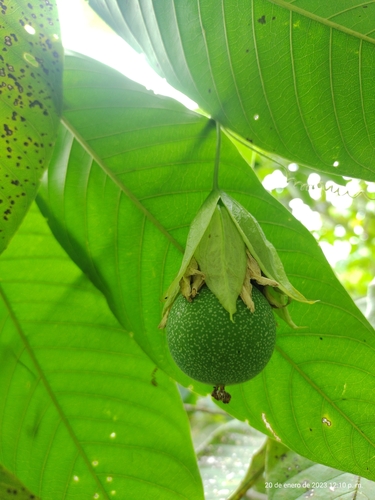
(c) Javier David Quiroga Nova, some rights reserved (CC BY-NC), uploaded by Javier David Quiroga Nova

(c) Juan Manuel de Roux, some rights reserved (CC BY-NC), uploaded by Juan Manuel de Roux
What to Eat
Edible parts: Fruit
The flesh of the fruit is eaten and made into drinks. The plant is cultivated and sold in local markets.
Where to Find It
A tropical plant. It grows in more tropical conditions than purple passionfruit. It suits the warm, wet tropical lowlands. In South America it grows up to 1,700 m above sea level. In Jamaica it grows between 150-400 m above sea level.
American Samoa, Andes, Antilles, Australia, Bermuda, Brazil, Caribbean, Central America, Colombia, Cook Islands, Cuba*, Dominican Republic, Ecuador, Fiji, Guadeloupe, Guiana, Guyana, Haiti, Hawaii, Jamaica, Marquesas, Martinique, Niue, Pacific, Puerto Rico, Rotuma, Samoa, South America*, Tonga, Trinidad, Vanuatu, Venezuela, West Indies*,
How to Identify
The plant is a vigorous vine. It grows 10 m long. The leaves are light green and can be curved back at the tip. They are 6-15 cm long. The flowers are white and purple. They are 4-5 cm across and have a scent. The fruit has a yellow-green hard shell. It is round and smooth and 5 cm across. It has white dots on the skin.
How to Grow
They can be grown from seed or leafy cuttings.
Propagation: Seed - best sown as soon as it is ripe along with the pulp which will help break down the seed coat and speed up germination. Stored seed should be soaked for 24 hours in warm water and germination time can be reduced if the seed is then mixed with the juice of a fresh passion fruit (of any species). Even so, it can take 12 months for stored seed to germinate. Place the seed tray in a shady position, maintaining a temperature around 19 - 24°c. Prick the seedlings out into individual containers as soon as they are large enough to handle and plant out when large enough. Cuttings of young shoots, taken at the nodes. The cuttings root best in a neutral to slightly acid compost, but 100% sharp sand also produces good results. Cuttings of fully mature wood taken at a node. They can take 3 months, but there is usually a high percentage. Layering. Very easy. Air layering.
Medicinal Uses
The leaves and roots of some, if not all, members of this genus contain a substance called 'passiflorina' which has similaritiesr to morphine and is an effective tranquilizer. We have no specific information for this species but many species are used in herbal infusions to calm the nerves and help bring about a restful sleep. The leaves of many species are also considered to be anthelmintic, antihysteric and diaphoretic. They are used in Brazil to combat intermittent fevers, cutaneous inflammations, and erysipelas.
Wikipedia
Source ↗Passiflora maliformis, the sweet calabash, conch apple, wild purple passionfruit, or sweet cup, is a smallish (5 cm or 2 in) passionfruit with purple, yellow or green skin and a greyed-yellow to orange pulp that is aromatically scented and flavoured. It is a fast-growing vine, growing best in somewhat cooler-than-tropical climates. The rind is particularly hard and tougher than most passionfruits. It is usually eaten fresh or used to flavour drinks. It is a native to the Caribbean, Central America and Northern South America.
Other Information
It is sold in local markets. It is cultivated.
Notes
There are about 400 Passiflora species.
Names & Synonyms
Bell-apple, Calabacito de Indio, Callebassie, Ceibey cimarron, Cholupa, Conch apple, Conch nut, Culupa, Curuba, Chulupa, Guerito, Hardshelled passionflower, Kuruba, Liane a agouti, Lila, Parcha cimarrona, Pomme calabas, Qaranidila, Sweet cup, Tsururu fintsumi puka, Water lemon
References (28)
- Barfod, A. S. & Kvist, L. P., 1996, Comparative Ethnobotanical Studies of the Amerindian Groups in Coastal Ecuador. The Danish Academy of Sciences and Letters. p 79
- Bodkin, F., 1991, Encyclopedia Botanica. Cornstalk publishing, p 765
- Castillo, R. O., 1995, Plant Genetic Resources in the Andes: Impact, Conservation, and Management. Crop Science 35:355-360
- Facciola, S., 1998, Cornucopia 2: a Source Book of Edible Plants. Kampong Publications, p 167
- Franklin, J., Keppel, G., & Whistler, W., 2008, The vegetation and flora of Lakeba, Nayau and Aiwa Islands, Central Lau Group, Fiji. Micronesica 40(1/2): 169–225, 2008
- Gouldstone, S., 1983, Growing your own Food-bearing Plants in Australia. Macmillan p 112
- Hedrick, U.P., 1919, (Ed.), Sturtevant's edible plants of the world. p 468
- Hermandez Bermejo, J.E., and Leon, J. (Eds.), 1994, Neglected Crops. 1492 from a different perspective. FAO Plant Production and Protection Series No 26. FAO, Rome. p16
- Heywood, V.H., Brummitt, R.K., Culham, A., and Seberg, O. 2007, Flowering Plant Families of the World. Royal Botanical Gardens, Kew. p 245
- Jansen, A. A. J., et al, (Eds), 1990, Food and Nutrition in Fiji. Volume One. p 53
- Kermath, B. M., et al, 2014, Food Plants in the Americas: A survey of the domesticated, cultivated and wild plants used for Human food in North, Central and South America and the Caribbean. On line draft. p 615
- Lopez-Diago, D. & Garcia, N., 2021, Wild edible fruits of Colombia. Biota ColomBiana 22 (2) p 47
- Lord, E.E., & Willis, J.H., 1999, Shrubs and Trees for Australian gardens. Lothian. p 335
- Lyle, S., 2006, Discovering fruit and nuts. Land Links. p 316
- Martin, F. W., et al, 1987, Perennial Edible Fruits of the Tropics. USDA Handbook 642 p 51
- Miguel, E., et al, 1989, A checklist of the cultivated plants of Cuba. Kulturpflanze 37. 1989, 211-357
- Morton, J. F., 1987, Fruits of Warm Climates. Wipf & Stock Publishers p 334
- Omawale, 1973, Guyana's edible plants. guyana University, Georgetown p 6
- Parham, B. E. V., 1972, Plants of Samoa. New Zealand Department of Scientific and Industrial Research. Information Series. No. 85 p 97
- Roa, J. A. G. & Boada, D. S. G., 2018, Fundación para el Fortalecimiento de la Fruticultura y Plantas Alimenticias no Convencionales en Colombia.
- Smith, A.C., 1981, Flora Vitiensis Nova, Lawaii, Kuai, Hawaii, Volume 2 p 669
- Sp. pl. 2:956. 1753
- Thaman, R.R., 1976, The Tongan Agricultural System, University of the South Pacific, Suva, Fiji. p 416
- Torre, de la, L., et al, 2008, Enciclopedia de las Plantas Útiles del Ecuador. Herbario QCA. Pontificia Universidad Católica del Ecuador. p 486
- USDA, ARS, National Genetic Resources Program. Germplasm Resources Information Network - (GRIN). [Online Database] National Germplasm Resources Laboratory, Beltsville, Maryland. Available: www.ars-grin.gov/cgi-bin/npgs/html/econ.pl (10 April 2000)
- Walter, A. & Lebot, V., 2007, Gardens of Oceania. ACIAR Monograph No. 122. p 209
- World Checklist of Useful Plant Species 2020. Royal Botanic Gardens, Kew
- Yuncker, T.G., 1959, Plants of Tonga, Bernice P. Bishop Museum, Hawaii, Bulletin 220. p 192


