Passiflora quadrangularis
L.
Granadilla
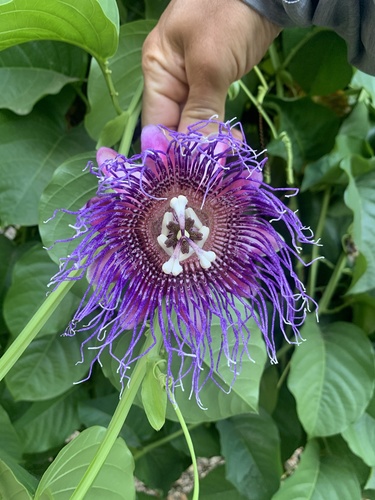
(c) danielamjq, some rights reserved (CC BY-NC)
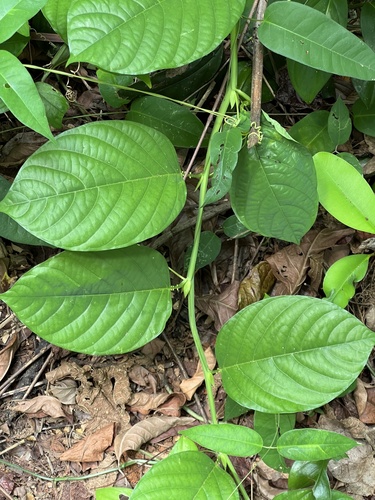
(c) ogockman, some rights reserved (CC BY-NC)

(c) ogockman, some rights reserved (CC BY-NC)
What to Eat
Edible parts: Fruit, Seeds, Vegetable, Root
The fruit can be eaten raw, cooked, or made into drinks and is sweetly acid and very palatable. It is the largest fruit in the genus, growing up to 30cm long, and has a mild, melon-like flavour. The immature fruit is used as a vegetable — it can be steamed, boiled, or added to soups — and the thick rind is also cooked in various ways as a vegetable. The fruit is frequently used to make juices. The roots of old plants can be baked or roasted and eaten like yams, though the raw root is narcotic and poisonous and should not be consumed uncooked.
Known Hazards
Where to Find It
A tropical plant. It mainly occurs in the tropical lowlands but grows up to about 1000 m. It suits hot humid lowland areas in the tropics. Fruiting is often best between 200-500 m altitude. They can stand cool temperatures when mature. At 21-26°C seed germinate in 1-2 weeks but at lower temperatures seed can take 10 weeks. It suits hardiness zones 10-12. In XTBG Yunnan.
Africa, Amazon, Asia, Australia, Bahamas, Bangladesh, Bolivia*, Brazil*, Cambodia, Cameroon, Cape Verde, Central Africa, Central America, China, Colombia*, Comoros, Congo DR, Cook Islands, Costa Rica, Cuba, Dominican Republic, East Africa, East Timor, Ecuador, El Salvador, Fiji, Gabon, Ghana, Guatemala, Guiana, Guianas, Guinea-Bissau, Guyana, Haiti, Hawaii, Honduras, India, Indochina, Indonesia, Jamaica, Kenya, Madagascar, Malawi, Malaysia, Marquesas, Mauritius, Mexico, Mozambique, Myanmar, New Caledonia, Nicaragua, Niue, Northeastern India, Pacific, Palau, Papua New Guinea, PNG, Peru*, Philippines, Puerto Rico, Reunion, Rotuma, Samoa, Sao Tome and Principe, SE Asia, Sierra Leone, Solomon Islands, South America*, Sri Lanka, Suriname, Taiwan, Tanzania, Thailand, Timor-Leste, Tonga, Trinidad-Tobago, Uganda, Vanuatu, Venezuela, Vietnam, West Africa, West Indies, West Papua, Zimbabwe,
How to Identify
A long creeping vine with square stems. It has fleshy tuberous roots. The vine can be from 5-15 m long. The vine has four wings. The tendrils are pale green and coiled in a spiral. The tendrils are not branched and can be 30 cm long. The leaf stalk is 3 sided and 5-8 cm long. The leafy structures (stipules) at the base of the leaf are sword shaped and 2-5 cm long by 1-2.5 cm wide. The leaves are also large (10-25 cm long and 8-17 cm wide) and green or purple. The flowers occur singly in the axils of the leaves and can be 10-12 cm across. Flowers are white and purple and have red dots on them. The fruit is greenish yellow 12-30 cm long by 10-18 cm wide and with black seeds amongst purple flesh. The aril or layer around the seed is white and edible. The seeds are 1 cm long.
Nutrition Score: 32/100
| Part | Moisture | kJ | kcal | Protein | Vit A | Vit C | Iron | Zinc |
|---|---|---|---|---|---|---|---|---|
| Seed & aril | 78.4 | 339 | 81 | 1.9 | — | 15 | 2.9 | — |
| Fruit - flesh only | 94.4 | 170 | 41 | 0.7 | — | 15 | 0.8 | — |
How to Grow
Succeeds in the hot, wet, lowlands to moderate elevations in tropical to subtropical climates. Plants require a temperature no lower than around 16°c when they are flowering in order to ensure fruit set. They can be damaged if temperatures fall much below 10°c. Requires a humus-rich, moist but well-drained soil and a position in dappled shade where it can grow up towards the sun. Prefers a circumneutral soil, disliking very acid or very alkaline conditions. Passiflora species tend to flower and fruit more freely when grown in soils of only moderate fertility. Seedling plants can commence fruiting when only 1 - 2 years old, whilst cuttings have been known to fruit in their first year of growth. Plants can flower and fruit all year round. A self-sterile species. Plants are very tolerant of pruning and can be cut back to ground level if required to rejuvenate the plant. Plants in this genus are notably resistant to honey fungus. Flowering Time: Blooms repeatedly. Bloom Color: Red Violet/Lavender White/Near White. Spacing: 24-36 in. (60-90 cm).
Propagation: Seed is best sown as soon as it is ripe, together with the pulp, which helps break down the seed coat and speeds germination. Stored seed should be soaked for 24 hours in warm water; germination can be further accelerated by mixing the seed with the juice of a fresh passion fruit of any species. Even so, stored seed can take up to 12 months to germinate. Place the seed tray in a shady position at around 19–24°C. Prick seedlings out into individual containers as soon as they are large enough to handle and plant out when sufficiently established. Take cuttings of young shoots at the nodes — these root best in a neutral to slightly acid compost, though 100% sharp sand also gives good results. Cuttings of fully mature wood taken at a node can take about 3 months but generally achieve a high success rate. Layering is very easy; air layering is also suitable.
Medicinal Uses
The root is diuretic, emetic, narcotic, and vermifuge. It contains passiflorine, an anthelmintic that also causes lethargy. When powdered and mixed with oil, the root is applied externally as a soothing poultice. The leaves can be powdered and mixed with oil for the same external soothing use, and in this form are also used to treat liver complaints. The fruit is antiscorbutic and stomachic. The fruit rind is sedative and used in the treatment of headaches, asthma, diarrhoea, dysentery, neurasthenia, and insomnia.
Other Uses
None known.
Wikipedia
Source ↗Passiflora quadrangularis, the giant granadilla, barbadine (Trinidad), grenadine (Haiti), giant tumbo or badea (Spanish pronunciation: [baˈðe.a]), is a species of plant in the family Passifloraceae. It produces the largest fruit of any species within the genus Passiflora. It is a perennial climber native to the Neotropics.
Production
The vine is fast growing. A vine lasts for 5-6 years. Flowers are produced 9 months from planting. Fruit are ready to harvest 60-80 days from flowering. A vine can produce 16-50 fruit in a season.
Other Information
Reasonably common in lowland areas in Papua New Guinea. It is a cultivated food plant.
Notes
There are about 400 Passiflora species.
Names & Synonyms
Akar mentimun, Aka-wadi, Badea, Bandee tsururu chuwa, Barbadine, Barbajina, Belewa, Chum bao dua, Corvejo, Drap, Dua gang tay, Erbis, Gendola, Giant granadilla, Granadilla de fresco, Granadilla grande, Granadilla real, Jujo, Karora chi, Kasaflora, Manesa, Maracuya real, Markiza, Markoesa, Marquesa, Masaflula, Mentimun, Misriphal, Na wa kinto, Panthao milao, Parcha, Percha granadina, Qaranidila, Sao warot, Sapthailempa, Sukhontharot, Taeng kalaa, Tasiri, Telur dewa, Thaloi, Timun belanda, Timun hatan, Tambo, Tumbo, Tutbun
References (90)
- Abbiw, D.K., 1990, Useful Plants of Ghana. West African uses of wild and cultivated plants. Intermediate Technology Publications and the Royal Botanic Gardens, Kew. p 42
- Ambasta, S.P. (Ed.), 2000, The Useful Plants of India. CSIR India. p 434
- Anderson, E. F., 1993, Plants and people of the Golden Triangle. Dioscorides Press. p 217
- Arora, R. K., 2014, Diversity in Underutilized Plant Species - An Asia-Pacific Perspective. Bioversity International. p 80
- Asprilla-Perea, J., & Diaz-Puente, J.M., 2018, Traditional use of wild edible food in rural territories within tropical forest zones: A case study from the northwestern Colombia. New Trends and Issues Proceedings on Humanities and Social Sciences [Online]. 5(1), 162–181.
- Blench, R., 2004, Fruits and Arboriculture in the Indo-Pacific Region. Indo-Pacific Prehistory Association Bulletin 24. (Taipei Papers Volume 2) p 39
- Bodkin, F., 1991, Encyclopedia Botanica. Cornstalk publishing, p 765
- Bodner, C. C. and Gereau, R. E., 1988, A Contribution to Bontoc Ethnobotany. Economic Botany, 43(2): 307-369
- Bourke, R. M., Altitudinal limits of 230 economic crop species in Papua New Guinea. Terra australis 32.
- Bourret, D., 1981, Bonnes-Plantes de Nouvelle-Caledonie et des Loyaute. ORSTOM. p 55
- Brickell, C. (Ed.), 1999, The Royal Horticultural Society A-Z Encyclopedia of Garden Plants. Convent Garden Books. p 756
- Burkill, H. M., 1985, The useful plants of west tropical Africa, Vol. 4. Kew.
- Burkill, I.H., 1966, A Dictionary of the Economic Products of the Malay Peninsula. Ministry of Agriculture and Cooperatives, Kuala Lumpur, Malaysia. Vol 2 (I-Z) p 1705
- Castaneda, H., & Stepp, J. R., 2007, Ecosystems as Sources of Useful Plants for the Guaymi People of Costa Rica. Ethnobotany Journal. 5:249-257
- Cheifetz, A., (ed), 1999, 500 popular vegetables, herbs, fruits and nuts for Australian Gardeners. Random House p 215
- Coe, F. G. and Anderson, G. J., 1999, Ethnobotany of the Sumu (Ulwa) of Southeastern Nicaragua and Comparisons with Miskitu Plant Lore. Economic Botany Vol. 53. No. 4. pp. 363-386
- Coe, F. G. & Anderson, G. J., 1997, Ethnobotany of the Miskitu of Eastern Nicaragua. Journal of Ethnobiology 17(2): 171-214
- Coronel, R.E., 1982, Fruit Collections in the Philippines. IBPGR Newsletter p 8
- Cundall, P., (ed.), 2004, Gardening Australia: flora: the gardener's bible. ABC Books. p 991
- Darley, J.J., 1993, Know and Enjoy Tropical Fruit. P & S Publishers. p 96
- Duarte, M. C., et al, 2022, Diversity of Useful Plants in Cabo Verde Islands: A Biogeographic and Conservation Perspective. Plants 2022, 11, 1313 p 15
- Etkin, N.L. (Ed.), 1994, Eating on the Wild Side, Univ. of Arizona. p 157
- Facciola, S., 1998, Cornucopia 2: a Source Book of Edible Plants. Kampong Publications, p 167
- Flora of Australia, Volume 8, Lecythidales to Batales, Australian Government Publishing Service, Canberra (1982) p 154
- Flowerdew, B., 2000, Complete Fruit Book. Kyle Cathie Ltd., London. p 136
- French, B.R., 1986, Food Plants of Papua New Guinea, A Compendium. Asia Pacific Science Foundation p 258
- French, B.R., 2010, Food Plants of Solomon Islands. A Compendium. Food Plants International Inc. p 249
- Gillaumin, R., 1954, Les Plantes utiles des Nouvelles-Hebrides (fin et complement) In: Journal d'agriculture tropicale et de botanique appliquee Vol. 1, No. 10-12 pp 453-460
- Gori, B., et al, 2022, Understanding the diversity and biogeography of Colombian edible plants. Scientific Reports 12:7835
- Gouldstone, S., 1983, Growing your own Food-bearing Plants in Australia. Macmillan p 114
- Grubben, G. J. H. and Denton, O. A. (eds), 2004, Plant Resources of Tropical Africa 2. Vegetables. PROTA, Wageningen, Netherlands. p 563
- Hedrick, U.P., 1919, (Ed.), Sturtevant's edible plants of the world. p 467 (Also as Passiflora macrocarpa)
- Hermandez Bermejo, J.E., and Leon, J. (Eds.), 1994, Neglected Crops. 1492 from a different perspective. FAO Plant Production and Protection Series No 26. FAO, Rome. p16
- Hibbert, M., 2002, The Aussie Plant Finder 2002, Florilegium. p 220
- http://palaeoworks.anu.edu.au/Nuno_PhD/04.pdf re Timor
- http://www.botanic-gardens-ljubljana.com/en/plants
- Jardin, C., 1970, List of Foods Used In Africa, FAO Nutrition Information Document Series No 2.p 153
- Katende, A.B., Birnie, A & Tengnas B., 1995, Useful Trees and Shrubs for Uganda. Identification, Propagation and Management for Agricultural and Pastoral Communities. Technical handbook No 10. Regional Soil Conservation Unit, Nairobi, Kenya. p 482
- Kapelle, M., et al, 2000, Useful plants within a Campesino Community in a Costa Rican Montane Cloud Forest. Mountain Research and Development, 20(2): 162-171
- Kew Plants of the World Online
- Killip, 1941, Flora of Peru. Field Museum of Natural History - Botany, Vol. X111 p 119
- Kiple, K.F. & Ornelas, K.C., (eds), 2000, The Cambridge World History of Food. CUP p 1777
- Langlois, H. C., 2004, Ethnobotanical analysis of different successional stages as sources of wild edible plants for the Guaymi people in Costa Rica. M. Sc. thesis University of Florida.
- Latham, P., 2004, Useful Plants of Bas-Congo province. Salvation Army & DFID p 214
- Lazarides, M. & Hince, B., 1993, Handbook of Economic Plants of Australia, CSIRO. p 184
- Lembaga Biologi Nasional, 1977, Buah-Buahan, Balai Pustaka, Jakarta. p 36
- Lim, T. K., 2015, Edible Medicinal and Non Medicinal Plants. Volume 9, Modified Stems, Roots, Bulbs. Springer p 63
- Llamas, K.A., 2003, Tropical Flowering Plants. Timber Press. p 310
- Lord, E.E., & Willis, J.H., 1999, Shrubs and Trees for Australian gardens. Lothian. p 336
- Lorenzi, H., Bacher, L., Lacerda, M. & Sartori, S., 2006, Brazilian Fruits & Cultivated Exotics. Sao Paulo, Instituto Plantarum de Estuados da Flora Ltda. p 272
- Lyle, S., 2006, Discovering fruit and nuts. Land Links. p 315
- Macmillan, H.F. (Revised Barlow, H.S., et al) 1991, Tropical Planting and Gardening. Sixth edition. Malayan Nature Society. Kuala Lumpur. p 305
- Martin, F. W., et al, 1987, Perennial Edible Fruits of the Tropics. USDA Handbook 642 p 51
- Menninger, E.A., 1977, Edible Nuts of the World. Horticultural Books. Florida p 120
- Miguel, E., et al, 1989, A checklist of the cultivated plants of Cuba. Kulturpflanze 37. 1989, 211-357
- Morley, B. & Everard, B., 1970, Wild Flowers of the World. Ebury press. Plate 173
- Morton, J. F., 1987, Fruits of Warm Climates. Wipf & Stock Publishers p 328
- Norrington, L., & Campbell, C., 2001, Tropical Food Gardens. Bloomings Books. p 102
- Ochse, J. J. et al, 1931, Vegetables of the Dutch East Indies. Asher reprint. p 580
- Omawale, 1973, Guyana's edible plants. Guyana University, Georgetown p 21
- Parham, B. E. V., 1972, Plants of Samoa. New Zealand Department of Scientific and Industrial Research. Information Series. No. 85 p 98
- Partha, P., 2014, Ethnobotany of the Laleng (Patra) Community in Bangladesh. Journal of Pharmacognosy and Phytochemistry. 2(6):173-184
- Pasha, M. K. & Uddin, S. B., 2019, Minor Edible Fruits of Bangladesh. Bangladesh J. Plant Taxon. 26(2): 299–313
- Paz, F. S., et al, 2021, Edible Fruit Plant Species in the Amazon Forest Rely Mostly on Bees and Beetles as Pollinators. Journal of Economic Entomology, XX(XX), 2021, 1–13
- Peekel, P.G., 1984, (Translation E.E.Henty), Flora of the Bismarck Archipelago for Naturalists, Division of Botany, Lae, PNG. p 387, 386
- Pham-Hoang Ho, 1999, An Illustrated Flora of Vietnam. Nha Xuat Ban Tre. p 556
- Plants of Haiti Smithsonian Institute http://botany.si.edu/antilles/West Indies
- PROSEA (Plant Resources of South East Asia) handbook, Volume 2, 1991, Edible fruits and nut. p 248
- Purseglove, J.W., 1968, Tropical Crops Dicotyledons, Longmans. p 427
- Roa, J. A. G. & Boada, D. S. G., 2018, Fundación para el Fortalecimiento de la Fruticultura y Plantas Alimenticias no Convencionales en Colombia.
- Segura, S., et al, 2018, The edible fruit species in Mexico. Genet Resour Crop Evol (2018) 65:1767–1793
- Smith, N., et al, 2007, Amazon River Fruits. Flavors for Conservation. Missouri Botanical Gardens Press. p 210
- Styger, E., et al, 1999, Indigenous fruit trees of Madagascar: potential components of agroforestry systems to improve human nutrition and restore biological diversity. Agroforestry Systems 46: 289-310
- Syst. nat. ed. 10, 2:1248. 1759
- Tate, D., 1999, Tropical Fruit. Archipelago Press. Singapore. p 78
- Thaman, R.R., 1976, The Tongan Agricultural System, University of the South Pacific, Suva, Fiji. p 416
- Torre, de la, L., et al, 2008, Enciclopedia de las Plantas Útiles del Ecuador. Herbario QCA. Pontificia Universidad Católica del Ecuador. p 487
- Uphof,
- USDA, ARS, National Genetic Resources Program. Germplasm Resources Information Network - (GRIN). [Online Database] National Germplasm Resources Laboratory, Beltsville, Maryland. Available: www.ars-grin.gov/cgi-bin/npgs/html/econ.pl (10 April 2000)
- Vael, L., 2015, Ethnobotanical study of the plant use in the natural landscape of two mestizo communities in the Ucayali region of the Peruvian Amazon. Universiteit Gent.
- van Wyk, B., 2005, Food Plants of the World. An illustrated guide. Timber press. p 280
- Vasquez, R. and Gentry, A. H., 1989, Use and Misuse of Forest-harvested Fruits in the Iquitos Area. Conservation Biology 3(4): 350f
- Vivien, J., & Faure, J.J., 1996, Fruitiers Sauvages d'Afrique. Especes du Cameroun. CTA p 259
- Wahyudi, 2017, Non-timber Forest Product (NTFP) Commodities Harvested and Marketed by Local People at the Local Markets in Manokwari - West Papua. Indonesian Journal of Forestry Research Vol. 4, No. 1, 27-35
- Wiersema, J. H. & Leon, B., 2013, World Economic Plants. A Standard Reference CRC Press. 2nd Ed. p 500
- Williams, C.N., Chew, W.Y., and Rajaratnam, J.A., 1989, Tree and Field Crops of the Wetter Regions of the Tropics. Longman, p 125
- World Checklist of Useful Plant Species 2020. Royal Botanic Gardens, Kew
- Yuncker, T. G., 1943, The Flora of Niue Island. Bernice P. Bishop Museum Bulletin 178 p 87
- Yuncker, T.G., 1959, Plants of Tonga, Bernice P. Bishop Museum, Hawaii, Bulletin 220. p 192
- Zuchowski W., 2007, Tropical Plants of Costa Rica. A Zona Tropical Publication, Comstock Publishing. p 191


