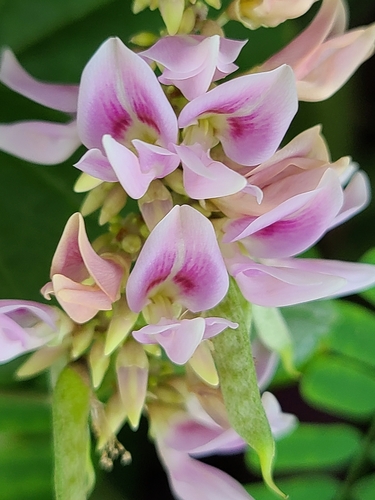
Amphicarpaea bracteata
(L.) Fernald
Hog Peanut, Wild peanut

(c) Suzanne Cadwell, some rights reserved (CC BY-NC)
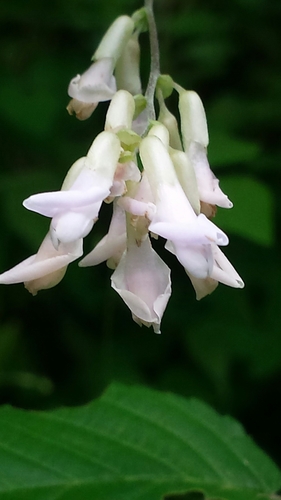
(c) Tom Norton, some rights reserved (CC BY), uploaded by Tom Norton

(c) Douglas Goldman, some rights reserved (CC BY-SA), uploaded by Douglas Goldman
What to Eat
Edible parts: Seeds, Root, Tuber
Two distinct types of seed are produced. Flowers borne close to the ground produce pods that bury themselves just below the soil surface, each containing a single seed up to 15mm in diameter. These can be harvested throughout winter and eaten raw or cooked; raw, they are sweet and delicious, tasting more like shelled garden beans than peanuts, making them a pleasant peanut substitute. Yields are low and locating the buried seeds takes some effort, but they are nutritious and enjoyable. Flowers higher on the plant produce pods that stay above ground. The seeds within these are much smaller and are usually cooked before eating, used in all the same ways as lentils and providing a good source of protein, though the overall yield is low and harvest is fiddly. The root can also be eaten after peeling and boiling. One source describes it as fleshy and nutritious, while another considers it too small to contribute meaningfully to the diet; plants in cultivation have tended to produce only small, stringy roots.
Where to Find It
It is a temperate plant. It grows in rich soils and moist woods.
Canada, Mexico, North America, USA,
How to Identify
A climber or vine. The leaves have oval leaflets. There are 2 kinds of flowers. The lower ones are underground and produce fruit. The pods develop underground. The seeds are brown.
How to Grow
Propagation: Pre-soak seed for 12 hours in warm water, then sow in spring in a semi-shaded position in a greenhouse. Germination usually occurs within a few weeks. Prick seedlings out into individual pots once large enough to handle, grow on in the greenhouse through their first winter, and plant out in late spring or early summer. Division is also possible, though the plant produces only a small taproot, making conventional division difficult. Many seeds are produced underground and can be harvested like tubers and potted up to produce new plants.
Medicinal Uses
An infusion of the root has been used to treat diarrhoea. The root has also been applied externally to rattlesnake bites. A poultice made from pulverized leaves, applied with a salve, has been used on swellings.
Other Uses
Nitrogen fixer.
Wikipedia
Source ↗Amphicarpaea bracteata (American hog peanut or hog-peanut or ground bean) is an annual to perennial vine in the legume family, native to woodland, thickets, and moist slopes in eastern North America. A. bracteata can be found in eastern North America, as well as further west into the Midwestern region, including Iowa, Indiana, Illinois, and Wisconsin.
Names & Synonyms
Dakota pea, Pea vine
References (17)
- Beckstrom-Sternberg, Stephen M., and James A. Duke. "The Foodplant Database." http://probe.nalusda.gov:8300/cgi-bin/browse/foodplantdb.(ACEDB version 4.0 - data version July 1994) (As Falcata comosa and Falcata pitcheri)
- Bircher, A. G. & Bircher, W. H., 2000, Encyclopedia of Fruit Trees and Edible Flowering Plants in Egypt and the Subtropics. AUC Press. p 25 (As Amphicarpaea monoica and as Amphicarpaea sarmentosa)
- Duke, J.A., 1992, Handbook of Edible Weeds. CRC Press. p 32
- Facciola, S., 1998, Cornucopia 2: a Source Book of Edible Plants. Kampong Publications, p 102 (As Amphicarpaea monoica)
- Hedrick, U.P., 1919, (Ed.), Sturtevant's edible plants of the world. p 51 (As Amphicarpaea monoica)
- ILDIS Legumes of the World http:www;ildis.org/Legume/Web
- Illustrated Flora of Central Texas p 626
- Kiple, K.F. & Ornelas, K.C., (eds), 2000, The Cambridge World History of Food. CUP p 1785
- Menninger, E.A., 1977, Edible Nuts of the World. Horticultural Books. Florida p 89 (As Amphicarpaea monoica)
- Plants for a Future database, The Field, Penpol, Lostwithiel, Cornwall, PL22 0NG, UK. http://www.scs.leeds.ac.uk/pfaf/ (Also as Amphicarpaea pitcheri)
- Rhodora 35:276. 1933
- Saunders, C.F., 1948, Edible and Useful Wild Plants. Dover. New York. p 61 (As Amphicarpaea monoica)
- Toupal, R. S. & Hollenback, K., 2009, An Ethnobotany of Indiana Dunes National Lakeshore: Plant Uses of the Ojibwa People. Bureau of Applied research in Anthropology. University of Arizona
- Tozer, F., 2007, The Uses of Wild Plants. Green Man Publishing. p 28
- Turner, N. J. et al, 2011, Edible and Tended Wild Plants, Traditional Ecological Knowledge and Agroecology. Critical Reviews in Plant Sciences, 30:198-225
- USDA, ARS, National Genetic Resources Program. Germplasm Resources Information Network - (GRIN). [Online Database] National Germplasm Resources Laboratory, Beltsville, Maryland. Available: www.ars-grin.gov/cgi-bin/npgs/html/econ.pl (10 April 2000)
- World Checklist of Useful Plant Species 2020. Royal Botanic Gardens, Kew