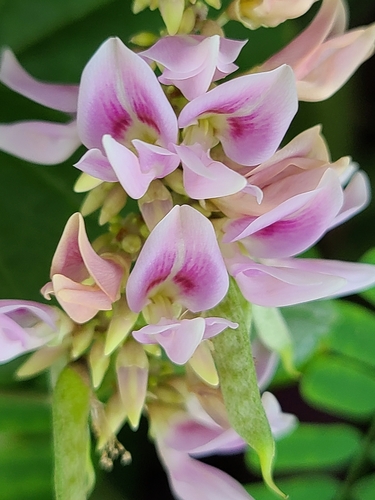
Pentaclethra macrophylla
Benth.
Oil Bean Tree, Owala oil

(c) Scamperdale, some rights reserved (CC BY-NC)

(c) Scamperdale, some rights reserved (CC BY-NC)

(c) Scamperdale, some rights reserved (CC BY-NC)
What to Eat
Edible parts: Seeds, Seeds - oil
The seeds can be boiled or roasted, or ground into a flour for bread-making. The pods are 40–50cm long and 5–10cm wide, each containing 6–10 flat, glossy brown seeds up to 7cm in length. The seeds are fermented to make 'ugba': they are first boiled for 3–12 hours, after which the seed coat is removed. Once the cotyledons have cooled to room temperature, they are sliced into pieces roughly 4–5cm × 1–2mm and washed with water. These slices are then boiled for a further 1–2 hours, cooled, soaked in water for 10 hours, and drained in a basket lined with banana leaves. The drained slices are wrapped in blanched banana leaves or leaves of Mallotus oppositifolius and incubated at ambient temperature for 4–6 days when intended as a snack or side dish, or for 7–10 days when used as a soup condiment. The fermentation is proteolytic, occurring under alkaline conditions and driven primarily by Bacillus subtilis, with other Bacillus species and occasional bacterial contaminants also involved. The seeds contain 30–36% edible oil, used to produce 'owala-oil' or 'owala-butter' for cooking. The ash of the seedpods is used as a salt substitute.
Known Hazards
Where to Find It
A tropical plant. It grows in tropical Africa. It grows from sea level to 500 m altitude. It needs temperatures above 18°C. An average temperature of 25°C and a rainfall between 1,500-2,000 mm per year is best. It is best on a well-drained soil but can tolerate waterlogging. It can grow in acid soils. It can grow in arid places.
Africa, Angola, Benin, Cameroon, Central Africa, Central African Republic, CAR, Congo DR, Congo R, Côte d'Ivoire, Equatorial-Guinea, Gabon, Gambia, Ghana, Guinea, Guinée, Guinea-Bissau, Ivory Coast, Liberia, Niger, Nigeria, Sahel, Sao Tome and Principe, Senegal, Sierra Leone, Sudan, Togo, West Africa,
How to Identify
A large tree. It grows to 6-30 m high. The crown is spreading. The leaves are twice divided. There are 12-20 pairs of secondary leaflets. The flowers are in groups 30 cm long in the axils of leaves or at the ends of branches. The fruit are long pods. They can be 40-60 cm long and 5-10 cm wide. There are 5-8 oval, flat seeds. These are 4-7 cm long by 2-3 cm wide. They are purplish brown.
Nutrition Score: 66/100
| Part | Moisture | kJ | kcal | Protein | Vit A | Vit C | Iron | Zinc |
|---|---|---|---|---|---|---|---|---|
| Seeds dry | 6.2 | 2332 | 558 | 22.6 | — | — | 16 | — |
How to Grow
It grows best in areas where the mean annual temperature is within the range 24 - 30°c, but can tolerate 18 - 34°c. It prefers a mean annual rainfall in the range 1,800 - 2,200mm, tolerating 1,000 - 2,700mm. Succeeds in full sun and in light shade. Prefers a deep, moderately fertile medium soil. Tolerant of some water-logging. Prefers a pH in the range 4.5 - 5.5, but tolerates 4 - 6.5. Seedling trees can reach a height of 1.5 metres by the end of their first year. The trees start to produce beans from their tenth year and will continue to bear regularly. After about 2-years growth in the forest, the trees become relatively fire resistant and resprout readily when lopped. Trees coppice well and often produce watershoots around their base. There are conflicting reports on whether or not this tree has a symbiotic relationship with certain soil bacteria, so it is unclear as to whether this tree fixes atmospheric nitrogen.
Propagation: Seed is best sown as soon as ripe, as viability is short. Storage at 15°C can extend longevity by around three months. Scarifying the seed and soaking it in warm water for 24 hours before sowing improves germination rate and speed — approximately 87% of treated seed germinates within 14–16 days. Adult trees can be air layered. Cuttings from juvenile plants can be rooted but generally require rooting hormone.
Medicinal Uses
Leaf, stem bark, seed, and fruit pulp extracts possess anti-inflammatory and anthelmintic activity, and are used to treat gonorrhoea, convulsions, and pain. Crushed seeds are taken to induce abortion. Leaf and stem decoctions are taken for diarrhoea. A lotion made from the bark is applied as a wash on sores. Ripe fruits are applied externally to promote wound healing. The root bark is used as a laxative, administered as an enema against dysentery, and applied as a liniment to relieve itch. An infusion of the bark is used as an abortifacient.
Other Uses
Farmers retain this tree on farmland because its open crown allows enough light through to avoid suppressing crops grown beneath it, making it well suited to agroforestry systems and home gardens, particularly in south-east Nigeria. The tree produces a heavy leaf fall useful as mulch. The seeds contain 30–36% oil used in soap and candle production. Dried pods serve as fuel, and the ash of burned pods is used as a mordant. The decorative seeds are fashioned into beads for necklaces and rosaries. The reddish-brown heartwood is hard with interlocked grain and can be difficult to work, but when available in suitable sizes is used for turnery, wheelwrighting, fencing, railway sleepers, and general carpentry — traditionally also for pestles and mortars. The wood is used as firewood and for charcoal production. Pentaclethra macrophylla nodulates and fixes atmospheric nitrogen.
Wikipedia
Source ↗Pentaclethra macrophylla, also known as the African oil bean, tree is a large size tree with long bipinnate compound leaves that is endemic to West and Central Africa. It is within the family Fabaceae. Seeds of the species are prepared and fermented to make Ugba, a soup condiment in Nigeria.
Production
Trees from cuttings can produce seed after 4 years. Harvesting pods can occur throughout the year but is a difficult task. In Liberia the seeds are produced from December to March. In Central African Republic plants have been recorded flowering in March and April.
Other Information
It is popular in Nigeria. The nuts are commonly eaten. They are sold in local markets.
Notes
The oil from the seeds is used for cooking and lamps. It contains an alkaloid paucine. Also as Mimosaceae.
Names & Synonyms
Afo, An-fal, Apara, Arvore-das-mares, Ataa, Atawa, Atta Bean, Bemba, Benguele, Bgangban, Biague, Bobala, Bowala, Bubala, Cheboe, Chebartueh, Cherbou, Congo acacia, Coquenguer, Djogtu, Ebaye, Ebe, Essiri, Fa-wuli, Faa, Fakha, Fawei, Gbaih, Gbau, Gbeka Gbeuse, Kombolo, Kweh Lubala, Leca-mgbi, Marrone, Mbala, Mbalaka, Mpkah, Mubala, N'tantass, Nganzi, Ngasi, Okpagha, Opachalo, Otchalda, Otshakula, Ovala, Pao-di-godre, Puaye, Sindjam-djane, Uaua, Ugba, Ukana, Ukelede, Ukpaka
References (49)
- Akinola, R., et al, 2020, A Review of Indigenous Food Crops in Africa and the Implications for more Sustainable and Healthy Food Systems. Sustainability 2020, 12, 3493;
- Akoroda M.O., 1990, Ethnobotany of Telfairia occidentalis (Cucurbitaceae) among Igbos of Nigeria. Economic Botany. 44(1) pp 29-39
- Awodoyin, R.O., Olubode, O.S., Ogbu, J.U., Balogun, R.B., Nwawuisi, J.U. and Orji, K.O., 2015, Indigenous Fruit Trees of Tropical Africa: Status, Opportunity for Development and Biodiversity Management. Agricultural Sciences, 6, 31-41
- Billong Fils, P. E., et al, 2020, Ethnobotanical survey of wild edible plants used by Baka people in southeastern Cameroon. Journal or Ethnobiology and Ethnomedicine. 16:64 p 9
- Burkill, H. M., 1985, The useful plants of west tropical Africa, Vol. 3. Kew.
- Burkill, I.H., 1966, A Dictionary of the Economic Products of the Malay Peninsula. Ministry of Agriculture and Cooperatives, Kuala Lumpur, Malaysia. Vol 2 (I-Z) p 1718
- Busson, 1965,
- Codjia, J. T. C., et al, 2003, Diversity and local valorisation of vegetal edible products in Benin. Cahiers Agricultures 12:1-12
- Dalziel, J. M., 1937, The Useful plants of west tropical Africa. Crown Agents for the Colonies London.
- Danforth, R.M., & Boren, P.D., 1997, Congo Native fruits. Twenty-five of the best. Privately published. p 67
- Fongnzossie Fedoung, E., et al, 2014, Density and Natural Regeneration Potential of Selected Non-timber Forest Products Species in the Semi-deciduous Rainforest of Southeastern Cameroon. African Study Monographs, Suppl. 49:69-90.
- Fungo, R., et al, 2015, Nutrients and bioactive compounds content of Baillonella toxisperma, Trichoscypha abut and Pentaclethra macrophylla from Cameroon. Food Science & Nutrition 2015; 3(4):292-301
- Gallois, S., et al, 2020, Methodological priorities in assessing wild edible plant knowledge and use – a case study among the Baka in Cameroon.
- Grivetti, L. E., 1980, Agricultural development: present and potential role of edible wild plants. Part 2: Sub-Saharan Africa, Report to the Department of State Agency for International Development. p 32
- Hawthorne, W.& Marshall, C., 2013, Nimba Western Area Iron Ore Concentrator Mining Project Environmental and Social Impact Assessment. AcelorMittel Liberia. p 500
- Hedrick, U.P., 1919, (Ed.), Sturtevant's edible plants of the world. p 470
- Hwang, L. C., et al, 2020, Traditional Botanical Uses of Non-Timber Forest Products (NTFP) in Seven Counties in Liberia. ACS Symposium Series; American Chemical Society: Washington, DC, 2020.
- ILDIS Legumes of the World http:www:ildis.org/Legume/Web
- Jardin, C., 1970, List of Foods Used In Africa, FAO Nutrition Information Document Series No 2.p 27
- Jusu, A. & Cuni-Sanchez, A., 2017, Priority indigenous fruit trees in the African rainforest zone: insights from Sierra Leone. Genet Resour Crop Evol (2017) 64:745–760
- Kiple, K.F. & Ornelas, K.C., (eds), 2000, The Cambridge World History of Food. CUP p 1824
- Kuhnlein, H. V., et al, 2009, Indigenous Peoples' food systems. FAO Rome p 261
- Latham, P & Mbuta, A., 2017, Useful Plants of Central Province, Democratic Republic of Congo. Volume 2. Salvation Army p 94
- liberianfaunaflora.org Plant Atlas
- Liengola, I. B., 2001, A contribution to the study of native edible plants by the Turumbu and Lokele of the Tshopo District, Province Orientale, D. R. Congo. Syst. Geogr. Pl. 71:687-698
- Manvell, A., 2011, Use of Non-Timber Forest Products around Sapo National Park, Liberia (Report B) p 16
- Menninger, E.A., 1977, Edible Nuts of the World. Horticultural Books. Florida p 98
- Meregini, O. A., 2005, Some endangered plants producing edible fruits and seeds in Southeastern Nigeria. Fruits, Vol. 60 pp 211-220
- Mosango, M., Szafranski, F., 1985, Plantes sauvages à fruits comestibles dans les environs de Kisangani (Zaïre). In: Journal d'agriculture traditionnelle et de botanique appliquée, 32e année, pp. 177-190
- Moutsambote, J., 1996, Vegetation forestiere et plantes alimentaires de la region de la Sangha. Chp. 11 of Bien Manger et Bien Vivre. ORSTOM p 119
- Nkeoua, G. & Boundzanga, G. C., 1999, Donnees sur les produits forestieres non ligneux en Republique du Congo. FAO. p 33
- Oboh, G., 2007. Pentaclethra macrophylla Benth. [Internet] Record from Protabase. van der Vossen, H.A.M. & Mkamilo, G.S. (Editors). PROTA (Plant Resources of Tropical Africa), Wageningen, Netherlands. < http://database.prota.org/search.htm>. Accessed 20 October 200919 October 2009.
- Obizoba, I. C. & Atu, L. N., 1993, Production and chemical evaluation of some food condiments of Nigeria. Plant Foods for Human Nutrition. 44:249-254
- Okafor, J. C., 1978, Development of Forest Tree crops for Food Supplies in Nigeria. Forest Ecology and Management 1:235-247
- Oteng-Amoako, A. A. (Ed.), 2006, 100 Tropical African Timber Trees from Ghana. Forestry Research Institute of Ghana. p 206
- PAGEZY,
- Peters, C. R., O'Brien, E. M., and Drummond, R.B., 1992, Edible Wild plants of Sub-saharan Africa. Kew. p 130
- Royal Botanic Gardens, Kew (1999). Survey of Economic Plants for Arid and Semi-Arid Lands (SEPASAL) database. Published on the Internet; http://www.rbgkew.org.uk/ceb/sepasal/internet [Accessed 28th April 2011]
- Savill, P. S. & Fox, J. E. D., Trees of Sierra Leone. p 178
- Terashima, H., et al, 1992, Ethnobotany of the Lega in the Tropical Rainforest of Eastern Zaire (Congo): Part Two, Zone de Walikale, African Study Monographs, Suppl. 19:1-60
- Terashima, H., & Ichikawa, M., 2003, A comparative ethnobotany of the Mbuti and Efe hunter-gatherers in the Ituri Forest, Democratic Republic of Congo. African Study Monographs, 24 (1, 2): 1-168, March 2003
- Termote, C., et al, 2011, Eating from the wild: Turumbu, Mbole and Bali traditional knowledge of non-cultivated edible plants, District Tshopo, DRCongo, Gen Resourc Crop Evol. 58:585-618
- Terra, G.J.A., 1973, Tropical Vegetables. Communication 54e Royal Tropical Institute, Amsterdam, p 65
- Ubom, R. M., 2010, Ethnobotany and Diversity Conservatioon in the Niger Delta, Nigeria. International Journal of Botany. 6(3): 310-322
- Udo, E. S., et al, 2009, Life-form and Density of Valuable Non-timber Plants in Ukpom Community Forest, Akwa Ibom State, Nigeria. African Research Review 3(3) p 7
- Vivien, J. & Faure, J.J., 1985, Abres des forets dense d'Afrique Centrale. Agence de Cooperation Culturelle et Technique. Paris. p 296
- Vivien, J., & Faure, J.J., 1996, Fruitiers Sauvages d'Afrique. Especes du Cameroun. CTA p 205
- www.worldagroforestrycentre.org/treedb/
- Zapfack, L., et al, 2001, Ethnobotanical Survey of the Takamanda Forest Reserve. Consultancy Report PROFA, Cameroon. p 25