Pergularia daemia
(Forskkal) Chiov.
Trellis vine
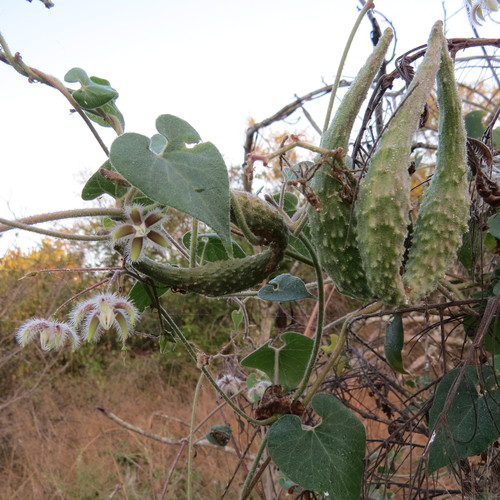
(c) Phil White, some rights reserved (CC BY-NC), uploaded by Phil White

(c) Riana Fourie, some rights reserved (CC BY-NC)

(c) Riana Fourie, some rights reserved (CC BY-NC)
What to Eat
Edible parts: Leaves, Shoots, Stems, Flowers, Roots, Tubers, Vegetable, Fruit
Young hollow stems are cooked as a vegetable. Young leaves are cooked and eaten or added to soup as a potherb. Flower buds are used as a vegetable. Starchy roots are eaten. Small fruit are finely chopped and cooked as a vegetable.
Known Hazards
Where to Find It
A tropical plant. It grows in the scrub near the coast and in damp savannah and on the edges of forests. In southern Africa it grows from sea level to 1,200 m above sea level. It can grow in arid places. It can grow in coastal sands.
Afghanistan, Africa, Arabia, Asia, Bangladesh, Benin, Botswana, Burkina Faso, Cameroon, Central Africa, Chad, Côte d'Ivoire, East Africa, Egypt, Eswatini, Ethiopia, Gambia, Ghana, Guinea, Guinée, Guinea-Bissau, India, Ivory Coast, Kenya, Liberia, Malaysia, Mali, Middle East, Mozambique, Myanmar, Namibia, Niger, Nigeria, North Africa, Oman, Pakistan, Rwanda, Sahel, Saudi Arabia, SE Asia, Senegal, Socotra, South Africa, Southern Africa, Sri Lanka, Sudan, Swaziland, Tanzania, Togo, Uganda, West Africa, Yemen, Zambia,
How to Identify
A climber. It has milky sap. It has fine hairs. It grows up to 6 m high. The leaves are opposite. They have stalks 7 cm long. The leaf blades are heart shaped at the base. They are 10 cm long and 10 cm wide. The lobes at the base are rounded. The flowers are in loose irregular clusters at the sides of the plant. There are 2-30 flowers that hang down. The flowers are green or pink and bell shaped. There are long white woolly hairs along the edge. The flowers open at sundown. The fruit are 5-8 cm long by 1-2 cm wide. They taper to a short curved tip.
How to Grow
Plants can be grown by seed or cuttings.
Medicinal Uses
Pergularia daemia is a popular traditional medicine in Africa where numerous uses have been reported for all parts of the plant throughout its distribution area. In India it is extensively employed in treating the diseases of children. Modern research has shown the presence of a wide range of medically active compounds, especially glycosides. The plant is also toxic causing an immediate and sustained rise of carotid blood pressure when taken in excess. Complex effects on the respiratory system and intestinal movements are also present combined with a generally cardiotoxic effect upon the heart with marked depression of both auricles and ventricles, resulting in ventricular fibrillation and ultimate stoppage of the heart in diastole. Therefore any use of the plant should only be carried out under the guidance of a skilled practitioner. The glycosides have been shown to have a strong action on uterus contraction. A methanolic extract of the aerial parts has shown significant activity against Herpes simplex virus, influenza virus, rhinovirus, poliovirus and several other viruses. A leaf extract showed moderate antioxidant activity in vitro. An ethanolic extract of the aerial parts of the plant at an oral dose of 200 mg/kg exhibited a significant protective effect on the liver by lowering different blood serum levels. The extracts showed no signs of toxicity up to a dose level of 2000 mg/kg. An extract of aerial parts demonstrated significant anti-inflammatory, antipyretic and analgesic activities. The leaves and young stems are considered aperitive, anthelmintic, expectorant, emetic and emmenagogue. Taken as infusions or decoctions, they are used to treat liver problems, fainting, diarrhoea, dysentery, colic, rheumatism, painful joints and limbs, cramps in the legs, malaria, appendicitis, amenorrhoea, venereal diseases and tachycardia arising from overexertion or fright. An enema of a leaf infusion is given to facilitate child-birth, as it stimulates muscle contraction and also arterial blood pressure. The crushed leaves, combined with Capsicum peppers, are given as an enema to treat tetanus. The crushed leaves, or sometimes the crushed young fruits, are applied externally to boils, abscesses, subcutaneous worm infections and eczema. The latex is applied to sore eyes and aching teeth, is used as a liniment to treat rheumatism, asthma and oedema, and to combat abscesses and snakebites and remove thorns from the skin. An infusion of the roots is taken against stomach-ache, colic and cough, and as an abortifacient. The roots may also simply be chewed to treat cough. A root decoction is taken to treat venereal diseases, arthritis, muscular pain, asthma and rheumatism. Powder from roasted roots or leaves is applied to wounds.
Other Uses
The stems yield a strong fibre, which is used in many places for making rope and fishing lines. The fibre is said to resist fire longer than other species. Pergularia daemia is a deep-rooted shrub traditionally preserved in fields in the semi-arid zones of Mali for its soil-improving properties. In a field test the grain weight, the head weight and the plant length of pearl millet (Pennisetum glaucum) showed significant increase in the vicinity of the shrub.
Wikipedia
Source ↗Pergularia daemia, the trellis-vine, is a hispid, perennial vine in the family Asclepiadaceae, with an extensive range in the Old World tropics and subtropics. It has been used traditionally to treat a number of ailments. It is sometimes called atufa.
Notes
The leaves contain 5.6 mg/100 g of Vitamin C. Also put in the family Asclepiadaceae.
Names & Synonyms
Amaradudheli, Chagul bati, Dhudhilota, Dudhilata, Dushtupa tige, Erico, Etse-hreg, Fujani, Furana, Gurtichettu, Hacher, Hala koritige, Jittupaku, Juttapala teega, Juttuve balli, Jutuk, ka-Riaria, Karial, Korroda, Kutitany, Leshwe, Likotapeni, Mausi arxa, Mausi sag, Mothuhu, Mousi, Murahari, Nagaladudhi, Nandamani, Nhocane, Okuru, Phala kantaka, Pijee, Sagovani, Silai, Talayarana balli, Thalika, Trotu, Ujani, Umkotapeni, Utaran, Utarni, Utranajutuka, Uttaravaruni, Utthamani, Uturdi, Veliparatti, Veliparutti, Yugma
References (43)
- Achigan-Dako, E, et al (Eds), 2009, Catalogue of Traditional Vegetables in Benin. International Foundation for Science.
- Ambasta, S.P. (Ed.), 2000, The Useful Plants of India. CSIR India. p 440
- Ara, R. I. T., 2015, Leafy Vegetables in Bangladesh. Photon eBooks. p 126
- Asfaw, Z. and Tadesse, M., 2001, Prospects for Sustainable Use and Development of Wild Food Plants in Ethiopia. Economic Botany, Vol. 55, No. 1, pp. 47-62
- Avouhou, H. T., et al, 2012, Ethnobotanical Factors Influencing the Use and Management of Wild Edible Plants in Agricultural Environments in Benin. Ethnobotany Research & Applications Vol 10:571-592
- Batawila, K., et al, 2007, Diversite et gestion des legumes de cueillete au Togo. African Journal of Food, Agriculture, Nutrition and Development 7( 3& 4): 64
- Burkill, H. M., 1985, The useful plants of west tropical Africa, Vol. 1. Kew.
- Dalziel, J. M., 1937, The Useful plants of west tropical Africa. Crown Agents for the Colonies London.
- Dansi, A., et al, 2008, Traditional leafy vegetables and their use in the Benin Republic. Genet Resour Crop Evol (2008) 55:1239–1256
- Facciola, S., 1998, Cornucopia 2: a Source Book of Edible Plants. Kampong Publications, p 32
- Famine foods
- Flyman, M. V. & Afolayan, A. J., 2006, A Survey of plants used as wild vegetables in four districts of Botswana. Ecology of Food and Nutrition, 45:405-415
- Fowler, D. G., 2007, Zambian Plants: Their Vernacular Names and Uses. Kew. p 76
- Fox, F. W. & Young, M. E. N., 1982, Food from the Veld. Delta Books. p 112
- Goyder, D. J., 2006, A Revision of the Genus Pergularia L. (Apocynaceae: Asclepiadoideae) Kew Bulletin, Vol. 61, No. 2, pp 245-256
- Grivetii, 1979,
- Grivetti, L. E., 1980, Agricultural development: present and potential role of edible wild plants. Part 2: Sub-Saharan Africa, Report to the Department of State Agency for International Development. p 75
- Grubben, G. J. H. and Denton, O. A. (eds), 2004, Plant Resources of Tropical Africa 2. Vegetables. PROTA, Wageningen, Netherlands. p 564
- Jardin, C., 1970, List of Foods Used In Africa, FAO Nutrition Information Document Series No 2.p 93
- Kidane, B., et al, 2014, Wild and semi-wild leafy vegetables used by the Maale and Ari ethnic communities in southern Ethiopia. Genetic Resour Crop Evol. Springer. p 8
- Long, C., 2005, Swaziland's Flora - siSwati names and Uses http://www.sntc.org.sz/flora/
- Lulekal, E., et al, 2011, Wild edible plants in Ethiopia: a review on their potential to combat food insecurity. Afrika Focus - Vol. 24, No 2. pp 71-121
- Marandi, R. R. & Britto, S. J., 2015, Medicinal Properties of Edible Weeds of Crop Fields and Wild plants Eaten by Oraon Tribals of Latehar District, Jharkhand. International Journal of Life Science and Pharma Research. Vo. 5. (2) April 2015
- Martin, F.W. & Ruberte, R.M., 1979, Edible Leaves of the Tropics. Antillian College Press, Mayaguez, Puerto Rico. p 178 (Also as Pergularia extensa)
- Masters, T., 2021, Traditional food plants of the upper Aswa River catchment of northern Uganda—a cultural crossroads. Journal of Ethnobiology and Ethnomedicine (2021) 17:24
- Matlhare, T., et al, Vegetables in Botswana. p 21 Bioversity website.
- Molla, A., Ethiopian Plant Names. http://www.ethiopic.com/aplants.htm
- Mutie, F. M., et al, 2023, Important Medicinal and Food Taxa (Orders and Families) in Kenya, Based on Three Quantitative Approaches. Plants 2023, 12, 1145
- Okigbo, B.N., Vegetables in Tropical Africa, in Opena, R.T. & Kyomo, M.L., 1990, Vegetable Research and development in SADCC countries. Asian Vegetable Research and development Centre. Taiwan. p 38
- Peters, C. R., O'Brien, E. M., and Drummond, R.B., 1992, Edible Wild plants of Sub-saharan Africa. Kew. p 65
- Reddy, K.R., 1989, Additional Notes on the Wild Edible Plants of India. J. Econ. Tax. Bot. Vol. 13 No. 1 pp 125-127
- Royal Botanic Gardens, Kew (1999). Survey of Economic Plants for Arid and Semi-Arid Lands (SEPASAL) database. Published on the Internet; http://www.rbgkew.org.uk/ceb/sepasal/internet [Accessed 4th April 2011]
- Result. Sci. Miss. Stefan.-Paoli Somal. Ital. 1:115. 1916
- RILEY & BROKENSHA.
- Ruiters-Welcome, A. K., 2019, Food plants of southern Africa. Ph.D. thesis. Univ. of Johannesburg p 26
- Setiya, A. V., et al, 2016, Exploration and documentation of some wild edible plants used by the aboriginals from Gadchiroli District (M.S.) India. International Advanced Research Journal in Science, Engineering and Technology. 3(7)
- Sinha, R. & Lakra, V., 2007, Edible weeds of tribals in Jharkhand, Orissa and West Bengal. Indian Journal of Traditional Knowledge 6(1) January 2007 pp 217-222 (As Pergularia extensa)
- Swaziland's Flora Database http://www.sntc.org.sz/flora
- Termote, C., et al, 2014, Assessing the potential of wild foods to reduce the cost of a nutritionally adequate diet: An example from eastern Baringo District, Kenya. Food and Nutrition Bulletin, vol. 35, no. 4
- Van Damme, P et al, 1922, Plant Uses by the Topnaar of the Kuiseb Valley Namib Desert. Afrika Focus Vol. 8(3-4):223-252
- van Wyk, B-E., 2011, The potential of South African plants in the development of new food and beverage products. South African Journal of Botany 77 (2011) 857–868
- Welcome, A. K. & Van Wyk, B.-E., 2019, An inventory and analysis of the food plants of southern Africa. South African Journal of Botany 122 (2019) 136–179
- World Checklist of Useful Plant Species 2020. Royal Botanic Gardens, Kew


