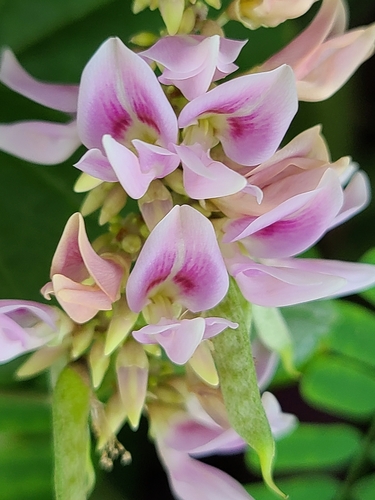
Phaseolus acutifolius
A. Gray
Tepary bean

(c) Alex Abair, some rights reserved (CC BY), uploaded by Alex Abair

(c) Alex Abair, some rights reserved (CC BY), uploaded by Alex Abair

(c) Michael Schmidt, some rights reserved (CC BY-NC-SA)
What to Eat
Edible parts: Seeds, Vegetable, Leaves
Mature dried seeds are the primary food use — they are made into soups, ground into flour, fried, parched, or processed into meal for commercial use. Tepary beans have a strong flavour and odour and are considered less palatable than common beans. Seedpods measure 40–100mm long, 5–13mm wide, and 4–8mm thick, containing 2–9 seeds that are 4–10mm long, 4–7mm wide, and 2–5mm thick. Stored dry seeds become very hard and require long cooking times. White-seeded cultivars have a more permeable seedcoat than black-seeded ones, resulting in shorter cooking times. Young green seedpods are occasionally eaten. Seeds can be sprouted and eaten cooked or added to salads. In parts of Africa, the leaves are also eaten, though they are tougher than those of common bean and need longer cooking. The wideleaf tepary bean (var. latifolius) produces edible mature seeds once properly prepared. Raw or undercooked seeds are toxic due to lectins and other anti-nutritive compounds including trypsin inhibitors and phytates; thorough boiling destroys these substances and makes the beans safe. Sprouts from wild beans should not be eaten raw, as they may retain harmful levels of these compounds. When boiled, wideleaf tepary beans are comparable in flavour, texture, and aroma to cultivated beans. They were traditionally eaten by Native American peoples of the southwestern United States, and domestication of the species dates back more than 2,000 years to the Tehuacan Valley of Mexico. Tepary beans are highly drought-tolerant and suited to desert conditions, capable of producing a crop in as little as two months during hot summers following seasonal rains. Harvest generally falls in early to mid-autumn. Immature pods are dull green; mature pods turn brown, brittle, and often hairy, splitting open and scattering seeds when ripe — careful handling during collection is needed. Because pods ripen over several weeks, the harvest area should be checked frequently. Beans that have already been shed can often still be gathered from the ground, though they can be difficult to spot. Once collected, the beans require little processing; winnowing is straightforward, making them a reliable and nutritious food source.
Known Hazards
Where to Find It
A tropical and subtropical plant. It can grow in hot dry regions. They do not do well in humid weather. It grows between 50 and 1920 m altitude. It requires an annual rainfall of 250-300 mm. It needs well drained soils. It needs a pH between 6.7-7.1. It can grow in arid places. It grows in the Sonoran Desert. It suits hardiness zones 8-11.
Africa, Algeria, Australia, Botswana, Central Africa, Central America*, Congo, Costa Rica, Côte d'Ivoire, Cuba, East Africa, El Salvador, Eswatini, Ethiopia, Gambia, Guatemala, Iraq, Israel, Ivory Coast, Kenya, Lesotho, Madagascar, Malawi, Mali, Mediterranean, Mexico*, Middle East, Morocco, North Africa, North America, Senegal, South Africa, Southern Africa, Sudan, Swaziland, Uganda, USA, West Africa, West Indies,
How to Identify
A twining or sprawling bean plant. It is an annual herb. It grows 45-100 cm high and spreads 30-60 cm wide. The leaves are compound. They have 3-5 narrow, pointed, sword shaped leaflets. The primary leaves do no have stalks. The flowers are white or yellow on short stalks. The fruit are oblong seed pods. These are slightly hairy and green but dry to a straw colour. There are 2-10 seeds per pod. These are normally flat.
Nutrition Score: 55/100
| Part | Moisture | kJ | kcal | Protein | Vit A | Vit C | Iron | Zinc |
|---|---|---|---|---|---|---|---|---|
| Seeds dry | 8.6 | 1476 | 353 | 19.3 | — | — | — | — |
How to Grow
Phaseolus acutifolius is a plant mainly of the drier subtropics. However, it can also be cultivated in warmer regions of the temperate zone so long as there is a sufficiently long growing season to ripen the crops in autumn. It can also be grown in tropical areas at elevations up to 1,900 metres so long as the climate is not excessively wet. It prefers a mean annual temperature within the range 20 - 30°c, but can tolerate 8 - 38°c It cannot be grown in areas where night temperatures fall below 8°c. It prefers a mean annual rainfall of 600 - 1,000mm, tolerating 300 - 1,700mm. Excessive rainfall may create vegetative growth at the expense of seed yield. The plant can withstand heat and a dry atmosphere, though only very few varieties are suited for the wet tropics. Requires a sunny position. Succeeds in most soils that are well-drained. Succeeds in poor, shallow soils. Established plants are rather drought resistant.Prefers a pH in the range 6 - 7, but tolerates 5 - 8. The crop can be grown on residual soil moisture. Often cultivated for its edible seed, there are many cultivated forms with seeds considerably larger than the wild forms The seedpods of wild forms have pods that burst open explosively when ripe to expel the seeds, which are smaller than cultivated forms. The seedpods of cultivated forms remain closed when the seeds first ripen, making harvesting much simpler. The species is highly daylength sensitive, growmg under natural field conditions during the long days of summer and beginning to bloom in late summer when daylength has fallen to around 13 hours. Flowering occurs within 27 - 40 days from germination. First harvest may be taken in as little as 60 days in the tropics, though in cooler climates it can be up to 120 days from sowing. The seeds of many domesticated types of tepary bean are shattered less easily than those of wild types. Average yields of dry seed under dry conditions are reported to be 450 - 800 kg/ha and with irrigation 0.9-1.7 t/ha. In areas of poor rainfall, tepary bean has possibilities as a catch-crop where a rapid food supply is needed. This species has a symbiotic relationship with certain soil bacteria; these bacteria form nodules on the roots and fix atmospheric nitrogen. Some of this nitrogen is utilized by the growing plant but some can also be used by other plants growing nearby. Tepary beans are highly drought-tolerant and well adapted to desert conditions, capable of producing a crop in as little as two months during the hot summer following seasonal rains.
Propagation: Cultivated forms absorb water rapidly — in moist soil the seedcoat wrinkles within 5 minutes, and within 3 minutes when soaked in water, leading to quick and even germination. Germination rate increases with temperatures rising from 10 to 35°C. White-seeded types emerge faster than dark-seeded ones. Wild forms typically have a hard seedcoat and benefit from scarification before sowing. Pour a small amount of nearly boiling water over the seeds (taking care not to cook them), then soak in warm water for 12–24 hours. If the seeds have not swollen by then, carefully nick the seedcoat without damaging the embryo and soak for a further 12 hours before sowing. Note that domesticated types have no dormancy, which can be a disadvantage in humid regions where fallen seeds may germinate rapidly.
Medicinal Uses
None known
Other Uses
Tepary bean has occasionally been grown as a green manure, for example in the United States, and may also serve as a cover crop or intercrop in agroforestry systems. The plant is also chewed and held between the teeth as a traditional remedy for toothache.
Wikipedia
Source ↗Phaseolus acutifolius, also known as the tepary bean, is a legume native to the southwestern United States and Mexico and has been grown there by the native peoples since pre-Columbian times. It is more drought-resistant than the common bean (Phaseolus vulgaris) and is grown in desert and semi-desert conditions from Arizona through Mexico to Costa Rica. The water requirements are low. The crop will grow in areas where annual rainfall is less than 400 mm (16 in).
Production
Plants flower 27-40 days after germination. They ripen 60-80 days after germination. Yields of 200-950 kg per ha are achieved. Yields are high with good fertiliser use.
Other Information
It is a commercially cultivated vegetable.
Notes
There are about 20 Phaseolus species.
Names & Synonyms
Frijol tepari, Pavi, Pawi, Tepari, Xmayum, Yori mui, Yorimuni
References (29)
- Beckstrom-Sternberg, Stephen M., and James A. Duke. "The Foodplant Database." http://probe.nalusda.gov:8300/cgi-bin/browse/foodplantdb.(ACEDB version 4.0 - data version July 1994)
- Burkill, H. M., 1985, The useful plants of west tropical Africa, Vol. 3. Kew.
- Cobley, L.S. (rev. Steele, W.M.) 2nd Ed., 1976, An Introduction to the Botany of Tropical Crops. Longmans. p 90
- Cundall, P., (ed.), 2004, Gardening Australia: flora: the gardener's bible. ABC Books. p 1022
- Evans, A.M., 1979, Beans, in Simmonds N.W.,(ed), Crop Plant Evolution. Longmans. London. p 168
- Facciola, S., 1998, Cornucopia 2: a Source Book of Edible Plants. Kampong Publications, p 109
- FAO, 1993, Valor Nutritivo Y Usis en Alimantacion humana de Algunis Cultivos Autoctonos Subexplotados de Mesoamerica. FAO, Santiago, Chile. p 100
- Grubben, G. J. H. and Denton, O. A. (eds), 2004, Plant Resources of Tropical Africa 2. Vegetables. PROTA, Wageningen, Netherlands. p 564
- Hermandez Bermejo, J.E., and Leon, J. (Eds.), 1994, Neglected Crops. 1492 from a different perspective. FAO Plant Production and Protection Series No 26. FAO, Rome. p18, 52
- https://www.fireflyforest.com/flowers/category/edible-plants/ Edible Plants – Southeastern Arizona Wildflowers and Plants
- ILDIS Legumes of the World http:www:ildis.org/Legume/Web
- Jardin, C., 1970, List of Foods Used In Africa, FAO Nutrition Information Document Series No 2.p 27
- Kays, S. J., and Dias, J. C. S., 1995, Common Names of Commercially Cultivated Vegetables of the World in 15 languages. Economic Botany, Vol. 49, No. 2, pp. 115-152
- Kermath, B. M., et al, 2014, Food Plants in the Americas: A survey of the domesticated, cultivated and wild plants used for Human food in North, Central and South America and the Caribbean. On line draft. p 635
- Kiple, K.F. & Ornelas, K.C., (eds), 2000, The Cambridge World History of Food. CUP p 1729
- Macmillan, H.F. (Revised Barlow, H.S., et al) 1991, Tropical Planting and Gardening. Sixth edition. Malayan Nature Society. Kuala Lumpur. p 327
- Mapes, C. & Basurto, F., 2016, Biodiversity and Edible Plants of Mexico. Chapter 5 in R. Lira, et al. (eds.), Ethnobotany of Mexico, Ethnobiology, Springer. p 87
- Miguel, E., et al, 1989, A checklist of the cultivated plants of Cuba. Kulturpflanze 37. 1989, 211-357
- Moerman, D. F., 2010, Native American Ethnobotany. Timber Press. p 390
- Mogotsi, K.K., 2006. Phaseolus acutifolius A.Gray. [Internet] Record from Protabase. Brink, M. & Belay, G. (Editors). PROTA (Plant Resources of Tropical Africa), Wageningen, Netherlands. < http://database.prota.org/search.htm>. Accessed 21 October 200919 October 2009
- Purseglove, J.W., 1968, Tropical Crops Dicotyledons, Longmans. p 287
- Royal Botanic Gardens, Kew (1999). Survey of Economic Plants for Arid and Semi-Arid Lands (SEPASAL) database. Published on the Internet; http://www.rbgkew.org.uk/ceb/sepasal/internet [Accessed 29th April 2011]
- Self, M., 1999, Phoenix Seeds Catalogue p 3
- Smith, K., 1998. Growing Uncommon Fruits and Vegetables. New Holland. p 28
- Ulian, T., et al, 2020, Unlocking plant resources to support food security and promote sustainable agriculture. Plants, People, Planet. 2020;2:421–445.
- van Wyk, B., 2005, Food Plants of the World. An illustrated guide. Timber press. p 288
- Wiersema, J. H. & Leon, B., 2013, World Economic Plants. A Standard Reference CRC Press. 2nd Ed. p 514
- Williamson, J., 2005, Useful Plants of Malawi. 3rd. Edition. Mdadzi Book Trust. p 195
- Wilson, J.M. & Witcombe, J.R., Crops for Arid lands, in Wickens, G.E., Goodin, J.R., and Field, D.V.,(Eds.) 1985, Plants for Arid Lands. Unwin Hyman, London, p 41