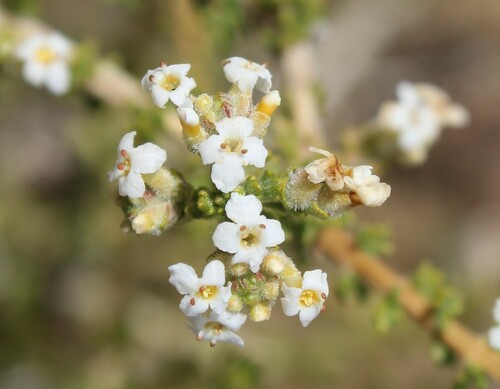
Phyla nodiflora
(L.) Greene
Frogfruit, Lippia
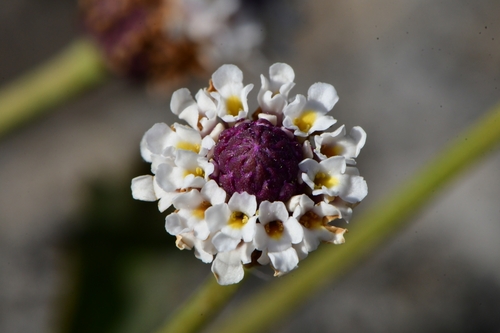
(c) Joey Santore, some rights reserved (CC BY-NC), uploaded by Joey Santore
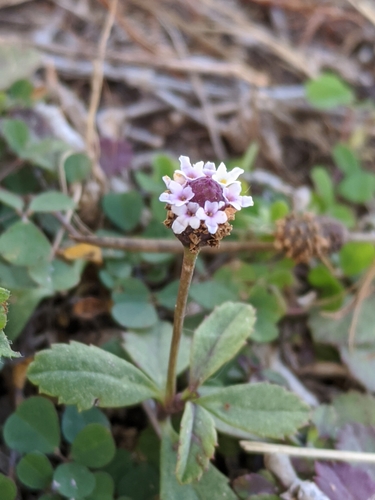
(c) Sue, some rights reserved (CC BY-NC), uploaded by Sue
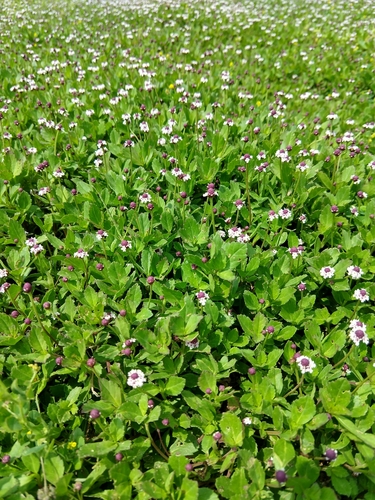
(c) Geoffrey Parks, some rights reserved (CC BY-NC), uploaded by Geoffrey Parks
What to Eat
Edible parts: Leaves - tea, Leaves
The fresh leaves are used as a tea substitute. The flavour is grassy and unremarkable.
Where to Find It
It grows in temperate places but will grow in the subtropics and in semi-arid places. It needs well drained soil. It needs to grow in full sun. It can stand heavy frosts. It also grows in regularly flooded areas and near ditches and ponds. In Zimbabwe it grows up to 1,300 m above sea level. It suits hardiness zones 9-10. In Sichuan and Yunnan.
Africa, Argentina, Asia, Australia, Bahamas, Bangladesh, Botswana, Brazil, British Indian Ocean Terr., BIOT, Burkina Faso, Cambodia, Central Africa, Central African Republic, CAR, Central America*, Chile, China, Cuba*, Dominican Republic, East Africa, East Timor, Eswatini, Ethiopia, Europe, Greece, Guinea, Guinée, Guinea-Bissau, Haiti, Hawaii, India, Indochina, Iraq, Italy, Jamaica*, Laos, Malawi, Maldives, Mediterranean, Mexico*, Middle East, Mozambique, North America, Pacific, Paraguay, Philippines, Puerto Rico, SE Asia, Somalia, South Africa, Southern Africa, South America*, Spain, Sri Lanka, St Helena, Sudan, Swaziland, Taiwan, Thailand, Tibet, Timor-Leste, Turkey, Türkiye, United Arab Emirates, UAE, Uruguay, USA, West Africa, West Indies*, Zambia, Zimbabwe,
How to Identify
A plant which forms a tight mat. It spreads by runners or stolons. It grows 3-15 cm high. These can be woody near the base. They produce many roots. It can spread 2-5 m wide. The leaves are small and opposite. The are oblong or sword shaped and narrow to a leaf stalk at the base. There can be some teeth near the end of the blade. The leaves can be smooth or covered with hairs. The flowers heads are round or oval and 1.25 cm across. They are on long flowering stalks. The flowers are pink and like clover flowers.
How to Grow
It can be grown by small cuttings.
Propagation: No specific information is available for this species. It is suggested to sow seed in a greenhouse in mid-spring. Prick seedlings into individual pots when large enough to handle and plant out in late spring or early summer. If growing as a perennial, do not plant out in the first spring; instead grow on in the greenhouse through the first winter and plant into permanent positions in late spring or early summer after the last expected frosts. Division can be carried out in spring.
Medicinal Uses
The plant is anodyne, antibacterial, deobstruent, diuretic, emmenagogue, parasiticide, and refrigerant, and is used in the treatment of hookworm. The juice of the plant is cooling and used to relieve fevers, coughs, and colds. The aroma of the plant, when inhaled directly, is also used to treat coughs and colds. The juice of the root is used to treat gastric troubles.
Other Uses
This plant makes a good ground cover for dry, sunny banks and has been used as a grass substitute for lawns in tropical areas, though it would probably not tolerate heavy traffic. It is suitable as a perennial groundcover for zone 2 firebreaks — the second zone out from a building in the US government's wildfire firebreak system — where low-growing plants provide little fuel.
Wikipedia
Source ↗Phyla nodiflora, commonly known as lippia, kurapia, turkey tangle frogfruit, capeweed, and frogfruit, is a species of flowering plant in the family Verbenaceae. It can be found in the tropics around the globe. It is often grown as an ornamental plant for ground cover, and is often present in yards or disturbed areas.
Other Information
It is sold in local markets in China.
Notes
There are 15 Phyla species. It has medicinal properties.
Names & Synonyms
Berbin al-jedie, Fan li zai, Hunigon difilaa, Matgrass, Turkey tangle
References (26)
- Ambasta, S.P. (Ed.), 2000, The Useful Plants of India. CSIR India. p 450
- Ara, R. I. T., 2015, Leafy Vegetables in Bangladesh. Photon eBooks. p 148 (As Lippia nodiflora)
- Blamey, M and Grey-Wilson, C., 2005, Wild flowers of the Mediterranean. A & C Black London. p 387
- Cowie, I, 2006, A Survey of Flora and vegetation of the proposed Jaco-Tutuala-Lore National Park. Timor-Lests (East Timor) www.territorystories.nt/gov.au p 55
- Cundall, P., (ed.), 2004, Gardening Australia: flora: the gardener's bible. ABC Books. p 1034
- Dashorst, G.R.M., and Jessop, J.P., 1998, Plants of the Adelaide Plains & Hills. Botanic Gardens of Adelaide and State Herbarium. p 122
- Hibbert, M., 2002, The Aussie Plant Finder 2002, Florilegium. p 232
- Hussey, B.M.J., Keighery, G.J., Cousens, R.D., Dodd, J., Lloyd, S.G., 1997, Western Weeds. A guide to the weeds of Western Australia. Plant Protection Society of Western Australia. p 228
- Karim, F. M. & Dakheel, A, J., 2006, Salt-tolerant plants of the United Arab Emirates. 2006. International Center for Biosaline Agriculture, Dubai, UAE. p 157
- Lamp, C & Collet F., 1989, Field Guide to Weeds in Australia. Inkata Press. p 211
- Li, D. et al, 2017, Ethnobotanical survey of herbal tea plants from the traditional markets in Chaoshan, China. Journal of Ethnopharmacology. 205 (2017) 195-206
- Macmillan, H.F. (Revised Barlow, H.S., et al), 1991, Tropical Planting and Gardening. Sixth edition. Malayan Nature Society. Kuala Lumpur. p 357
- Martin, F.W. & Ruberte, R.M., 1979, Edible Leaves of the Tropics. Antillian College Press, Mayaguez, Puerto Rico. p 80
- McMakin, P.D., 2000, Flowering Plants of Thailand. A Field Guide. White Lotus. p 103
- Molla, A., Ethiopian Plant Names. http://www.ethiopic.com/aplants.htm
- Molyneux, B. and Forrester, S., 1997, The Austraflora A-Z of Australian Plants. Reed. p 144
- Paczkowska, G . & Chapman, A.R., 2000, The Western Australian Flora. A Descriptive Calatogue. Western Australian Herbarium. p 566
- Pittonia 4:46. 1899
- Plants for a Future database, The Field, Penpol, Lostwithiel, Cornwall, PL22 0NG, UK. http://www.scs.leeds.ac.uk/pfaf/
- Plants of Haiti Smithsonian Institute http://botany.si.edu/antilles/West Indies
- Staples, G.W. and Herbst, D.R., 2005, A tropical Garden Flora. Bishop Museum Press, Honolulu, Hawaii. p 566 (Drawing)
- Sujanapal, P., & Sankaran, K. V., 2016, Common Plants of Maldives. FAO & Kerala FRI, p 203
- Swaziland's Flora Database http://www.sntc.org.sz/flora
- Terra, G.J.A., 1973, Tropical Vegetables. Communication 54e Royal Tropical Institute, Amsterdam, p 57
- Topp, J. M. W., 1988, An Annotated Check List of the Flora of Diego Garcia, British Ocean Territory. Atoll Research Bulletin No. 313
- World Checklist of Useful Plant Species 2020. Royal Botanic Gardens, Kew