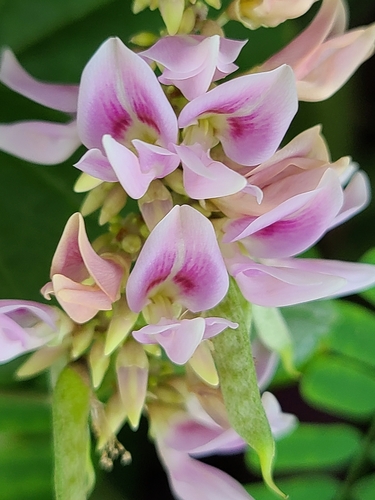
Physostigma mesoponticum
Taub.

Royal Botanic Gardens, Kew

Royal Botanic Gardens, Kew

Royal Botanic Gardens, Kew
What to Eat
Edible parts: Flowers
The flowers are eaten.
Where to Find It
A tropical plant. It grows in woodland and along rivers. It grows between 90-1,410 m altitude.
Africa, Angola, Central Africa, Congo, East Africa, Malawi, Mozambique, Southern Africa, Tanzania, Zambia,
How to Identify
A herb that keeps growing from year to year. It can be climbing or lie along the ground. It grows 1 m tall. It has a woody rootstock about 80 cm long. It usually flowers before the leaves appear. The leaflets are 3-9 cm long by 1-6 cm wide. They often have 2-3 lobes. There are hairs on both surfaces. The flowers are in groups at the ends of branches or in the axils of leaves. They are in groups 7-50 cm long. The flowers are purple and pink. The fruit is a pod 5-12 cm long by 6-10 mm wide. It is narrow and curved. There are 6-12 seeds. The pods have velvety hairs. The seeds are brown and 6-10 mm long by 4-6 mm wide.
Names & Synonyms
Ciluwe, Kawowo, Mulya-mfuma
References (5)
- Ber. Deutsch. Bot. Ges. 12:81. 1894
- Flora Zambesiaca. http://apps.kew.org/efloras
- Fowler, D. G., 2007, Zambian Plants: Their Vernacular Names and Uses. Kew. p 39
- Jardin, C., 1970, List of Foods Used In Africa, FAO Nutrition Information Document Series No 2.p 94
- Vickery, M.L. and Vickery, B., 1979, Plant Products of Tropical Africa, Macmillan. p 91 another species.