Anamirta cocculus
(L.) Wight et Arn
Levant berries, Fish berries

(c) Rejoice Gassah, some rights reserved (CC BY), uploaded by Rejoice Gassah
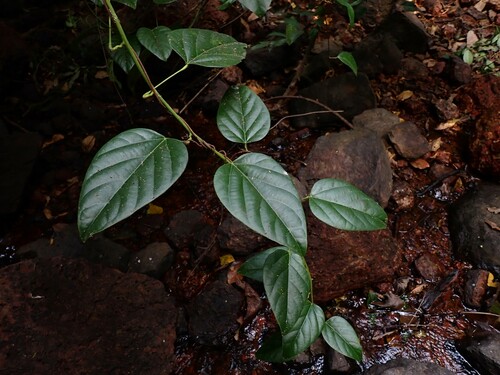
(c) Radha Veach, some rights reserved (CC BY-NC)
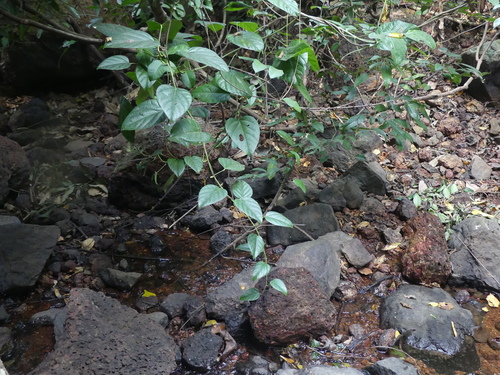
(c) Radha Veach, some rights reserved (CC BY-NC)
What to Eat
Edible parts: Fruit - flavouring, Vegetable, Caution, Poisonous
Its crushed seeds are an effective pediculicide (anti-lice) and are also traditionally used to stun fish or as a pesticide. In pharmacology, it is known as Cocculus Indicus. Although poisonous, hard multum is a preparation made from Cocculus Indicus, etc., once used (by 19th century brewers) to impart a more intoxicating quality ("giddiness") to beer than provided by the alcoholic content alone. Charles Dickens referred to those engaging in such practices as "brewers and beer-sellers of low degree,... who do not understand the wholesome policy of selling wholesome beverage." Although appearing in many homeopathic volumes and at least two brewers' guides, the use of such preparations was outlawed in England, during the mid-19th century, with fines of £500 for sale and £200 for use of the drug. The wood of the plant is used for fuel and carving.
Known Hazards
Where to Find It
A tropical plant. It grows on the edges of forests and on riverbanks, It can be on limestone or sandy soils. It grows up to 400 m above sea level. It occurs in the Western Ghats in India.
Andamans, Asia, Cambodia, East Timor, India, Indochina, Indonesia, Laos, Malaysia, Myanmar, New Guinea, Philippines, SE Asia, Sri Lanka, Thailand, Timor-Leste, Vietnam,
How to Identify
A strong climbing shrub. It can be 15-25 m tall. The stem can be 10 cm across. They twine to the left. The leaves are broadly oval and the leaf stalk can be 6-26 cm long. The flowers are small, yellowish-white and have a sweet scent. The fruit is a fleshy berry. They can be white, red or dark purple. The seeds are deeply cup shaped.
How to Grow
Plants can be grown from seeds.
Medicinal Uses
Poison berry is a very toxic plant and its medicinal use should only be carried out by competent practitioners. The plant has a wide range of traditional herbal uses and its fruits are officially listed in the Pharmacopoeias of various countries. The fruit, and especially the seed, contain picrotoxin, a very strong poison. Picrotoxin has been used intravenously as an antidote against poisoning by barbiturates and morphine. However, the safe therapeutic dose range is very narrow. Picrotoxin has also been used in very minute doses as a nervine tonic in schizophrenia and epilepsy and similar afflictions. The fruits contain about 1.5% picrotoxin, which is also known as cocculin. On a biochemical level, picrotoxin (or more precisely its active constituent, picrotoxinin) act as GABA (gamma-amino butyric acid) antagonists. It stimulates the central nervous system, particularly the medulla oblongata and respiratory centre. Administration of picrotoxin via the vertebral artery decreased sinus rate and increased circulating levels of vasopressin. On the other hand, infusion of picrotoxin into the internal carotid artery caused increases in sinus rate, blood pressure and plasma vasopressin. Picrotoxin can be used as a specific barbiturate poisoning antagonist, although its safety limits are very narrow. The fruits also contain a number of isoquinoline alkaloids, whilst the stem and roots contain only small amounts (about 0.1%) of alkaloids. In general, the alkaloids isolated have antibacterial, antimicrobial, and antifertility activities. An infusion of the roots is used to treat fevers, dyspepsia and menstrual problems. An extract of the stem is added to native wine and is drunk to make the blood strong. The leaves may be used as a poultice for headache, stomach-ache or delayed menstruation. The dried fruits constitute the drug known as 'cocculus' or 'cocculus indicus'. The fruit is used in very small doses to treat eruptive fevers, whilst the powdered fruit is used to treat acute barbiturate poisoning. Applied externally, the fruits and seeds are made into an ointment to treat skin diseases. The seeds are also applied to the scalp to kill head lice. The juice of the fruits is applied externally to ulcers and scabies. The fruits are an ingredient of many homeopathic formulations.
Other Uses
The bast-fibres are used for basketry rope and belt making. The poisonous fruit can be used as an insecticide.
Wikipedia
Source ↗Anamirta cocculus (Marathi: काकमारी) is a Southeast Asian and Indian climbing plant. It is the source of picrotoxin, a poisonous compound with stimulant properties. The plant is large-stemmed (up to 10 cm in diameter); the bark is "corky gray" with white wood. The "small, yellowish-white, sweet-scented" flowers vary between 6 and 10 millimeters across; the fruit produced is a drupe, "about 1 cm in diameter when dry".
Notes
It contains the poison picrotoxin.
Names & Synonyms
Day dong Cau, Kakamari, Oyod peron, Tuba biji
References (7)
- Ambasta S.P. (Ed.), 2000, The Useful Plants of India. CSIR India. p 38
- Cowie, I, 2006, A Survey of Flora and vegetation of the proposed Jaco-Tutuala-Lore National Park. Timor-Lests (East Timor) www.territorystories.nt/gov.au p 50
- Mot So Rau Dai an Duoc O Vietnam. Wild edible Vegetables. Ha Noi 1994, p 270
- Forman, L.L., 1984, Menispermaceae in Flora Malesiana Series 1 Vol 10 (2) p 166,
- Hedrick, U.P., 1919, (Ed.), Sturtevant's edible plants of the world. p 51 (As Anamirta paniculate)
- Prodr. fl. Ind. orient. 446. 1834
- Sukarya, D. G., (Ed.) 2013, 3,500 Plant Species of the Botanic Gardens of Indonesia. LIPI p 895


