Piper nigrum
L.
Pepper
(c) Nuno Veríssimo P., some rights reserved (CC BY-NC-SA), uploaded by Nuno Veríssimo P.

(c) Irfan Nurarifin, some rights reserved (CC BY-NC), uploaded by Irfan Nurarifin

(c) breki74, some rights reserved (CC BY-SA)
What to Eat
Edible parts: Seeds, Herb, Spice, Fruit
The pungent fruits — known as peppercorns — are dried and ground into black pepper, one of the world's most widely used condiments. The globose red fruits are 4–6mm in diameter and deliver a hot flavour. White pepper, which is milder, is made by removing the outer fruit coverings before drying. Unripe green fruits can be pickled in vinegar and used as a relish. An essential oil obtained from the seed is used as a flavouring in various foods.
Where to Find It
It is a tropical plant. It grows from sea level up to at least 1100 m altitude in equatorial places. It suits areas with a temperature between 24° and 26°C. It cannot tolerate frost. It likes high humidity and shade. It does best with a rainfall between 1200 and 2500 mm per year. It has been planted in commercial stands in a few coastal areas of Papua New Guinea. In the Cairns Botanical Gardens. It originally came from the tropics of India. It occurs in the Western Ghats in India. It suits hardiness zones 10-12.
Africa, Asia, Australia, Bangladesh, Bougainville, Brazil, Burkina Faso, Cambodia, Cameroon, Central Africa, Central America, China, Congo DR, Cook Islands, Costa Rica, Cuba, East Africa, East Timor, Ethiopia, Europe, Fiji, FSM, Guam, Guatemala, Guyana, Hawaii, Himalayas, India, Indochina, Indonesia, Laos, Madagascar, Malaysia, Myanmar, Northeastern India, Pacific, Pakistan, Papua New Guinea, PNG, Peru, Philippines, Pohnpei, Samoa, Sao Tome and Principe, SE Asia, Singapore, South America, Spain, Sri Lanka, Suriname, Thailand, Timor-Leste, USA, Vanuatu, Venezuela, Vietnam, Wallis and Futuna, West Africa, West Indies,
How to Identify
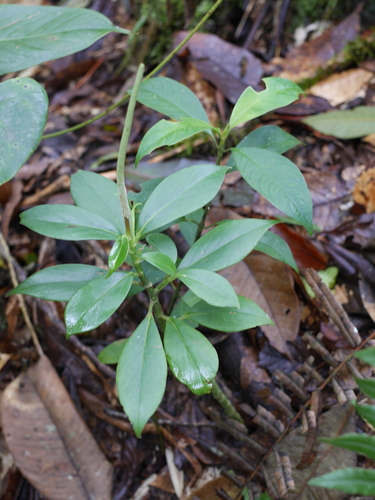
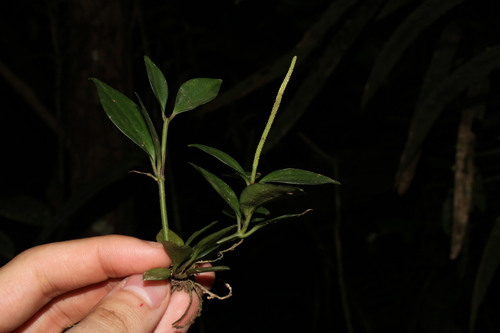
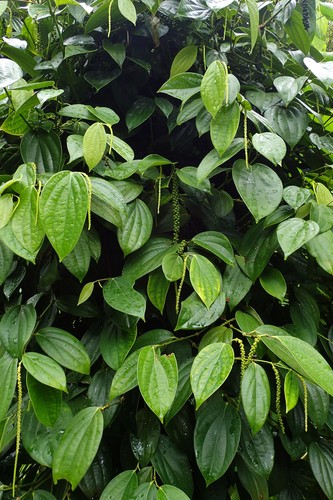
A climbing, green, leafy vine. It is woody. The nodes are enlarged. The plant has roots on the main stem which attach to tree trunks. The vines can be 8-10 m long. The leaf stalk is 1-2 cm long. The leaf blade is oval and 10-15 cm long by 5-9 cm wide. It is thick and leathery. The base is rounded and it tapers to a short tip. The flowers are usually of one sex but many flowers occur together. The spikes are opposite the leaves. The spikes are 3-3.5 cm long by 0.8 mm wide. They can be 10 cm long. It has clusters of berries on the side branches. The berries are red when ripe. They are 3-4 mm across.
Nutrition Score: 73/100
| Part | Moisture | kJ | kcal | Protein | Vit A | Vit C | Iron | Zinc |
|---|---|---|---|---|---|---|---|---|
| Seeds - white | 11.4 | 1238 | 296 | 10.4 | 0 | 21 | 14.3 | 1.1 |
| Seeds - black | 10.5 | 1067 | 255 | 11 | 19 | 21 | 28.9 | 1.4 |
How to Grow
A plant of the hot and humid lowland tropics, where it grows best at elevations up to 500 metres, but can be grown up to 2,000 metres. It grows best in areas where annual daytime temperatures are within the range 22 - 35°c, but can tolerate 10 - 40°c. It prefers a mean annual rainfall in the range 2,500 - 4,000mm, but tolerates 2,000 - 5,500mm. Grows best in sheltered positions in semi-shade. Prefers a neutral soil rich in organic matter. Prefers a pH in the range 6 - 7, tolerating 5 - 7.5. Level ground is most suitable for the production of pepper, prov ided there is no flooding, but it is often grown in rolling country or on hill slopes of varying steepness. The plant begins to bear in 3 - 4 years, can reach full production after 7 years and has an economic life of about 12 - 20 years. Optimum yields at low capital input are 6 tonnes per hectare of the unprocessed (green) peppers; 2 tonnes of the sundried (black) peppers; or 1.67 tonnes of the washed and dried (white) peppers. In gardens with higher inputs, yields may be 8 - 9 tonnes of green pepper in the first harvest and 12 - 20 tonnes in the sixth or seventh harvest. The root system can be 4 metres or more deep. Flowering Time: Mid Summer. Bloom Color: White/Near White. Spacing: 12-15 ft. (3.6-4.7 m).
Propagation: Propagate by seed or by cuttings — very easy. Use shoots of wood about 45cm long, taken from parts of the plant that have already flowered.
Medicinal Uses
Black pepper fruits contain an essential oil (comprising beta-bisabolene, camphene, beta-caryophyllene, and many other terpenes and sesquiterpenes), up to 9% alkaloids — particularly piperine, which accounts for the acrid taste — around 11% protein, and small amounts of minerals. The fruit is a pungent, aromatic, warming herb that lowers fever, acts as an antiseptic, and improves digestion. In Western and Ayurvedic medicine, black pepper is regarded as a stimulating expectorant; in Chinese medicine it is considered tranquilizing and anti-emetic. Used internally in Western herbalism, the seed treats indigestion and wind. In Chinese medicine it is a warming herb for stomach chills, food poisoning, cholera, dysentery, diarrhoea, and cold-induced vomiting. In Ayurvedic medicine it is applied externally to treat nasal congestion, sinusitis, epilepsy, and skin inflammations. The essential oil is antiseptic, antibacterial, and febrifuge, and has been used to relieve rheumatic pain and toothache.
Other Uses
An essential oil obtained from the fruits is used in perfumery to create oriental-type bouquets with spicy notes.
Wikipedia
Source ↗An evergreen climbing vine reaching 6 meters tall with a 1-meter spread, growing at a fast rate. Hardy to UK zone 10. Tolerates light sandy, medium loamy, and heavy clay soils with good drainage; adapts to mildly acidic through basic pH levels. Prefers moist conditions and semi-shaded environments but is intolerant of wind exposure.
Production
Berries dried with the skin give white pepper. Berries where the skin is soaked off produce black pepper. To do these they are soaked in water for a few days. Plants produce in the third year. They can continue producing for 20 years. Flowering normally follows rain. Fruit ripen after 3-4 months.
Other Information
In Papua New Guinea it is becoming of some importance as a cash crop but is little used locally as a spice. About 80,000 tons are produced each year worldwide. It is a cultivated food plant.
Notes
There are between 1000-2000 Piper species. They are mostly in the tropics.
Names & Synonyms
Black pepper, Bumawng-ru, Gol morich, Hapusha, Jaluk, Kajmurch, Kalamari, Kalamorich, Kalimirch, Kalomirich, Kapidi, Kare menasu, Konda miriyam, Kurumulaku, Lada hitam, Lada puteh, Lado ketek, Lado kobon, Maricha, Merica, Micha, Milagu, Mire, Miriyala tige, Morshaidi, Nallamulaku, Nga-yok-kaung, Paminta, Pappaa, Pedes, Pepe nero, Pfeffer, Phrik tai, Pimenta negra, Pimienta, Poivre, Priktai, Sayo-me, U-pinlong, Ushana, White pepper, Zwarte
References (70)
- Ambasta, S.P. (Ed.), 2000, The Useful Plants of India. CSIR India. p 460
- Balkrishna, A., et al, 2022, Indigenous Uses of Plants among Forest-dependent Communities of Seijosa, Arunachal Pradesh. International Journal of Economic Plants 2022, 9(1):064-080
- Bodkin, F., 1991, Encyclopedia Botanica. Cornstalk publishing, p 804
- Bremness, L., 1994, Herbs. Collins Eyewitness Handbooks. Harper Collins. p 283
- Brickell, C. (Ed.), 1999, The Royal Horticultural Society A-Z Encyclopedia of Garden Plants. Convent Garden Books. p 804
- Burkill, H. M., 1985, The useful plants of west tropical Africa, Vol. 4. Kew.
- Burkill, I.H., 1966, A Dictionary of the Economic Products of the Malay Peninsula. Ministry of Agriculture and Cooperatives, Kuala Lumpur, Malaysia. Vol 2 (I-Z) p 1776
- Chin, H. F., 1999, Malaysian Vegetables in Colour. Tropical Press. p 87
- Cobley, L.S. (rev. Steele, W.M.) 2nd Ed., 1976, An Introduction to the Botany of Tropical Crops. Longmans. p 236
- Cundall, P., (ed.), 2004, Gardening Australia: flora: the gardener's bible. ABC Books. p 1052
- Facciola, S., 1998, Cornucopia 2: a Source Book of Edible Plants. Kampong Publications, p 172
- Flowerdew, B., 2000, Complete Fruit Book. Kyle Cathie Ltd., London. p 163
- Fongnzossie Fedoung, E., et al, 2020, Wild edible plants and mushrooms of the Bamenda Highlands in Cameroon: ethnobotanical assessment and potentials for enhancing food security. Journal of Ethnobiology and Ethnomedicine 16:12
- French, B.R., 1986, Food Plants of Papua New Guinea, A Compendium. Asia Pacific Science Foundation p 375
- French, B.R., 2010, Food Plants of Solomon Islands. A Compendium. Food Plants International Inc. p 367
- Hedrick, U.P., 1919, (Ed.), Sturtevant's edible plants of the world. p 500
- Hemphill, I, 2002, Spice Notes. Macmillan. p 299
- Heywood, V.H., Brummitt, R.K., Culham, A., and Seberg, O., 2007, Flowering Plant Families of the World. Royal Botanical Gardens, Kew. p 256
- http://www.botanic-gardens-ljubljana.com/en/plants
- Hu, Shiu-ying, 2005, Food Plants of China. The Chinese University Press. p 333
- Tseng Yung-chien, Xia Nianhe, Gilbert, M.G., Piperaceae. Flora of China.
- Gouldstone, S., 1983, Growing your own Food-bearing Plants in Australia. Macmillan p 177
- Hibbert, M., 2002, The Aussie Plant Finder 2002, Florilegium. p 235
- Hutton, W., 1997, Tropical Herbs and Spices of Indonesia. Periplus. p 46
- Khan, A. H., et al, 2023, Traditional foraging for ecological transition? Wild food ethnobotany among three ethnic groups in the highlands of the eastern Hindukush, North Pakistan. Journal of Ethnobiology and Ethnomedicine 19:9
- Kiple, K.F. & Ornelas, K.C., (eds), 2000, The Cambridge World History of Food. CUP p 433, 1832
- Kybal, J., 1980, Herbs and Spices, A Hamlyn Colour Guide, Hamlyn Sydney p 156
- Latham, P., 2004, Useful Plants of Bas-Congo province. Salvation Army & DFID p 224
- Llamas, K.A., 2003, Tropical Flowering Plants. Timber Press. p 313
- Macmillan, H.F. (Revised Barlow, H.S., et al), 1991, Tropical Planting and Gardening. Sixth edition. Malayan Nature Society. Kuala Lumpur. p 383
- Medhi, P. & Borthakur, S. K., 2012, Phytoresources from North Cachur Hills of Assam -3: Edible plants sold at Hflong market. Indian Journal of Natural Products and Resources. 3(1) pp 84-109
- Mertz, O., Lykke, A. M., and Reenberg, A., 2001, Importance and Seasonality of Vegetable Consumption and Marketing in Burkina Faso. Economic Botany, 55(2):276-289
- Miguel, E., et al, 1989, A checklist of the cultivated plants of Cuba. Kulturpflanze 37. 1989, 211-357
- Moerman, D. F., 2010, Native American Ethnobotany. Timber Press. p 415
- Molla, A., Ethiopian Plant Names. http://www.ethiopic.com/aplants.htm
- Morton,
- Mulherin, J., 1994, Spices and natural flavourings. Tiger Books, London. p 75
- Murtem, G. & Chaudhrey, P., 2016, An ethnobotanical note on wild edible plants of Upper Eastern Himalaya, India. Brazilian Journal of Biological Sciences, 2016, v. 3, no. 5, p. 63-81
- Norrington, L., & Campbell, C., 2001, Tropical Food Gardens. Bloomings Books. p 71
- Ochse,
- Omawale, 1973, Guyana's edible plants. Guyana University, Georgetown p 63
- Owen, S., 1993, Indonesian Food and Cookery, INDIRA reprints. p 74
- Parham, B. E. V., 1972, Plants of Samoa. New Zealand Department of Scientific and Industrial Research. Information Series. No. 85 p 100
- Pham-Hoang Ho, 1999, An Illustrated Flora of Vietnam. Nha Xuat Ban Tre. p 292
- Phon, P., 2000, Plants used in Cambodia. © Pauline Dy Phon, Phnom Penh, Cambodia. p 502
- Purseglove, J.W., 1968, Tropical Crops Dicotyledons, Longmans. p 441
- Rajapaksha, U., 1998, Traditional Food Plants in Sri Lanka. HARTI, Sri Lanka. p 380
- Rao, M. L. S., et al, 2014, Indigenous Plant Foods which are commonly consumed by the tribal communities in Dumbriguda Area of Visakhapatnam District, Andhra Pradesh, India. Biolife. Vol 2, Issue 3
- Rashid, H. E., 1977, Geography of Bangladesh. Westview. p 280
- Sasi, R. & Rajendran, A., 2012, Diversity of Wild Fruits in Nilgiri Hills of the Southern Western Ghats - Ethnobotanical Aspects. IJABPT, 3(1) p 82-87
- Small, E., 2009, Top 100 Food Plants. The world's most important culinary crops. NRC Research Press. p 420
- Smith, A.C., 1981, Flora Vitiensis Nova, Lawaii, Kuai, Hawaii, Volume 2 p 59
- Solomon, C., 2001, Encyclopedia of Asian Food. New Holland. p 278
- Sp. pl. 1:28. 1753
- Staples, G.W. and Herbst, D.R., 2005, A tropical Garden Flora. Bishop Museum Press, Honolulu, Hawaii. p 457
- Sukarya, D. G., (Ed.) 2013, 3,500 Plant Species of the Botanic Gardens of Indonesia. LIPI p 955
- Sukenti, K., et al, 2016, Ethnobotanical study on local cuisine of the Sasak tribe in Lombok Island, Indonesia. Journal of Ethnic Foods. 3 (2016) 189-200 p 198
- Tyagi, R. K., et al, 2004, Conservation of Spices Germplasm in India. Indian J. Plant Genet. Resour. 17(3): 163-174
- Vael, L., 2015, Ethnobotanical study of the plant use in the natural landscape of two mestizo communities in the Ucayali region of the Peruvian Amazon. Universiteit Gent.
- van Wyk, B., 2005, Food Plants of the World. An illustrated guide. Timber press. p 298
- Vickery, M.L. and Vickery, B., 1979, Plant Products of Tropical Africa, Macmillan. p 88
- Vivien, J., & Faure, J.J., 1996, Fruitiers Sauvages d'Afrique. Especes du Cameroun. CTA p 262
- Walter, A. & Lebot, V., 2007, Gardens of Oceania. ACIAR Monograph No. 122. CD-ROM minor species p 18
- Wiersema, J. H. & Leon, B., 2013, World Economic Plants. A Standard Reference CRC Press. 2nd Ed. p 535
- Williams, C.N., Chew, W.Y., and Rajaratnam, J.A., 1989, Tree and Field Crops of the Wetter Regions of the Tropics. Longman, p 218
- Woodward, P., 2000, Asian Herbs and Vegetables. Hyland House. p
- World Checklist of Useful Plant Species 2020. Royal Botanic Gardens, Kew
- Zeven, A.C., 1979, Black Pepper, in Simmonds, N.W., (ed), Crop Plant Evolution. Longmans. London. p 234
- Zeven, A. C. & de West, J. M. J., 1982, Dictionary of cultivated plants and their regions of diversity. Wageningen. p 78
- Zuchowski W., 2007, Tropical Plants of Costa Rica. A Zona Tropical Publication, Comstock Publishing. p 191