Pipturus argenteus
(Forst.f.) Wedd.
Native Mulberry, White Nettle

(c) Greg Tasney, some rights reserved (CC BY-SA), uploaded by Greg Tasney

(c) Greg Tasney, some rights reserved (CC BY-SA), uploaded by Greg Tasney
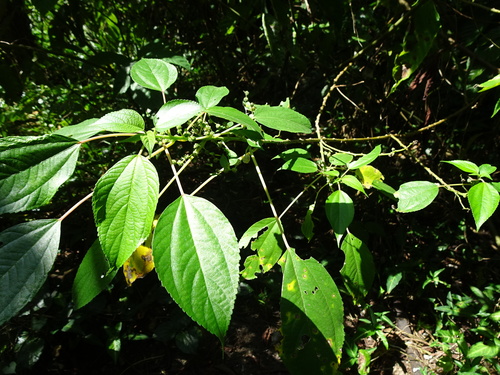
(c) Steven Chong, some rights reserved (CC BY-NC), uploaded by Steven Chong
What to Eat
Edible parts: Fruit, Bark, Leaves, Seeds
The fruit, bark, leaves, and seeds are all edible, with the fruit and leaves being a minor edible resource especially enjoyed by children.
Where to Find It
A tropical plant but can grow in temperate areas. It is damaged by frost. It grows in forests and areas that are not too dry. It occurs from the coast up to at least 1800 m altitude in Papua New Guinea. It is frequent on rocky cliffs near the sea in the Pacific.
American Samoa, Australia, British Indian Ocean Terr., BIOT, Cambodia, Caroline Islands, Cook Islands, East Timor, Fiji, French Polynesia, Guam, Indochina, Indonesia, Kiribati, Malaysia, Mariana Islands, Marshall Islands, Micronesia, Myanmar, Niue, Pacific, Palau, Papua New Guinea, PNG, Philippines, Rotuma, Samoa, SE Asia, Seychelles, Solomon Islands, Sri Lanka, Thailand, Timor-Leste, Tokelau, Tonga, Tuvalu, Vanuatu, Yap,
How to Identify
A small tree up to 4-8 m tall. It spreads 4-8 m across. Young growth is silvery grey. The bark is grey to brown and has rows of small swellings along it. The leaves are alternate. They are 7-26 cm long by 2-8 cm wide. The leaves are green on top and woolly white underneath. They have fine to coarse teeth along the edges. They have a long stalk and 3 prominent veins. Plants are separately male and female. The flowers are greenish white. They occur in small round clusters. These form spikes about 6 cm long. They grow on older wood. The fruit are fleshy and like a mulberry. They are 0.6 cm across and white. They have many small seeds. They are edible.
How to Grow
Found in subtropical and tropical areas. A dioecious species, both male and female forms need to be grown if seed is required.
Propagation: Seed - best sown as soon as it is ripe. Cuttings strike readily.
Medicinal Uses
The crushed leaves are used to treat coughs. The leaf sap is drunk to relieve a fever or headache. The leaves are boiled with the leaves of Alstonia spectabilis and the liquid drunk to treat coughs, colds and flu. A leaf infusion is drunk to stimulate child birth. Applied externally, the leaves, or the juice from heated leaves, are used for poulticing boils, burns and herpes sores. The crushed leaves are rubbed on the body to relieve a fever or headache and to ease centipede bites. Fresh young leaves, combined with those of Hibiscus tiliaceus, are squeezed in little water and the liquid is drunk immediately to treat urticaria and itchiness caused by the ingestion of the raw leaves of taro (Colocasia esculenta). The rainwater collected from the leaves is used to treat asthma. The sap from the scraped inner bark is given to women in labour in order to facilitate delivery. Combined with the leaves of Rubus glomeratus, it is eaten daily to soothe a bad cough. Sap from the bark is taken as a gargle to treat thrush. The bark is crushed in cold water and drunk twice daily to treat dysentery. The grated bark, mixed an equal amount of grated dry coconut flesh, has been eaten in order to induce sterility. Externally, the scraped bark is applied to spear wounds, to facilitate removal of the spear head. New roots are cut and the sap is allowed to drip into a container. Some of this is drunk and the rest is used to wash the body of a patient with malaria fever or a severe cough. The root sap is also used on wounds and to soothe toothache. The scraped roots are chewed with betel nuts (Areca spp.) and lime, then the red mixture is rubbed into centipede bites. The plant has been shown to be weakly antibacterial.
Other Uses
A fibre obtained from the bark is used traditionally for making nets, string and rope. It is of fine texture and great strength, but difficult to prepare. The fibre is used to make the traditional red, shaggy, rug-like mats of Samoa. A brown dye can be obtained from the bark. The flowers are used to scent coconut oil. The wood is used in house construction, for fishhooks, rollers for hauling etc. The wood is used for fuel. Not a particularly ornamental plant, but it is a good, fast growing screening plant. It is an important pioneer species that is commonly found in abandoned gardens.
Wikipedia
Source ↗Pipturus argenteus, known as false stinger, native mulberry, white mulberry, white nettle, amahatyan (Chamorro), and ghasooso (Carolinian), is a small tree native to tropical Asia, northern and eastern Australia and the Pacific. Unlike many members of its family, this species does not sting. It has been used traditionally for medicine and for making rope.
Other Information
A minor edible leaf and fruit. It is eaten especially by children.
Notes
There are about (13) 40-50 Pipturus species. They grow in the tropics.
Names & Synonyms
Adomai, Amahadyan, Armwe, Aroma, Fau soga, Guruwel, Koomeroo-Koomeroo, Odoma, Oleiulakerasus, Ormuh, Soga, Te aroma, Tupwpwunuwen, Yaroma
References (44)
- Anon., 2003, Native Plants for the Fitzroy basin. Society for Growing Australian Plants Inc. (Rockhampton Branch) p 71
- Bodkin, F., 1991, Encyclopedia Botanica. Cornstalk publishing, p 804
- Borrell, O.W., 1989, An Annotated Checklist of the Flora of Kairiru Island, New Guinea. Marcellin College, Victoria Australia. p 142
- Bourke, R. M., Altitudinal limits of 230 economic crop species in Papua New Guinea. Terra australis 32.
- Bradacs, G., 2008, Ethnobotanical Survey and Biological Screening of Medicinal Plants from Vanuatu. PhD thesis Frankurt University. p 101
- Cabalion, P. and Morat, P., 1983, Introduction le vegetation, la flore et aux noms vernaculaires de l'ile de Pentcoste (Vanuatu), In: Journal d'agriculture traditionnelle et de botanique appliquee JATBA Vol. 30, 3-4
- Calvert, G., 2010, The Burdekin Delta Tree Guide. Lower Burdekin Landcare Association., Inc., Ayr p 139
- Clarke, W.C. & Thaman, R.R., 1993, Agroforestry in the Pacific Islands: Systems for sustainability. United Nations University Press. New York. p 254
- Cooper W & Cooper W T, 1994, Fruits of the Rain Forest. RD Press p 224
- Cowie, I, 2006, A Survey of Flora and vegetation of the proposed Jaco-Tutuala-Lore National Park. Timor-Lests (East Timor) www.territorystories.nt/gov.au p 55
- Cribb, A.B. & J.W., 1976, Wild Food in Australia, Fontana. p 49
- Elliot, W.R., & Jones, D.L., 1997, Encyclopedia of Australian Plants suitable for cultivation. Vol 7. Lothian. p 333 (Drawing)
- Facciola, S., 1998, Cornucopia 2: a Source Book of Edible Plants. Kampong Publications, p 243
- Ferns, Useful Tropical Plants
- Flora of Australia, Volume 3, Hamamelidales to Casuarinales, Australian Government Publishing Service, Canberra (1989) p 88
- French, B.R., 1986, Food Plants of Papua New Guinea, A Compendium. Asia Pacific Science Foundation p 90
- Gillaumin, R., 1954, Les Plantes utiles des Nouvelles-Hebrides (fin et complement) In: Journal d'agriculture tropicale et de botanique appliquee Vol. 1, No. 10-12 pp 453-460
- Haslam, S., 2004, Noosa's Native Plants. Noosa Integrated Catchment Assn. Inc. p 350
- Hedrick, U.P., 1919, (Ed.), Sturtevant's edible plants of the world. p 501 (As Pipturus velutinus)
- Hibbert, M., 2002, The Aussie Plant Finder 2002, Florilegium. p 235
- Jackes, B.R., 2001, Plants of the Tropics. Rainforest to Heath. An Identification Guide. James Cook University. p 85
- Jones D, L, 1986, Ornamental Rainforest Plants in Australia, Reed Books, p 340
- Lazarides, M. & Hince, B., 1993, Handbook of Economic Plants of Australia, CSIRO. p 191
- Leiper, G & Houser, J., Mutooroo. Plant Use by Australian Aboriginal People. Assembly press, Queensland.
- Low, T., 1991, Wild Food Plants of Australia. Australian Nature FieldGuide, Angus & Robertson. p 71
- Melzer, R. & Plumb, J., 2011, Plants of Capricornia. Belgamba, Rockhampton. p 354
- Morley, B.D., & Toelken, H.R., (Eds), 1983, Flowering Plants in Australia. Rigby. p 64 and p 65 (As Pipturus propinquus)
- Pearson, S. & A., 1992, Rainforest Plants of Eastern Australia. Kangaroo Press p 162
- Peekel, P.G., 1984, (Translation E.E.Henty), Flora of the Bismarck Archipelago for Naturalists, Division of Botany, Lae, PNG. p 153, 154
- Powell, J.M., Ethnobotany. In Paijmans, K., 1976, New Guinea Vegetation. Australian National University Press. p 111
- Reis, S. V. and Lipp, F. L., 1982, New Plant Sources for Drugs and Foods from the New York Botanical Garden herbarium. Harvard. p 47
- Smith, A.C., 1981, Flora Vitiensis Nova, Lawaii, Kuai, Hawaii, Volume 2 p 243
- Thaman, R. R., 1987, Plants of Kiribati: A listing and analysis of vernacular names. Atoll Research Bulletin No. 296
- Thaman, R. R, 2016, The flora of Tuvalu. Atoll Research Bulletin No. 611. Smithsonian Institute p 118
- Topp, J. M. W., 1988, An Annotated Check List of the Flora of Diego Garcia, British Ocean Territory. Atoll Research Bulletin No. 313
- Townsend, K., 1994, Across the Top. Gardening with Australian Plants in the tropics. Society for Growing Australian Plants, Townsville Branch Inc. p 314
- Walter, A. & Sam C., 2002, Fruits of Oceania. ACIAR Monograph No. 85. Canberra. p 222, 281
- Whistler, W. A., 1988, Ethnobotany of Tokelau: The Plants, Their Tokelau Names, and Their Uses. Economic Botany 42(2): 155-176
- Whistler, W.A., 2004, Rainforest Trees of Samoa. Isle Botanica Honolulu, Hawaii. p 179
- Williams, J.B., Harden, G.J., and McDonald, W.J.F., 1984, Trees and shrubs in rainforests of New South Wales and Southern Queensland. Univ. of New England, Armidale. p 70
- World Checklist of Useful Plant Species 2020. Royal Botanic Gardens, Kew
- www.manoa.hawaii.edu/botany/plants of micronesia
- Yallakool Reserve Plant List July 1, 2009 Off internet
- Yuncker, T.G., 1959, Plants of Tonga, Bernice P. Bishop Museum, Hawaii, Bulletin 220. p 103


