Pithecellobium dulce
(Roxb.) Benth.
Madras thorn fruit
(c) Francisco Farriols Sarabia, some rights reserved (CC BY), uploaded by Francisco Farriols Sarabia

(c) Jean-Philippe BASUYAUX, some rights reserved (CC BY-NC), uploaded by Jean-Philippe BASUYAUX
(c) Francisco Farriols Sarabia, some rights reserved (CC BY), uploaded by Francisco Farriols Sarabia
What to Eat
Edible parts: Fruit, Aril, Pods, Seeds, Seeds - oil
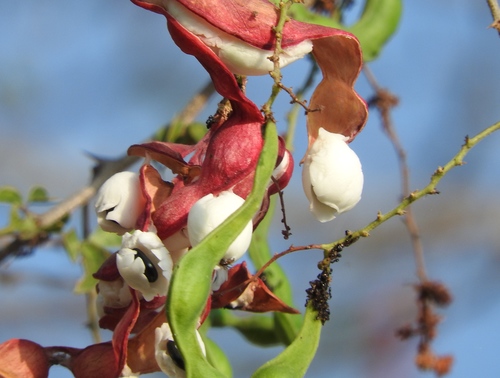
The pods contain sweet, pulpy flesh surrounding the seed, which can be eaten raw, boiled, or made into a refreshing drink reminiscent of lemonade. The pods are 10cm long by 1.5cm wide; when mature they split open along the lower suture, exposing the edible pulp. Because of this, the fruit does not keep long and should be consumed within a few days. The seeds themselves can be eaten raw or used in curries. An oil is also obtained from the seed.
Known Hazards
Where to Find It
A tropical plant. It is native to C and S America. Common and widely distributed throughout the Philippines. It suits dry coastal areas probably below 800 m altitude. It can grow in low and medium altitudes and in wet and dry areas. It needs light. It can tolerate drought. It can grow on a range of soil types. Well drained soils are best but it can grow in clay soils. In Nepal it grows to about 700 m altitude. It can grow in arid places. In XTBG Yunnan.
Africa, Andaman Is., Andes, Antilles, Argentina, Asia, Bahamas, Bangladesh, Belize, Benin, Bhutan, Bolivia, Brazil, Burkina Faso, Burundi, Cambodia, Cape Verde, Caribbean, Central Africa, Central America, Chad, China, Colombia, Comoros, Congo DR, Costa Rica, Cuba, Djibouti, Dominican Republic, East Africa, East Timor, Ecuador, Egypt, El Salvador, Eritrea, Ethiopia, Fiji, French Guiana, Gambia, Ghana, Guam, Guatemala, Guianas, Guyana, Haiti, Hawaii, Himalayas, Honduras, India, Indochina, Indonesia, Iran, Iraq, Jamaica, Kenya, Laos, Madagascar, Malawi, Malaysia, Maldives, Mariana Islands, Mauritania, Mauritius, Mexico*, Middle East, Mozambique, Myanmar, Nepal, New Caledonia, Nicaragua, Nigeria, North Africa, North America, Northeastern India, Oman, Pacific, Pakistan, Panama, Papua New Guinea, PNG, Paraguay, Peru, Philippines, Puerto Rico, Reunion, Saudi Arabia, SE Asia, Senegal, Seychelles, Sierra Leone, Somalia, Southern Africa, South America, Sri Lanka, Sudan, Suriname, Taiwan, Tanzania, Thailand, Timor-Leste, Togo, Trinidad-Tobago, Uganda, United Arab Emirates, UAE, Uruguay, USA, Venezuela, Vietnam, Virgin Islands, West Africa, West Indies, Yemen, Zimbabwe,
How to Identify
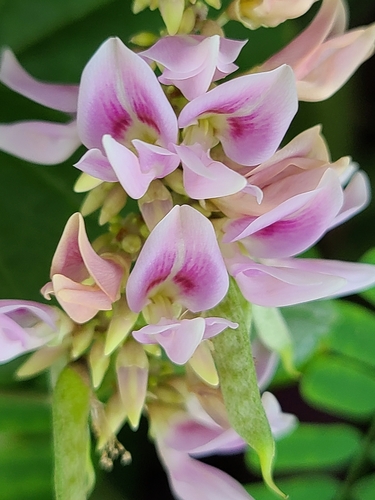
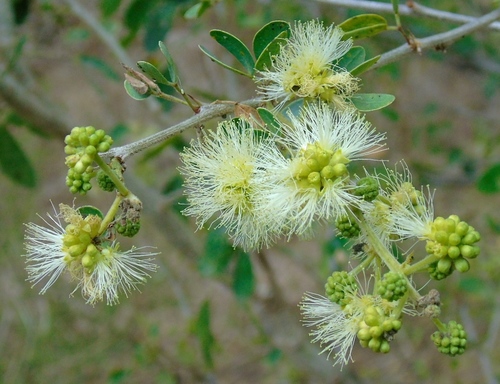
A shrub or small tree. It grows up to 10 m tall but can be 15-25 m tall. The trunk can be 50-60 cm across. There are many branches. The branches are spiny. These are in pairs and are 4-10 mm long. The young leaves are usually reddish. The leaves are twice compound with four leaflets. There is a small spine between the leaflets. The flowers are greenish white in rounded dense heads about 1 cm across. The pods are often twisted spirally. They are 10 to 18 cm long and red when ripe. They are about 1 cm wide and contain 6 to 8 black shiny seeds surrounded by a white to red fleshy aril or pulp. The seeds are flattened and 9 mm long by 7 mm wide and 2 mm thick.
Nutrition Score: 52/100
| Part | Moisture | kJ | kcal | Protein | Vit A | Vit C | Iron | Zinc |
|---|---|---|---|---|---|---|---|---|
| Fruit-aril dried | 7.8 | 326 | 78 | 3 | 25 | 133 | 0.5 | — |
How to Grow
Plants can be grown by seeds or cuttings. Seed takes 2 weeks to germinate. Plants can be grown by marcottage, grafting or budding. Pods can be harvested by climbing or using long bamboo poles.
Propagation: Seed germinates in about 2 weeks with no pre-treatment required — soaking actually reduces germination rates and heating kills the seeds. Best sown into nursery beds and planted out at around 12 months old. Plants often self-seed, especially around the margins of cultivated fields. Cuttings, air layering, and grafting are also viable propagation methods.
Medicinal Uses
The leaves can be applied as a plaster to relieve pain including that from venereal sores, and may relieve convulsions. A paste of the leaves applied externally treats muscular swellings caused by inflammation. Leaves taken with salt can cure indigestion, and in larger doses can induce abortion. The root bark is an effective remedy for diarrhoea and dysentery. The bark is used as a febrifuge. Fruit pulp is taken orally to stop blood flow in haemoptysis. Seed juice inhaled through the nostrils relieves chest congestion, and pulverised seeds are ingested for internal ulcers.
Other Uses
Because it can fix atmospheric nitrogen and grow on degraded or denuded land, this tree is used to afforest and reclaim poor soils. Regularly trimmed, it forms a dense, nearly impenetrable thorny hedge useful for excluding livestock and creating shelterbelts; for hedging, seeds may be sown in two rows at 15 x 30cm spacing and commonly mixed with species such as Ziziphus mauritiana and Azadirachta indica. A yellow dye is obtained from the bark, which contains about 25% tannin; the seeds and leaves are also sources of tannin. Wounded bark exudes a mucilaginous reddish-brown gum similar to gum arabic. The seeds contain about 20% of a greenish oil which, after refining and bleaching, can be used in soap making and as a substitute for kapok and groundnut seed oils. The heartwood is yellowish or reddish-brown with a yellowish sapwood. The wood is strong, durable, soft and flexible, moderately hard, and usually straight-grained, weighing about 590 kg/m³; it saws easily and finishes to a smooth surface, though it is not of very high quality. The tree coppices vigorously but has low calorific value (5,177–5,600 kcal/kg) and burns smokily, making it a poor-quality fuel; in parts of India it is nonetheless planted and harvested to fuel brick kilns.
Wikipedia
Source ↗Pithecellobium dulce, commonly known as Manila tamarind, Madras thorn, monkeypod tree or camachile, is a species of flowering plant in the pea family, Fabaceae, that is native to the Pacific Coast and adjacent highlands of Mexico, Central America, and northern South America. It is also sometimes known as monkeypod, but that name is also used for several other plants, including Samanea saman. It is an introduced species and extensively naturalized in the Caribbean and Florida, as well as the Philippines and Guam via the Manila galleons. It has also been introduced to Cambodia, Thailand and South Asia, It is considered an invasive species in Hawaii.
Production
Plants grow quickly. They can be pruned and cut back to regrow. Seedling trees take 5-8 years to start producing fruit. Pods ripen 2-3 months after flowering. Pods split open at maturity so they need to be eaten within a few days.
Other Information
The pulp is eaten especially by children. It is sold in markets in the Philippines. It is cultivated.
Notes
Also as Mimosaceae.
Names & Synonyms
Ai-terak, Aluwa, Am'pul tuk, Ampil tuk, Asam belanda, Asam koranji, Asam kranji, Asam tjina, Asem londo, Bak kaam lian, Blackbead, Camachile, Chichbilai, Coorkapooly, Cuamuchil, Damortis, Dekani tentul, Dhekhani babul, Borakh chinch, Ghaf al-bahr, Guamochil, Guamuchil, Guayamochil, Huamuchil, Jalebi, Jangal jalebi, Jangali jalabi, Jangle jalebi, Jilapi phal, Jilapi phul, Jilepi phal, Jungle jalebi, Kaam lian, Kala-magyi, Kamachile, Kamachili, Kamanchilis, Kamatsile, Karapilly, Karka puli, Karoenga, Kashi helebeli, Kataiya, Keo tay, Khaam th'eed, Khai babla, Kikar, Kodukkaapuli, Konapuli, Korukkapuli, Kottamphuli, Kukafalli, Kway-tanyeng, Kyeng-preng, Kywe-danyin, Madrasthorn, Makham-thet, Manila tamarind, Mchongoma, Me keo, Mhakam-khong, Mkwaju wa kihindi, Monkeypod, Opiuma, Payande bobo, Pinzan, Pohon asem londo, Seema chinta, Seemae hunase, Sima chinta, Simachinta, Simakoina, Sweet-inga, Tayok-magyi, Tierra espina, Vilayati babul, Vilayati chinch, Vilayati imli, Yacure
References (100)
- Ambasta, S.P. (Ed.), 2000, The Useful Plants of India. CSIR India. p 464
- Anderson, E. F., 1993, Plants and people of the Golden Triangle. Dioscorides Press. p 218
- Arellanes, Y., et al, 2013, Influence of traditional markets on plant management in the Tehuacan Valley. Journal of Ethnobiology and Ethnomedicine 9:38
- Arinathan, V., et al, 2007, Wild edibles used by Palliyars of the western Ghats, Tamil Nadu. Indian Journal of Traditional Knowledge. 6(1) pp 163-168
- Asfaw, Z. and Tadesse, M., 2001, Prospects for Sustainable Use and Development of Wild Food Plants in Ethiopia. Economic Botany, Vol. 55, No. 1, pp. 47-62
- Ashton, M. S., et al 1997, A Field Guide to the Common Trees and Shrubs of Sri Lanka. WHT Publications Ltd. pdf p 239
- Awas, T., 1997, A Study on the Ecology and Ethnobotany of Non-cultivated Food Plants and Wild Relatives of Cultivated crops in Gambella Region, Southwestern Ethiopia. Addis Ababa University. p 51
- Bandyopadhyay, S. et al, 2009, Wild edible plants of Koch Bihar district, West Bengal. Natural Products Radiance 8(1) 64-72
- Barwick, M., 2004, Tropical and Subtropical Trees. A Worldwide Encyclopedic Guide. Thames and Hudson p 325
- Basha, S. K. M., Ethnobotanical Trees of Sri Lanka Malleswara Wildlife Sanctuary; Eastern Ghats, Andhra Pradesh.
- Bekele-Tesemma A., Birnie, A., & Tengnas, B., 1993, Useful Trees and Shrubs for Ethiopia. Regional Soil Conservation Unit. Technical Handbook No 5. p 360
- Blench, R., 2004, Fruits and Arboriculture in the Indo-Pacific Region. Indo-Pacific Prehistory Association Bulletin 24. (Taipei Papers Volume 2) p 40
- BREWBAKER,
- Brown, W.H., 1920, Wild Food Plants of the Philippines. Bureau of Forestry Bulletin No. 21 Manila. p 70
- Burkill, H. M., 1985, The useful plants of west tropical Africa, Vol. 3. Kew.
- Burkill, I.H., 1966, A Dictionary of the Economic Products of the Malay Peninsula. Ministry of Agriculture and Cooperatives, Kuala Lumpur, Malaysia. Vol 2 (I-Z) p 1791
- Casas, A., et al, 1996, Plant Management Among the Nahua and the Mixtec in the Balsas River Basin, Mexico: An Ethnobotanical Approach to the Study of Plant Domestication. Human Ecology, Vol. 24, No. 4 pp. 455-478
- Chandrashekara, U. M., 2009, Tree species yielding edible fruit in the coffee-based homegardens of Kerala, India: their diversity, uses and management. Food Sec. 1:361-370
- Chowdery, T., et al, 2014, Wild edible plants of Uttar Dinajpur District, West Bengal. Life Science Leaflets. 47:pp 20-36 http://lifesciencesleaflets.ning.com
- Chowdhury, M. & Mukherjee, R., 2012, Wild Edible Plants Consumed by Local Communities of Maldah of West Bengal, India. Indian J.Sci.Res.3(2) : 163-170
- Coronel, R.E., 1982, Fruit Collections in the Philippines. IBPGR Newsletter p 8
- Cruz-Garcia, G. S., & Price, L. L., 2011, Ethnobotanical investigation of 'wild' food plants used by rice farmers in Kalasin, Northeast Thailand. Journal of Ethnobiology and Ethnomedicine 7:33
- Cruz, I. M., et al, 2015, Edible fruits and seeds in the State of Mexico. Revista Mexicana de Ciencias Agricolas. Vol. 6. Num. 2 pp 331-346
- Dangol, D. R. et al, 2017, Wild Edible Plants in Nepal. Proceedings of 2nd National Workshop on CUAOGR, 2017.
- Dey, A. & Mukhererjee, A., 2015, Living and Survival Amidst Hunger: Wild Edible Botanicals as a Prime Forest Productivity in the Rural Purulia District, West Bengal, India from Colonial to Present. Research Journal of Forestry 9(3): 71-86
- Dharani, N., 2002, Field Guide to common Trees & Shrubs of East Africa. Struik. p 250
- Dobriyal, M. J. R. & Dobriyal, R., 2014, Non Wood Forest Produce an Option for Ethnic Food and Nutritional Security in India. Int. J. of Usuf. Mngt. 15(1):17-37
- Duarte, M. C., et al, 2022, Diversity of Useful Plants in Cabo Verde Islands: A Biogeographic and Conservation Perspective. Plants 2022, 11, 1313 p 12
- Engel, D.H., & Phummai, S., 2000, A Field Guide to Tropical Plants of Asia. Timber Press. p 150
- Facciola, S., 1998, Cornucopia 2: a Source Book of Edible Plants. Kampong Publications, p 153
- Flora Somalia Vol. 1, 1993, http://plants.jstor.org
- Flora of Pakistan. www.eFloras.org
- Food Composition Tables for use in East Asia FAO http://www.fao.org/infoods/directory No. 871
- Forest Inventory and Planning Institute, 1996, Vietnam Forest Trees. Agriculture Publishing House p 447
- French, B.R., 1986, Food Plants of Papua New Guinea, A Compendium. Asia Pacific Science Foundation p 376
- Friday, J. B., 2005, Forestry and Agroforestry Trees of East Timor. http://www.ctahr.hawaii.edu/forestry/data/Timor/Timor trees.html
- Gonzalez-Insuasti, M. S. and Caballero, J., 2007, Managing Plants Resources: How Intensive Can it be? Human Ecology, 35:303-314
- Grandtner, M. M., 2008, World Dictionary of Trees. Wood and Forest Science Department. Laval University, Quebec, Qc Canada. (Internet database http://www.wdt.qc.ca)
- Grandtner, M. M. & Chevrette, J., 2013, Dictionary of Trees, Volume 2: South America: Nomenclature, Taxonomy and Ecology. Academic Press p 510
- Hazarika, B. et al. (2020). An overview of the unexplored underutilized fruit crops of Assam, India. Journal of Applied and Natural Science, 12(3): 442 - 453 (As Inga dulce)
- Hearne, D.A., & Rance, S.J., 1975, Trees for Darwin and Northern Australia. AGPS, Canberra p 95, Pl 29
- Hedrick, U.P., 1919, (Ed.), Sturtevant's edible plants of the world. p 506
- Jacquat, C., 1990, Plants from the Markets of Thailand. D.K. Book House p 42
- Jardin, C., 1970, List of Foods Used In Africa, FAO Nutrition Information Document Series No 2.p 155
- Joshi, N., et al, 2007, Traditional neglected vegetables of Nepal: Their sustainable utilization for meeting human needs. Tropentag 2007. Conference on International Agricultural Research for Development.
- Karim, F. M. & Dakheel, A, J., 2006, Salt-tolerant plants of the United Arab Emirates. 2006. International Center for Biosaline Agriculture, Dubai, UAE. p 114
- Kew Plants of the World Online
- Khan, D. & Shaukat, S.S., 2006, The Fruits of Pakistan: Diversity, Distribution, Trends of Production and Use. Int. J. Biol. Biotech., 3(3):463-499
- Kiple, K.F. & Ornelas, K.C., (eds), 2000, The Cambridge World History of Food. CUP p 1836
- Kiran, K. C., et al, 2019, Diversity and Seasonal Availability of Potential Wild Edible Plants from Vidarbha Region of Maharashtra State, India. Int.J.Curr.Microbiol.App.Sci (2019) 8(2): 1434-1446
- Kohila, A. & Kensa, V. M., 2019, Survey of Wild Edible Plants of Dhanakarkulam Panchayath, Tirunelveli District, Tamil Nadu, India. Kong. Res. J. 6(2): 20-27, 2019
- Kuvar, S. D. & Shinde, R. D., 2019, Wild Edible Plants used by Kokni Tribe of Nasik District, Maharashtra. Journal of Global Biosciences. Volume 8, Number 2, 2019, pp. 5936-5945
- Latham, P & Mbuta, A., 2017, Useful Plants of Central Province, Democratic Republic of Congo. Volume 2. Salvation Army p 112
- London J. Bot. 3:199. 1844
- Macbride. J. F., 1942, Flora of Peru. Leguminosae. Field Museum Natural History. Chicago. p 55
- Manandhar, N.P., 2002, Plants and People of Nepal. Timber Press. Portland, Oregon. p 367
- Mapes, C. & Basurto, F., 2016, Biodiversity and Edible Plants of Mexico. Chapter 5 in R. Lira, et al. (eds.), Ethnobotany of Mexico, Ethnobiology, Springer. p 98
- Martin, F. W., et al, 1987, Perennial Edible Fruits of the Tropics. USDA Handbook 642 p 99
- Martin, P. S. et al, (Eds.), 1998, Gentry's Rio Mayo Plants. The Tropical Deciduous Forest & Environs of Northwest Mexico. University of Arizona Press. p 334
- Massal, E. and Barrau, J., 1973, Food Plants of the South Sea Islands. SPC Technical Paper No 94. Noumea, New Caledonia. p 42
- Mbuya, L.P., Msanga, H.P., Ruffo, C.K., Birnie, A & Tengnas, B., 1994, Useful Trees and Shrubs for Tanzania. Regional Soil Conservation Unit. Technical Handbook No 6. p 398
- Miguel, E., et al, 1989, A checklist of the cultivated plants of Cuba. Kulturpflanze 37. 1989, 211-357
- Milow, P., et al, 2013, Malaysian species of plants with edible fruits or seeds and their evaluation. International Journal of Fruit Science. 14:1, 1-27
- Misra S. & Misra M., 2016, Ethnobotanical and Nutritional Evaluation of Some Edible Fruit Plants of Southern Odisha, India. International Journal of Advances in Agricultural Science and Technology, Vol.3 Issue.1, March- 2016, pg. 1-30
- Monsalud, M.R., Tongacan, A.L., Lopez, F.R., & Lagrimas, M.Q., 1966, Edible Wild Plants in Philippine Forests. Philippine Journal of Science. p 488
- Nayaham, M. C., et al, 1993, Less Known Edible Fruit - Yielding plants of Nilgiris. Ancient Science of Lif. Vol. X11 Nos. 3 & 4, pp 363-376
- NYBG herbarium "edible"
- Omawale, 1973, Guyana's edible plants. Guyana University, Georgetown p 8
- Pasha, M. K. & Uddin, S. B., 2019, Minor Edible Fruits of Bangladesh. Bangladesh J. Plant Taxon. 26(2): 299–313
- Pham-Hoang Ho, 1999, An Illustrated Flora of Vietnam. Nha Xuat Ban Tre. p 832
- Phon, P., 2000, Plants used in Cambodia. © Pauline Dy Phon, Phnom Penh, Cambodia. p 503
- Piedra-Malagón, E. M., et al, 2022, Edible native plants of the Gulf of Mexico Province. Biodiversity Data Journal 10: e80565 p 23
- Pio-Leon, J. F., et al, 2013, Nutritional and nutraceutical characteristics of white and red Pithecellobium dulce (Roxb.) Benth. fruits. Fruits, Vol. 68, p, 397-408
- Pio-Leon, J. F., et al, 2017, Prioritizing Wild Edible Plants of potential new crops based on Deciduous Forest traditional knowledge by a Rancher community. Botanical Sciences 95(1): 47-59
- PROSEA (Plant Resources of South East Asia) handbook, Volume 2, 1991, Edible fruits and nut. p 256
- Rao, M. L. S., et al, 2014, Indigenous Plant Foods which are commonly consumed by the tribal communities in Dumbriguda Area of Visakhapatnam District, Andhra Pradesh, India. Biolife. Vol 2, Issue 3
- Rasingam, L., 2012, Ethnobotanical studies on the wild edible plants of Irula tribes of Pillur Valley, Coimbatore district, Tamil Nadu, India. Asian Pacific Journal of Tropical Biomedicine. (2012) S1493-S1497
- Reddy, B. M., 2012, Wild edible plants of Chandrapur district, Maharashtra, India. Indian Journal of Natural Products and Resources. 3(1) pp 110-117
- Roa, J. A. G. & Boada, D. S. G., 2018, Fundación para el Fortalecimiento de la Fruticultura y Plantas Alimenticias no Convencionales en Colombia.
- Royal Botanic Gardens, Kew (1999). Survey of Economic Plants for Arid and Semi-Arid Lands (SEPASAL) database. Published on the Internet; http://www.rbgkew.org.uk/ceb/sepasal/internet [Accessed 28th April 2011]
- Sam, H. V. et al, 2004, Trees of Laos and Vietnam: A Field Guide to 100 Economically or Ecologically Important Species. BLUMEA 49: 201-349
- Sasi, R. & Rajendran, A., 2012, Diversity of Wild Fruits in Nilgiri Hills of the Southern Western Ghats - Ethnobotanical Aspects. IJABPT, 3(1) p 82-87
- SAXENA,
- Segura, S., et al, 2018, The edible fruit species in Mexico. Genet Resour Crop Evol (2018) 65:1767–1793
- Selvam, V., 2007, Trees and shrubs of the Maldives. RAP Publication No. 2007/12 p 134
- SHANKARNARAYAN & SAXENA,
- Smith, A.C., 1985, Flora Vitiensis Nova, Lawaii, Kuai, Hawaii, Volume 3 p 81
- Staples, G.W. and Herbst, D.R., 2005, A tropical Garden Flora. Bishop Museum Press, Honolulu, Hawaii. p 321 (Drawing)
- Sujanapal, P., & Sankaran, K. V., 2016, Common Plants of Maldives. FAO & Kerala FRI, p 211
- Sukarya, D. G., (Ed.) 2013, 3,500 Plant Species of the Botanic Gardens of Indonesia. LIPI p 455
- Swaminathan, M.S., and Kochnar, S.L., 2007, An Atlas of Major Flowering Trees in India. Macmillan. p 136
- Tomar, A., Kumar, A., & Dubey, K., 2002, Underutilized Wild Edible fruits of Nutritional and Medicinal Value. J. Res. Educ. Indian Med., Vol XX1
- Torre, de la, L., et al, 2008, Enciclopedia de las Plantas Útiles del Ecuador. Herbario QCA. Pontificia Universidad Católica del Ecuador. p 357
- USDA, ARS, National Genetic Resources Program. Germplasm Resources Information Network - (GRIN). [Online Database] National Germplasm Resources Laboratory, Beltsville, Maryland. Available: www.ars-grin.gov/cgi-bin/npgs/html/econ.pl (10 April 2000)
- Van Sam, H. et al, 2004, Trees of Laos and Vietnam: A Field Guide to 100 Economically or Ecologically Important Species. Blumea 29 (2004) 201-349
- Verdcourt, B., 1979, Manual of New Guinea Legumes. Botany Bulletin No 11, Division of Botany, Lae, Papua New Guinea. p 209
- WATT,
- Wickens, G.E., 1995, Edible Nuts. FAO Non-wood forest products. FAO, Rome. p 141
- Wiersema, J. H. & Leon, B., 2013, World Economic Plants. A Standard Reference CRC Press. 2nd Ed. p 538
- www.worldagroforestrycentre.org/treedb/