Pouteria australis
(R. Br.) Baehni
Black Apple, Wild Plum, Yellow Buttonwood

(c) greennatbird, some rights reserved (CC BY-NC)

(c) greennatbird, some rights reserved (CC BY-NC)

(c) greennatbird, some rights reserved (CC BY-NC)
What to Eat
Edible parts: Fruit
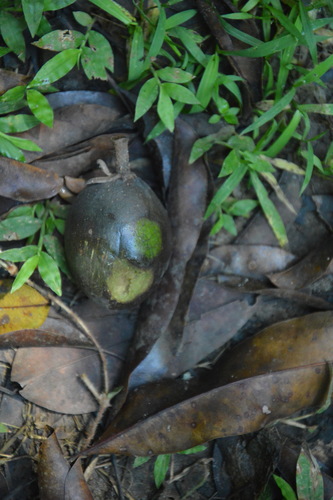
The fruit of the black apple is edible out-of-hand. It has a sweet and fibrous flesh. However, it is also favoured by maggots, which are often found inside. The taste has been reported as variable. Indigenous Australians in the Gosford region are recorded as traditionally having eaten the seeds. The 1889 book 'The useful native plants of Australia' records "Black Apple" "Brush Apple" or Achras australis as being called "Jerra-wa-wah" in the Illawarra and Brisbane Waters areas of New South Wales. The tree was originally harvested for its timber by colonialists. The attractively yellow-patterned wood is hard and suitable for making rulers. The fruit has been incorporated into gin production in Australia.
Where to Find It
A tropical plant. It needs well drained, moist soils. It can tolerate some frost. It can grow in full sun of light shade. It can tolerate coastal spray. Melbourne Botanical Gardens.
Asia, Australia, Pacific, Philippines, SE Asia,
How to Identify
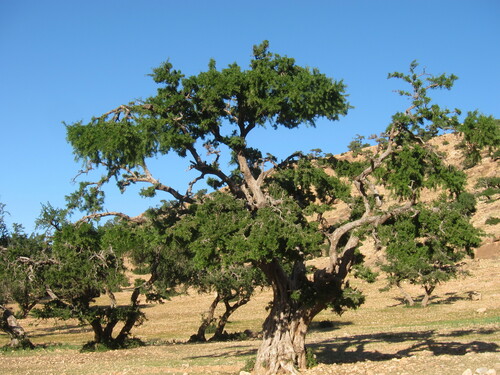
A tall tree. It grows 10-25 m tall and spreads 10-15 m wide. The crown is spreading. The bark is rough and cracked. Young growth is bright green and hairy. The leaves are dark green and shiny above and paler underneath. They are 8-16 cm long by 2-6 cm wide. They are broadly oval and taper to the base. The flowers are 0.5 cm long and greenish-cream. They occur either singly or in clusters. They can be in the axils of leaves or on old wood. The fruit are berries. They are 2-5 cm across and oval. They are purple or black. There are 3-5 seeds which are up to 5 cm long. They are brown and shiny. The fruit are edible.
How to Grow
Plants can be grown from seed or cuttings.
Production
It is slow growing. Trees take 10 years to start fruiting. A fruit weighs 50 g. A mature tree can produce several hundred fruit in a season.
Notes
There are about 100 Planchonella species. They are mostly in Asia and the Pacific.
Names & Synonyms
References (22)
- Anon., 2003, Native Plants for the Fitzroy basin. Society for Growing Australian Plants Inc. (Rockhampton Branch) p 73
- Barwick, M., 2004, Tropical and Subtropical Trees. A Worldwide Encyclopedic Guide. Thames and Hudson p 344 (As Planchonella australis)
- Bodkin, F., 1991, Encyclopedia Botanica. Cornstalk publishing, p 808 (As Planchonella australis)
- Candollea 9:308. 1942
- Cherikoff V. & Isaacs, J., The Bush Food Handbook. How to gather, grow, process and cook Australian Wild Foods. Ti Tree Press, Australia p 196 (As Planchonella australis)
- Coronel, R.E., 1982, Fruit Collections in the Philippines. IBPGR Newsletter p 10 (As Planchonella australis)
- Cribb, A.B. & J.W., 1976, Wild Food in Australia, Fontana. p 49 (As Planchonella australis)
- Edible and Useful Native Plants (off internet)
- Elliot, W.R., & Jones, D.L., 1997, Encyclopedia of Australian Plants suitable for cultivation. Vol 7. Lothian. p 355 (As Planchonella australis)
- Hardwick, G., 2001, Economically Useful Plants for Northern Australia: Master Species List. Crusader eBooks.
- Hibbert, M., 2002, The Aussie Plant Finder 2002, Florilegium. p 236 (As Planchonella australis)
- Isaacs, J., 1987, Bush Food, Aboriginal Food and Herbal Medicine. Weldons. p 68 (As Planchonella australis)
- Jones D, L, 1986, Ornamental Rainforest Plants in Australia, Reed Books, p 238, 340 (As Planchonella australis)
- Lord, E.E., & Willis, J.H., 1999, Shrubs and Trees for Australian gardens. Lothian. p 20 (As Planchonella australis)
- Low, T., 1991, Wild Food Plants of Australia. Australian Nature FieldGuide, Angus & Robertson. p 90 (As Planchonella australis)
- Low, T., 1992, Bush Tucker. Australia’s Wild Food Harvest. Angus & Robertson. p 61 (As Planchonella australis)
- Lyle, S., 2006, Discovering fruit and nuts. Land Links. p 333
- Nicholson, N & H., 1994, Australian Rainforest Plants 4, Terania Rainforest Publishing. NSW. p 55 (As Planchonella australis)
- Ratcliffe D & P., 1987, Australian Native Plants for Indoors. Little Hills press. p 116 (As Planchonella australis)
- Recher, P, 2001, Fruit Spirit Botanical Gardens Plant Index. www.nrg.com.au/~recher/ seedlist.html p 3 (As Planchonella australis)
- Williams, J.B., Harden, G.J., and McDonald, W.J.F., 1984, Trees and shrubs in rainforests of New South Wales and Southern Queensland. Univ. of New England, Armidale. p 92 (As Planchonella australis)
- Yallakool Reserve Plant List July 1, 2009 Off internet