Ancylobothrys amoena
Hua
Tukamale
(c) Carel Jongkind, some rights reserved (CC BY-NC), uploaded by Carel Jongkind
(c) Carel Jongkind, some rights reserved (CC BY-NC), uploaded by Carel Jongkind
What to Eat
Edible parts: Fruit, Seeds
Fruit - raw. A somewhat apricot-like flavour. The fruit is a yellow to red, globose or slightly pear-shaped berry, 15 - 20mm in diameter, containing 1 - 4 relatively large seeds. Seed.
Where to Find It
It is a tropical plant. It grows in savanna woodland. In Malawi it is common in lake shore forests.
Africa, Burkina Faso, Cameroon, Central Africa, Chad, Congo DR, East Africa, Ghana, Guinea, Guinée, Malawi, Mali, Nigeria, Rwanda, Sudan, Tanzania, Togo, Uganda, West Africa, Zambia,
How to Identify
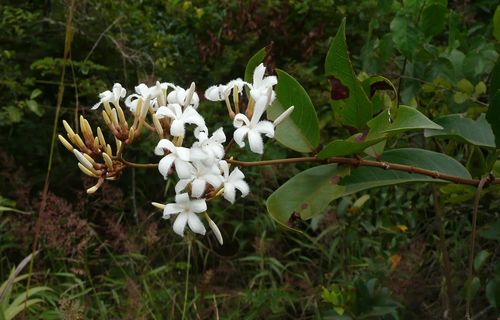
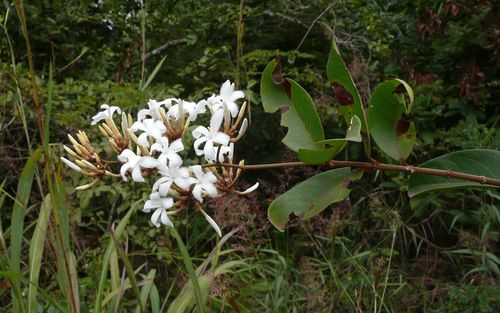
A creeper. It can grow 20 m long. It can be 15 cm around. The leaves are rough and paler underneath. The leaf blade is 7-11 cm long by 3-6 cm wide. They are oval. The flowers are white or green. They have a sweet scent. The fruit are 4 cm across. The are almost round and orange. The seeds are 8-12 mm long.
How to Grow
Flowering and fruiting is usually seasonal, though in the east of its range it can occur scattered through the year.
Medicinal Uses
The sap is dripped straight into the eye for suppuration. The fruits are used as a treatment on sores.
Other Uses
The plant contains a white latex which may be sparse, or abundant. It does not coagulate naturally, nor can it apparently be made to do so, but it dries to an useless powder. There are, however, references to it being a rubber yielder in the Bassa area of N Nigeria and in Sudan. The stems are woven into baskets and fish-traps.
Notes
There are 10 Ancylobotrys species.
Names & Synonyms
Amakamire, Kbalo aei, Malondo, Obo, Toloto, Toyaya oliki
References (15)
- Abbiw, D.K., 1990, Useful Plants of Ghana. West African uses of wild and cultivated plants. Intermediate Technology Publications and the Royal Botanic Gardens, Kew. p 47
- Aniama, S. O., et al, 2016, Ethnobotanical documentaton of some plants among Igala people of Kogi State (Nigeria). The International Journal Of Engineering And Science (IJES). 5(4) pp 33-42 (As Landolphia amoena)
- Atato, A., et al, 2010, Diversity of Edible Wild Fruit Tree Species of Togo. Global Science Books.
- Atato, A., et al, 2012, Especes lianescentes a fruits comestibles du Togo. Fruits. 67(5): 353-368
- Bigirimana, C., et al, 2016, Utilisation of Indigenous Fruit Tree Species within the Lake Victoria Basin, Rwanda. Agricultural Science: An International Journal. (AGRIJ) Vol. 1, No. 1
- Burkill, H. M., 1985, The useful plants of west tropical Africa, Vol. 1. Kew.
- Flora Zambesiaca. http://apps.kew.org/efloras
- Fowler, D. G., 2007, Zambian Plants: Their Vernacular Names and Uses. Kew. p 9
- Global Plants JSTOR
- Jardin, C., 1970, List of Foods Used In Africa, FAO Nutrition Information Document Series No 2.p 120
- Liengola, I. B., 2001, A contribution to the study of native edible plants by the Turumbu and Lokele of the Tshopo District, Province Orientale, D. R. Congo. Syst. Geogr. Pl. 71:687-698
- Reis, S. V. and Lipp, F. L., 1982, New Plant Sources for Drugs and Foods from the New York Botanical Garden herbarium. Harvard. p 242 (As Landolphia amaena)
- Vivien, J., & Faure, J.J., 1996, Fruitiers Sauvages d'Afrique. Especes du Cameroun. CTA p 53
- White, F., Dowsett-Lemaire, F. and Chapman, J. D., 2001, Evergreen Forest Flora of Malawi. Kew. p 135
- World Checklist of Useful Plant Species 2020. Royal Botanic Gardens, Kew


