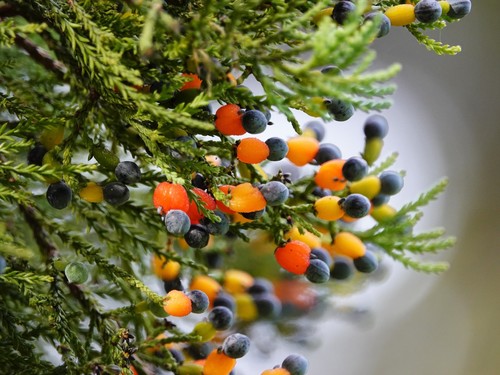
Podocarpus elatus
R. Br ex Endl.
Brown Pine, Plum Pine

(c) Peter Crowcroft, some rights reserved (CC BY), uploaded by Peter Crowcroft
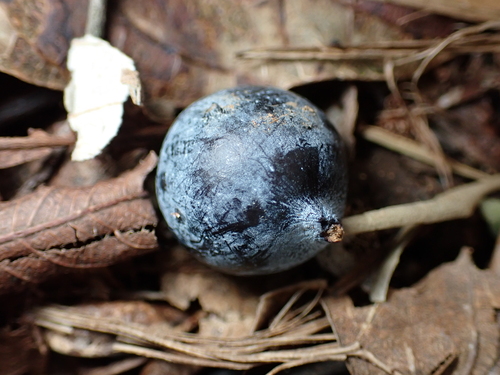
(c) Auradyme, some rights reserved (CC BY), uploaded by Auradyme
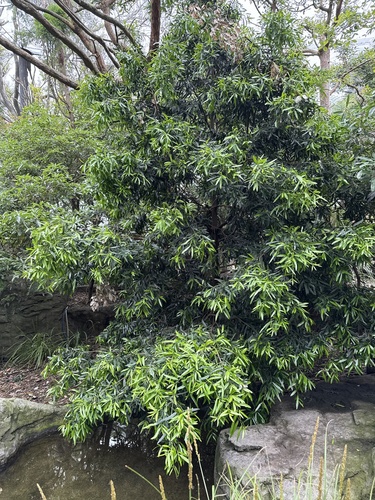
(c) glenw33, some rights reserved (CC BY-NC)
What to Eat
Edible parts: Fruit stalk, Fruit
The fruit can be eaten raw or cooked and makes a tasty jelly. It is rich, sweet, and mucilaginous with a resinous flavour. The fruit is a reasonable size at around 25mm in diameter, with the seed borne on its top.
Known Hazards
Where to Find It
It occurs in New South Wales and Queensland in Australia. It is a rainforest species in tropical and warm temperate regions. They need well drained acidic soils. It can stand light frosts. It suits hardiness zones 9-12. Arboretum Tasmania. In Melbourne Botanical Gardens. In Hobart Botanical gardens.
Asia, Australia*, Hawaii, Indonesia, Pacific, SE Asia, Tasmania,
How to Identify
A medium sized tree. It grows to 5-15 m high. It can be 40 m tall. It spreads 3.5-8 m wide. The bark is grey to brown and fibrous. The branches stick out or curve upwards. The young growth is yellowish green or pink. The small branches have ribs. The leaves are 6-18 cm long by 0.5-1.4 cm wide. They are deep green on top and paler underneath. The male cones are about 3 cm long. They are in clusters in the axils of leaves. They have very short stalks. The female cones are single and greenish on a large fleshy blue black stem. These plum like fruit are edible.
Nutrition Score: 30/100
| Part | Moisture | kJ | kcal | Protein | Vit A | Vit C | Iron | Zinc |
|---|---|---|---|---|---|---|---|---|
| Seed | 61 | 728 | 174 | 0.9 | — | 11 | — | — |
| Fruit | 87.3 | 347 | 83 | 0.2 | — | — | 0.3 | 0.2 |
How to Grow
Prefers a rich moist non-alkaline soil. Resists salt spray. Grows best in areas with a humid climate. Plants tolerate temperatures down to at least -7°c in Australian gardens, but this cannot be translated directly to British gardens because of our cooler summers and longer colder and wetter winters. They can be grown outdoors in the milder areas of Britain, preferably in a woodland garden. Plants in this genus are notably resistant to honey fungus. Dioecious. Male and female plants must be grown if seed is required.
Propagation: Seed can be sown at any time of year in sandy soil in a warm greenhouse, though sowing as soon as it is ripe is ideal. Prick seedlings into individual pots once large enough to handle and grow them on in the greenhouse for at least their first winter. Plant out into permanent positions in late spring or early summer, after the last expected frosts. Cuttings of half-ripe terminal shoots, 5–10cm long, can be taken in July or August and rooted in a frame.
Medicinal Uses
None known.
Other Uses
The wood is tough, durable, and silky-textured. It is used in cabinet making, indoor joinery, and boat building.
Wikipedia
Source ↗Podocarpus elatus, known as the plum pine, the brown pine, the Illawarra plum or the Queensland Christmas tree, is a species of Podocarpus endemic to the east coast of Australia, in eastern New South Wales and eastern Queensland. It is a medium to large evergreen tree growing to 30–36 m tall with a trunk up to 1.5 m diameter. The leaves are lanceolate, 5–15 cm long (to 25 cm long on vigorous young trees) and 6–18 mm broad. The seed cones are dark blue-purple, berry-like, with a fleshy base 2-2.5 cm diameter bearing a single oval or globose seed 1 cm in diameter.
Production
Trees often only fruit well on some years.
Notes
There are about 100 Podocarpus species. They are mostly in the tropics and subtropics.
Names & Synonyms
Cemara coklat, Goongum, Illawarra plum, She Pine, Yellow Pine
References (39)
- Abdillahi, H. S., 2009, Ethnobotany, phytochemistry and pharmacology of Podocarpus sensu latissimo (s.l.). South African Journal of Botany 76 (2010) 1–24
- Alice, L. & O'Quinn, T., Australian Bush Superfoods. Explore Australia p 70
- Anon., 2003, Native Plants for the Fitzroy basin. Society for Growing Australian Plants Inc. (Rockhampton Branch) p 73
- Bodkin, F., 1991, Encyclopedia Botanica. Cornstalk publishing, p 814
- Boland, D. J. et al, , 2006, Forest Trees of Australia. CSIRO p 58
- Bonney, N., 1997, Economic Native Trees and Shrubs for South Australia. Greening Australia (SA) inc. Campbelltown SA 5074 p 168
- Bonney, N., 2012, Edible Wild Native Plants for Southern Australia. p 56
- Cherikoff V. & Isaacs, J., The Bush Food Handbook. How to gather, grow, process and cook Australian Wild Foods. Ti Tree Press, Australia p 40, 196, 201
- Cooper, W. and Cooper, W., 2004, Fruits of the Australian Tropical Rainforest. Nokomis Editions, Victoria, Australia. p 7
- Cribb, A.B. & J.W., 1976, Wild Food in Australia, Fontana. p 51
- Cronin, L., 1989, The Concise Australian Flora. Reed. p 126
- Cundall, P., (ed.), 2004, Gardening Australia: flora: the gardener's bible. ABC Books. p 1064
- Edible and Useful Native Plants (off internet)
- Elliot, W.R., & Jones, D.L., 1997, Encyclopedia of Australian Plants suitable for cultivation. Vol 7. Lothian. p 394 (Drawing)
- Facciola, S., 1998, Cornucopia 2: a Source Book of Edible Plants. Kampong Publications, p 184
- Haslam, S., 2004, Noosa's Native Plants. Noosa Integrated Catchment Assn. Inc. p 353
- Hibbert, M., 2002, The Aussie Plant Finder 2002, Florilegium. p 237
- Holliday, I., 1989, A Field Guide to Australian Trees. Hamlyn. p 288
- Jackes, B.R., 2001, Plants of the Tropics. Rainforest to Heath. An Identification Guide. James Cook University. p 74
- Jones D, L, 1986, Ornamental Rainforest Plants in Australia, Reed Books, p 239, 340
- Lord, E.E., & Willis, J.H., 1999, Shrubs and Trees for Australian gardens. Lothian. p 88
- Low, T., 1991, Wild Food Plants of Australia. Australian Nature FieldGuide, Angus & Robertson. p 88
- Low, T., 1992, Bush Tucker. Australia’s Wild Food Harvest. Angus & Robertson. p 62
- Melzer, R., & Plumb, J., 2011, Plants of Capricornia. Belgamba, Rockhampton. p 33
- Nicholson, N & H., 1996, Australian Rainforest Plants, Terania Rainforest Publishing. NSW. p 55
- Pearson, S. & A., 1992, Rainforest Plants of Eastern Australia. Kangaroo Press p 168
- Queensland Forest Service, 1991, Trees and Shrubs. Department of Primary Industries. p 112
- Ratcliffe D & P., 1987, Australian Native Plants for Indoors. Little Hills press. p 118
- Recher, P, 2001, Fruit Spirit Botanical Gardens Plant Index. www.nrg.com.au/~recher/ seedlist.html p 3
- Robins, J., 1996, Wild Lime. Cooking from the Bush food garden. Allen & Unwin p 73
- Ryan, M. (Ed.), 2003, Wild Plants of Greater Brisbane. Queensland Museum. p 288
- Smith, K & I., 1999, Grow your own bushfoods. New Holland. Australia. p 41
- Staples, G.W. and Herbst, D.R., 2005, A tropical Garden Flora. Bishop Museum Press, Honolulu, Hawaii. p 74
- Sukarya, D. G., (Ed.) 2013, 3,500 Plant Species of the Botanic Gardens of Indonesia. LIPI p 462
- Syn. conif. 213. 1847 (ex Mirbel, Mem. Mus. Hist. Nat. 13:75. 1825, nom. nudum)
- Townsend, K., 1994, Across the Top. Gardening with Australian Plants in the tropics. Society for Growing Australian Plants, Townsville Branch Inc. p 318
- Williams, J.B., Harden, G.J., and McDonald, W.J.F., 1984, Trees and shrubs in rainforests of New South Wales and Southern Queensland. Univ. of New England, Armidale. p 17, 86
- Yallakool Reserve Plant List July 1, 2009 Off internet
- Young, P.A.R., 1991, Rainforest Guide. Brisbane Forest Park. p 30
More from Podocarpaceae