Polygonatum involucratum
(Franch. & Sav.) Maximowicz
Er bao huang jing
(с) V.S. Volkotrub, некоторые права защищены (CC BY-NC), загрузил V.S. Volkotrub

(с) Valery Kambalin, некоторые права защищены (CC BY-NC), загрузил Valery Kambalin
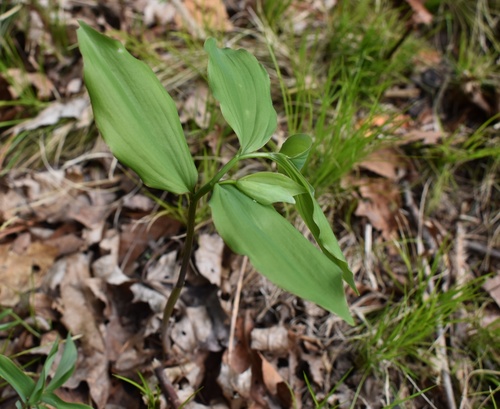
(с) Repina Tatyana, некоторые права защищены (CC BY), загрузил Repina Tatyana
What to Eat
Edible parts: Leaves, Root
Young shoots are cooked and can be used as an asparagus substitute. The root is also cooked and is rich in starch.
Known Hazards
Where to Find It
It is a temperate plant. It grows in forests in shaded and moist places between 700-1400 m altitude in N China.
Asia, China, Japan, Korea, Russia,
How to Identify
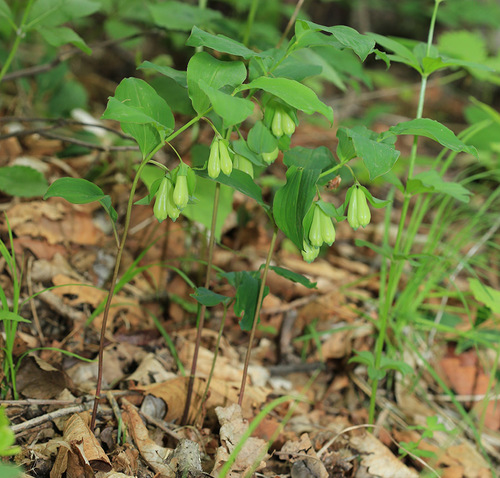
A herb. It has rhizomes or underground stems. These are 3-5 mm thick. The stem arches over. It is 20-50 cm high. There are 4-7 leaves which are alternate. The leaf stalk is short. The leaf blade is broadly oval and 5-10 cm long by 3-6 cm wide. The base is rounded. The flowering stalks has 2 flowers. The flowers hang downwards. The fruit is a berry. It is about 1 cm across and has 7 or 8 seeds.
How to Grow
We do not have much information on this species and do not know if it will be hardy in Britain, though judging by its native range it should succeed outdoors in most parts of this country. The following notes are based on the general needs of the genus. Prefers a fertile humus rich moisture-retentive well-drained soil in cool shade or semi-shade. Plants are intolerant of heat and drought but they tolerate most other conditions. Members of this genus are rarely if ever troubled by browsing deer or rabbits. The young shoots of most members of this genus are very attractive to slugs. Hybridizes with other members of this genus.
Propagation: Seed is best sown as soon as it is ripe in early autumn in a shady part of a cold greenhouse. Stored seed should be sown as early in the year as possible. Germination can be slow, seedlings may not come true to type, and it takes several years for plants to reach a good size. When large enough to handle, prick seedlings out into individual pots and grow on in a shady position in the greenhouse for at least the first winter. Plant out into permanent positions in late spring or early summer, after the last expected frosts. Division can be done in March or October. Larger divisions can go directly into permanent positions, while smaller divisions are better potted up and grown on in light shade in a cold frame until well established before planting out in late spring or early summer.
Medicinal Uses
No medicinal uses are known for this plant.
Other Uses
None known.
Wikipedia
Low-growing perennial reaching 0.3 m tall. Flowering occurs May to June with seeds ripening August to September. Self-fertile hermaphrodite pollinated by bees. Suitable for light sandy, medium loamy, and heavy clay soils with good drainage preferred. Accepts mildly acidic to basic soil pH. Grows in full shade or semi-shade with moist soil preference.
Notes
There are about 50 Polygonatum species. Also put in the family Convallariaceae.
Names & Synonyms
References (7)
- Bull. Acad. Imp. Sci. Saint-Peersbourg 29:205; Melanges Biol. Bull. Phys.-Math. Acad. Imp. Sci. Saint-Petersbourg 11:844. 1883 (Diagn. pl. nov. asiat.)
- Chen Xinqi, Liang Songyun, Xu Jiemei, Tamura M.N., Liliaceae. Flora of China. p 156
- Hu, Shiu-ying, 2005, Food Plants of China. The Chinese University Press. p 319
- Hwang, H., et al, 2013, A Study on the Flora of 15 Islands in the Western Sea of Jeollanamdo Province, Korea. Journal of Asia-Pacific Biodiversity Vol. 6, No. 2 281-310
- Hwang, HS, et al, 2014, Distribution characteristics of plant in the Ungseokbong Mountain, Gyeongsangnam-do, Korea. Journal of Asia-Pacific Biodiversity. 7(2014) e164-e178
- Plants for a Future database, The Field, Penpol, Lostwithiel, Cornwall, PL22 0NG, UK. http://www.scs.leeds.ac.uk/pfaf/
- Wujisguleng, W., et al, 2012, Ethnobotanical review of food uses of Polygonatum (Convallariaceae) in China. Acta Societatis Botanicorum Poloniae 81(4):239-244