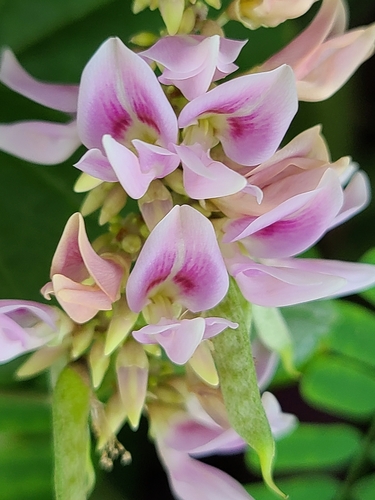
Vachellia karroo
(Hayne) Banfi & Gallaso
Karroo Thorn, Cape gum

no rights reserved, uploaded by Riaan Stals

(c) grinnin, some rights reserved (CC BY-NC), uploaded by grinnin
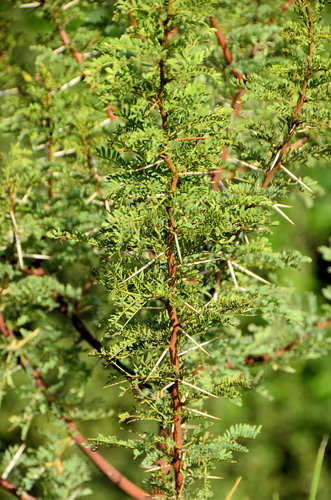
(c) Igmar Grewar, some rights reserved (CC BY-NC), uploaded by Igmar Grewar
What to Eat
Edible parts: Seeds - coffee, Gum, Bark, Roots, Seeds, Leaves - coffee
The gum obtained from the stems is eaten as a confection. Roasted seeds are used as a coffee substitute. Children chew the sweet thorns.
Known Hazards
Where to Find It
This is a native of Southern Africa. It prefers light to medium soils They need to be well drained. It requires a sunny protected position. It can resist drought and frost. It grows in areas with an annual rainfall between 50-1,500 mm. It grows between 3-2,400 m above sea level. It grows in coastal scrub and woodland and along streams. It can grow in arid places. It suits hardiness zones 9-11.
Africa, Angola, Australia, Botswana, Central Africa, Cyprus, East Africa, Egypt, Eswatini, Europe, Lesotho, India, Iraq, Libya, Malawi, Mauritius, Mediterranean, Middle East, Morocco, Mozambique, Namibia, North Africa, Portugal, South Africa, Southern Africa, Spain, St Helena, Swaziland, West Africa, Zambia, Zimbabwe,
How to Identify
An evergreen shrub or small tree. It grows to 5 m tall and 3 m wide. It can be 15 m tall. The stem is erect. It has spines. The spines are silvery white with a black tip. The spines or thorns can be 7 cm long. The bark is rough and grey-black. The bark peals off to show a rust red colour underneath. The branches are spreading. The leaves (phyllodes) are grey and divided twice. They are 10 cm long. There are 8-20 pairs of leaflets. The flowers are pale yellow. They have a sweet smell. They flowers occur in dense clusters. The pods are 12.5 cm long and narrow. The pods curve to a sickle shape. When ripe they are dark brown.
Nutrition Score: 58/100
| Part | Moisture | kJ | kcal | Protein | Vit A | Vit C | Iron | Zinc |
|---|---|---|---|---|---|---|---|---|
| Gum | 13.9 | 1308 | 313 | 6.8 | — | — | 16.6 | 0.3 |
| Seeds - coffee | — | — | — | — | — | — | — | — |
How to Grow
It is grown from seed. The seed needs to be treated to break the hard seed coat. Normally this is by putting the seeds in very hot water and letting the water cool down overnight then planting the seeds immediately. Seeds grow quickly. Seeds germinate in 3-12 days and can be transplanted when young.
Propagation: Soak seeds in hot water, leave them to cool overnight, and sow the following morning. Seeds can be sown directly into small nursery bags or into flat seedling trays filled with seedling mix. Germination occurs within 3–12 days. Within its natural range, the species is reported to be easy to raise from seed and has been planted widely for firewood on experimental plots in South Africa and Botswana.
Medicinal Uses
A root infusion is taken to treat pain in the alimentary canal, rheumatism, convulsions, gonorrhoea, and as an aphrodisiac. Root powder is applied externally to penile sores to treat syphilis. A decoction of the bark is used as an emetic for treating diarrhoea.
Other Uses
Vachellia karroo is widely used as a rehabilitation plant on degraded sites and dunes. It produces a flush of new leaves during the hottest period, before the rains, providing shade that reduces soil temperatures. It supports the development of an understorey of perennial, palatable, and nutritious grasses such as Cenchrus ciliaris and Panicum maximum through shade provision, nitrogen fixation, and improved soil structure and water infiltration. As a pioneer species, it has a climax of around 40 years and occupies a successional position between tropical forest and bushveld. Its long flowering season makes it valuable for apiculture, with bees collecting both pollen and nectar. Large specimens can indicate underground water sources. A gum obtained from the stems resembles gum arabic and is used regionally in southern Africa as a substitute, though it has not been cleared for export to Europe or the USA due to unresolved toxin testing. Annual gum production is 25–30 t/ha. The bark and seedpods yield tannins that impart a reddish colour; the bark contains up to 19% tannins. The Nama people of southern Africa extract a red dye from the bark and use the root bark for twine and rope in traditional mat house construction. The wood is hard, tough, and moderately durable, though few trees reach commercial size. It saws easily, planes to a smooth finish, and glues and varnishes well, making it suitable for furniture and interior finishing. It is, however, prone to twisting during seasoning and is susceptible to borers and fungi. It pulps readily under standard kraft macro-pulping conditions. The wood burns brightly with very little smoke and no odour, splits easily, and does not reabsorb moisture once dried. Its calcium oxalate crystals produce high-temperature, long-lasting embers, making it excellent firewood for cooking and heating. It is also regarded as a fine charcoal source, particularly in the coastal dunes of Zululand, South Africa.
Wikipedia
Source ↗Vachellia karroo, (synonym Acacia karroo) commonly known as the sweet thorn, common acacia, Karoo thorn, Cape gum or cockspur thorn, is a species of Vachellia, in the Mimosa sub-family (Mimosoideae) of the Fabaceae or pea family, which is native to southern Africa from southern Angola east to Mozambique, and south to South Africa. It is a shrub or small to medium-sized tree which grows to height of 12m. It is difficult to tell apart from Vachellia nilotica subsp. adstringens without examining the seed pods. The Botanical Society of South Africa has accepted a name change to Vachellia karroo. Common names in various languages include doringboom, soetdoring, cassie, piquants blancs, cassie piquants blancs, deo-babool, doorn boom, kaludai, kikar, mormati, pahari kikar, umga and udai vel.
Production
Plants are fast growing.
Other Information
The gum is chewed especially by children.
Notes
There are about 1,350 Acacia species. Over 1,000 occur in Australia. It can become a weed. Also as Mimosaceae.
Names & Synonyms
Cape gum, Doorn Boom, Isinga, Mfungu, Mimosa, Mkwangwa, Moangala, Mooka, Mpampa, Mubayamhondoro, Muhunga, Munenje, Mupfamutshena, Muunga, Muye-nyewe, Muzunga, Soetdoring, Sweet thorn, Umnga, Umunga, Witdoring
References (42)
- Barwick, M., 2004, Tropical and Subtropical Trees. A Worldwide Encyclopedic Guide. Thames and Hudson p 3 (As Acacia karroo)
- Blamey, M and Grey-Wilson, C., 2005, Wild flowers of the Mediterranean. A & C Black London. p 79 (As Acacia karroo)
- Bodkin, F., 1991, Encyclopedia Botanica. Cornstalk publishing, p 22 (As Acacia karroo)
- Burkill, H. M., 1985, The useful plants of west tropical Africa, Vol. 3. Kew. (As Acacia karroo)
- Cundall, P., (ed.), 2004, Gardening Australia: flora: the gardener's bible. ABC Books. p 76 (As Acacia karroo)
- De Vynk, J. C., et al, 2016, Indigenous edible plant use by contemporary Khoe-San descendants of South Africa's Cape South Coast. South African Journal of Botany. 102 (2016) 60-69 (As Acacia karroo)
- Drummond, R. B., 1981, Common Trees of the Central Watershed Woodlands of Zimbabwe, National Herbarium Salisbury. p 46 (As Acacia karroo)
- Etherington, K., & Imwold, D., (Eds), 2001, Botanica's Trees & Shrubs. The illustrated A-Z of over 8500 trees and shrubs. Random House, Australia. p 53 (As Acacia karroo)
- Fowler, D. G., 2007, Zambian Plants: Their Vernacular Names and Uses. Kew. p 32 (As Acacia karroo)
- Fox, F. W. & Young, M. E. N., 1982, Food from the Veld. Delta Books. p 198 (As Acacia karroo)
- Getreue Darstell. Gew. 10: t. 33. 1827 (As Acacia karroo)
- Grivetti, J., 1976, (As Acacia karroo)
- Grivetti, L. E., 1980, Agricultural development: present and potential role of edible wild plants. Part 2: Sub-Saharan Africa, Report to the Department of State Agency for International Development. p 79 (As Acacia karroo)
- Joffe, P., 2007, Creative Gardening with Indigenous Plants. A South African Guide. Briza. p 87 (As Acacia karroo)
- Le Houerou, H. N., (Ed.), 1980, Browse in Africa. The current state of knowledge. International Livestock Centre for Africa, Ethiopia. p 162 (As Acacia karroo)
- Long, C., 2005, Swaziland's Flora - siSwati names and Uses http://www.sntc.org.sz/flora/ (As Acacia karroo)
- Magwede, K., van Wyk, B.-E., & van Wyk, A. E., 2019, An inventory of Vhavenḓa useful plants. South African Journal of Botany 122 (2019) 57–89
- Mannheimer, C. A. & Curtis. B.A. (eds), 2009, Le Roux and Muller's Field Guide to the Trees and Shrubs of Namibia. Windhoek: Macmillan Education Namibia. p 102 (As Acacia karroo)
- Maroyi, A., 2011, The Gathering and Consumption of Wild Edible Plants in Nhema Communal Area, Midlands Province, Zimbabwe. Ecology of Food and Nutrition 50:6, 506-525 (As Acacia karroo)
- Paczkowska, G . & Chapman, A.R., 2000, The Western Australian Flora. A Descriptive Catalogue. Western Australian Herbarium. p 312 (As Acacia karroo)
- Palgrave, K.C., 1996, Trees of Southern Africa. Struik Publishers. p 241 (As Acacia karroo)
- Palmer, E and Pitman, N., 1972, Trees of Southern Africa. Vol. 2. A.A. Balkema, Cape Town p 700 (As Acacia karroo)
- Peters, C. R., O'Brien, E. M., and Drummond, R.B., 1992, Edible Wild plants of Sub-saharan Africa. Kew. p 126 (As Acacia karroo)
- Plowes, N. J. & Taylor, F. W., 1997, The Processing of Indigenous Fruits and other Wildfoods of Southern Africa. in Smartt, L. & Haq. (Eds) Domestication, Production and Utilization of New Crops. ICUC p 184 (As Acacia karroo)
- Roodt, V., 1998, Trees & Shrubs of the Okavango Delta. Medicinal Uses and Nutritional value. The Shell Field Guide Series: Part 1. Shell Botswana. p 193 (As Acacia karroo)
- Royal Botanic Gardens, Kew (1999). Survey of Economic Plants for Arid and Semi-Arid Lands (SEPASAL) database. Published on the Internet; http://www.rbgkew.org.uk/ceb/sepasal/internet [Accessed 26th April 2011] (As Acacia karroo)
- Ruiters-Welcome, A. K., 2019, Food plants of southern Africa. Ph.D. thesis. Univ. of Johannesburg p 62
- Schmidt, E., Lotter, M., & McCleland, W., 2007, Trees and shrubs of Mpumalanga and Kruger National Park. Jacana Media p 154 (As Acacia karroo)
- Shava, S., 2000, The Use of Indigenous Plants as Food by a Rural Community in the Eastern Cape: an Educational Exploration. Masters Thesis Rhodes University. p 63 (As Acacia karroo)
- Tredgold, M.H., 1986, Food Plants of Zimbabwe. Mambo Press. p 81 (As Acacia karroo)
- Uphof, (As Acacia karroo)
- van Wyk, B, van Wyk, P, and van Wyk B., 2000, Photographic guide to Trees of Southern Africa. Briza. p 33 (As Acacia karroo)
- Van Wyk, Br. and van Wyk P., 2009, Field Guide to Trees of Southern Africa. Struik Nature. p 494 (As Acacia karroo)
- van Wyk, Be., & Gericke, N., 2007, People's plants. A Guide to Useful Plants of Southern Africa. Briza. p 100 (As Acacia karroo)
- van Wyk, B-E., 2011, The potential of South African plants in the development of new food and beverage products. South African Journal of Botany 77 (2011) 857–868 (As Acacia karroo)
- van Wyk, Ben-Erik, 2019, The diversity and multiple uses of southern African legumes. Australian Systematic Botany, 2019, 32, 519–546
- Venter, F & J., 2009, Making the most of Indigenous Trees. Briza. p 22 (As Acacia karroo)
- Welcome, A. K. & Van Wyk, B.-E., 2019, An inventory and analysis of the food plants of southern Africa. South African Journal of Botany 122 (2019) 136–179
- Williamson, J., 2005, Useful Plants of Malawi. 3rd. Edition. Mdadzi Book Trust. p 10 (As Acacia karroo)
- World Checklist of Useful Plant Species 2020. Royal Botanic Gardens, Kew
- www.zimbabweflora.co.zw 2011 (As Acacia karroo)
- Young, J., (Ed.), 2001, Botanica's Pocket Trees and Shrubs. Random House. p 48 (As Acacia karroo)