Polystichum acrostichoides
(Michx.) Schott.
Christmas fern, Hard shield fern, Prickly shield fern
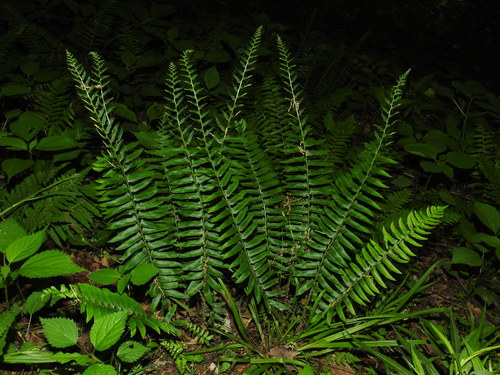
(c) William Van Hemessen, some rights reserved (CC BY-NC), uploaded by William Van Hemessen

(c) Ashley M Bradford, some rights reserved (CC BY-NC), uploaded by Ashley M Bradford

(c) Douglas Goldman, some rights reserved (CC BY-SA), uploaded by Douglas Goldman
What to Eat
Edible parts: Leaves, Fronds
Young fronds are edible — they are likely harvested as they unfurl and eaten cooked, though no further preparation details are recorded.
Where to Find It
A temperate plant. It grows in moist shaded slopes and damp forest floors. It suits hardiness zones 4-8.
Australia, Canada, Europe, North America, USA,
How to Identify
A fern. It grows 45-60 cm high and spreads 45-60 cm wide. It has a tufted rhizome. It has long narrow fronds which are divided into leaflets along the stalk. There fronds are 30-90 cm long and there are up to 50 leaflets on each side. These leaflets are oblong with a lobe near the base on the upper surface. The spore bodies or sori are small and on much reduce leaflets at the tips of the fronds.
How to Grow
Propagation: Sow spores on the surface of humus-rich sterilized soil as soon as they are ripe, though spring sowing is also possible. Keep the compost moist, preferably by covering the pot with a plastic bag. Pot on small clumps of plantlets once large enough to handle and keep humid until well established. Do not plant outside until the ferns are at least 2 years old, and then only in a very well sheltered position. Division is best done in spring.
Medicinal Uses
Christmas fern was used medicinally by several native North American Indian tribes, though it sees little or no use in modern herbalism. A tea made from the root acts as a blood purifier, emetic, and febrifuge, and is used to treat chills, fevers, pneumonia, stomach or bowel complaints, and rheumatism. A poultice of the root is applied for rheumatism, and a decoction of the root has been massaged into rheumatic joints. The powdered root has been inhaled and then coughed up to restore the voice.
Other Uses
None known.
Wikipedia
Source ↗Polystichum acrostichoides, commonly denominated Christmas fern, is a perennial, evergreen fern native to eastern North America, from Nova Scotia west to Minnesota and south to Florida and eastern Texas. It is one of the most common ferns in eastern North America, being found in moist and shady habitats in woodlands, stream banks and rocky slopes. The common name derives from the evergreen fronds, which are often still green at Christmas.
Notes
There are about 200 Polystichum species.
References (6)
- Cundall, P., (ed.), 2004, Gardening Australia: flora: the gardener's bible. ABC Books. p 1069
- Gen. fil. t. 9. 1834
- Goudey, C.J., 1988, A Handbook of Ferns for Australia and New Zealand. Lothian. p 146
- Jackes, D. A., Edible Forest Gardens
- MacKinnon, A., et al, 2009, Edible & Medicinal Plants of Canada. Lone Pine. p 379
- Plants for a Future database, The Field, Penpol, Lostwithiel, Cornwall, PL22 0NG, UK. http://www.scs.leeds.ac.uk/pfaf/


