Polystichum munitum
(Kaulfuss) C. Presl.
Sword fern, Giant holly fern, Western sword fern
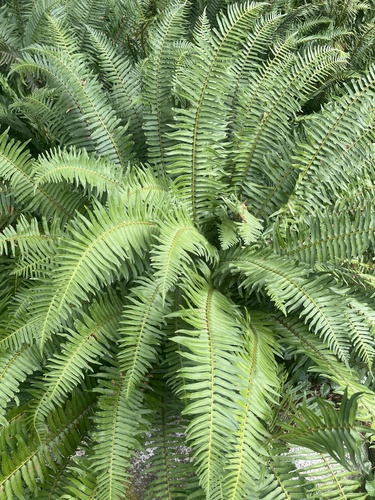
(c) mme_renn, some rights reserved (CC BY-NC)

(c) Don Loarie, some rights reserved (CC BY-NC-SA)

(c) Anthony Mendoza, some rights reserved (CC BY-NC-SA)
What to Eat
Edible parts: Root, Rhizome
The roots are roasted — peeled and baked like potatoes. Native North American Indians regarded them primarily as a famine food, eaten when little else was available. Roots were typically harvested in spring before new growth began, then cooked and peeled before eating.
Where to Find It
A temperate plant. It is frost hardy. It grows in moist shaded woods. It suits hardiness zones 4-9. Mt Cootha Botanical Gardens.
Australia, Canada, Mexico, North America, USA,
How to Identify
A fern. It grows 60-120 cm high and 90-120 cm wide. It has a slow creeping rhizome. The fronds are sword shaped and leathery. They are 50-120 cm long. They are twice divided. There are up to 40 leaflets on each side. They are matt dark green and slightly hairy underneath. The leaflets are spiny toothed. They have orange spore bodies underneath.
How to Grow
Propagation: Sow spores on the surface of humus-rich sterilized soil as soon as they are ripe, though spring sowing is also possible. Keep the compost moist, preferably by covering the pot with a plastic bag. Pot on small clumps of plantlets once large enough to handle and keep humid until well established. Do not plant outside until the ferns are at least 2 years old, and then only in a very well sheltered position. Division is best done in spring.
Medicinal Uses
An infusion of the fronds has been used as a wash or poultice to treat boils and sores. Young shoots have been chewed and eaten as a treatment for cancer of the womb, sore throats, and tonsillitis. Women have chewed the leaves to help facilitate childbirth. The sporangia have been crushed and applied as a poultice to burns, sores, and boils. A decoction of the rhizomes has been used to treat dandruff.
Other Uses
The leaves are used to line boxes, baskets, and fruit drying racks, and as a stuffing material in bedding. A decoction of the rhizome is used to treat dandruff. Plants can be grown as ground cover, spaced approximately 1 metre apart each way.
Wikipedia
Source ↗Polystichum munitum, the western swordfern, is an evergreen perennial fern native to western North America, where it is one of the most abundant ferns in forested areas. It occurs along the Pacific coast from southeastern Alaska to southern California, and also inland east to southeastern British Columbia, northern Idaho and western Montana, with disjunctive populations in northern British Columbia, Canada; the Black Hills in South Dakota, United States; and Guadalupe Island off of Baja California, Mexico. Western swordfern is known to have locally naturalized in parts of Great Britain and Ireland.
Notes
There are about 200 Polystichum species.
Names & Synonyms
References (17)
- Beckstrom-Sternberg, Stephen M., and James A. Duke. "The Foodplant Database." http://probe.nalusda.gov:8300/cgi-bin/browse/foodplantdb.(ACEDB version 4.0 - data version July 1994)
- Bocek, B. R., 1984, Ethnobotany of Costanoan Indians, California, Based on Collections by John P. Harrington. Economic Botany 38(2): 240-255
- Brickell, C. (Ed.), 1999, The Royal Horticultural Society A-Z Encyclopedia of Garden Plants. Convent Garden Books. p 819
- Cundall, P., (ed.), 2004, Gardening Australia: flora: the gardener's bible. ABC Books. p 1070
- Goudey, C.J., 1988, A Handbook of Ferns for Australia and New Zealand. Lothian. p
- Hedrick, U.P., 1919, (Ed.), Sturtevant's edible plants of the world. p 512
- Hibbert, M., 2002, The Aussie Plant Finder 2002, Florilegium. p 238
- Joyce, D., 1998, The Garden Plant Selector. Ryland, Peters and Small. p 336
- Kiple, K.F. & Ornelas, K.C., (eds), 2000, The Cambridge World History of Food. CUP p 1777
- Kuhnlein, H. V. and Turner, N. J., 1991, Traditional Plant Foods of Canadian Indigenous Peoples. Food and Nutrition in History and Anthropology Volume 8. Gordon and Breach. p 31
- MacKinnon, A., et al, 2009, Edible & Medicinal Plants of Canada. Lone Pine. p 379
- Moerman, D. F., 2010, Native American Ethnobotany. Timber Press. p 426
- Plants for a Future database, The Field, Penpol, Lostwithiel, Cornwall, PL22 0NG, UK. http://www.scs.leeds.ac.uk/pfaf/
- Slocum, P.D. & Robinson, P., 1999, Water Gardening. Water Lilies and Lotuses. Timber Press. p 131
- Tent. Pterid. 83. 1836
- Turner, N., 1995, Food Plants of Coastal First Peoples. Royal BC Museum Handbook p 29
- Yanovsky, E., 1936, Food Plants of the North American Indians. United States Department of Agriculture Miscellaneous Publication No 237. Washington, D.C. p 3


