Portulaca tuberosa
Roxb.

(c) Paulmathi Vinod, some rights reserved (CC BY), uploaded by Paulmathi Vinod
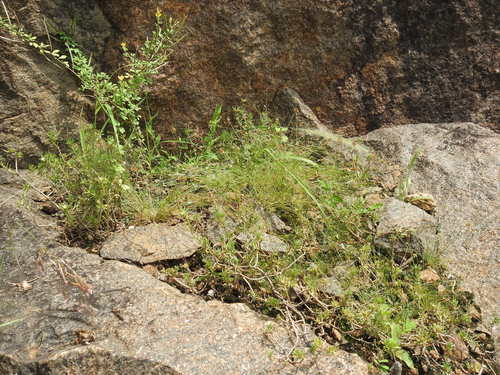
(c) Hopeland, some rights reserved (CC BY), uploaded by Hopeland
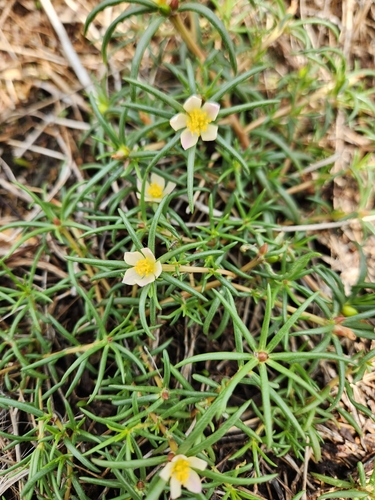
(c) Kobita Dass Kolli, some rights reserved (CC BY-NC), uploaded by Kobita Dass Kolli
What to Eat
Edible parts: Leaves, Root
The tuber-bearing roots are eaten raw, and the plant is eaten as a pot herb.
Dangerous Lookalikes
This plant can be confused with the following toxic species. Always verify identification carefully before consuming any wild plant.


Spotted Spurge: Milky white latex sap when broken, thinner leaves often with dark spot, prostrate growth, tiny flowers.
Portulaca tuberosa: Clear sap, thick succulent leaves, reddish smooth stems, yellow flowers.
Where to Find It
A tropical plant. It grows in rocky areas. In India it is use in western Rajasthan.
Africa, Asia, Australia, India, Pakistan, South Africa, Southern Africa, Sri Lanka,
How to Identify
A herb. It lies along the ground and keeps growing from year to year. It branches and is fleshy. The branches are 4-15 cm long and 2-3 mm wide. The roots have tubers. They are 5-8 cm long. The leaves are alternate and do not have stalks. They are 8-14 mm long by 1-1.5 mm wide.
Notes
There are about 200 Portulaca species. They are mostly in the tropics and subtropics.
Names & Synonyms
Bodda kura, Jabgli gajar, Kangli gajar, Laniya, Lunak, Safed mushali, Safed musli
References (10)
- Ambasta, S.P. (Ed.), 2000, The Useful Plants of India. CSIR India. p 486
- FAO, 1988, Traditional Food Plants, FAO Food and Nutrition Paper 42. FAO Rome p 414
- Flora of Pakistan. www.eFloras.org
- Lim, T. K., 2015, Edible Medicinal and Non Medicinal Plants. Volume 9, Modified Stems, Roots, Bulbs. Springer p 68
- Macmillan, H.F. (Revised Barlow, H.S., et al), 1991, Tropical Planting and Gardening. Sixth edition. Malayan Nature Society. Kuala Lumpur. p 357
- Martin, F.W. & Ruberte, R.M., 1979, Edible Leaves of the Tropics. Antillian College Press, Mayaguez, Puerto Rico. p 215
- SAXENA,
- Shekhawat, G.S. & Anand, S., 1984, An Ethnobotanical Profile of Indian Desert. J. Econ. Tax. Bot. Vol.5 No.3 pp 591-598
- Singh, H.B., Arora R.K.,1978, Wild edible Plants of India. Indian Council of Agricultural Research, New Delhi. p 34
- Terra, G.J.A., 1973, Tropical Vegetables. Communication 54e Royal Tropical Institute, Amsterdam, p 68
More from Portulacaceae


