Potentilla discolor
Bunge
Cinquefoil, White-beneath herb

(c) JODY HSIEH, some rights reserved (CC BY-NC), uploaded by JODY HSIEH
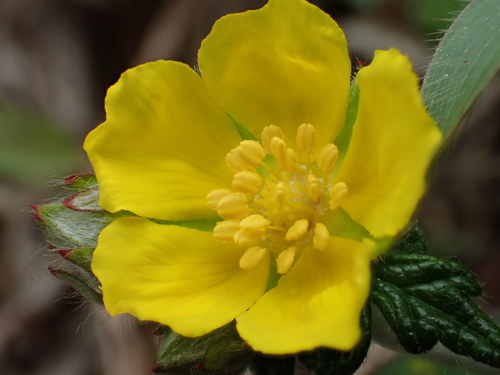
no rights reserved, uploaded by 葉子
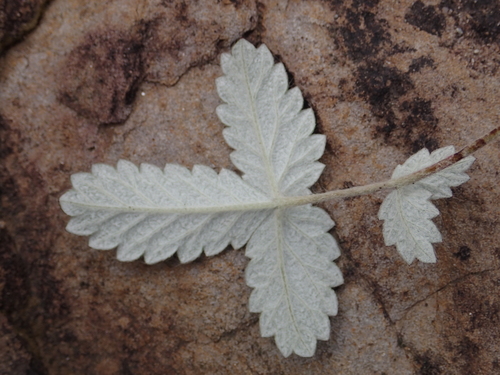
no rights reserved, uploaded by 葉子
What to Eat
Edible parts: Root, Shoots
The root can be eaten raw or cooked, though it is preferred raw.
Where to Find It
It is a temperate plant. It grows in valleys and on mountain slopes in N China. It grows in wetlands. In Sichuan and Yunnan.
Asia, China, Japan, Korea, Taiwan,
How to Identify
A herb. It keeps growing from year to year. The roots are robust. The lower part is often enlarged. The flowers stem can be erect, curving upwards or spreading. They are 16-45 cm tall. The leaves near the roots have 2-5 pairs of leaflets. The leaves up the stem are 1 or 2 and they are divided like fingers on a hand into 3-5 leaflets. The flowers are yellow.
How to Grow
We have very little information on this species and do not know if it will be hardy in Britain, though judging by its native range it should succeed outdoors in most parts of the country. The following notes are based on the general needs of the genus. Easily grown in a well-drained loam, preferring a position in full sun but tolerating shade. Prefers an alkaline soil but tolerates a slightly acid soil. Members of this genus are rarely if ever troubled by browsing deer.
Propagation: Sow seed in early spring or autumn in a cold frame. Once large enough to handle, prick seedlings into individual pots and grow on in a greenhouse through their first winter, then plant out in late spring or early summer after the last expected frosts. For division, spring is the best time. Larger divisions can go directly into permanent positions, while smaller ones are better potted up and grown on in light shade in a cold frame until well established before planting out in late spring or early summer.
Medicinal Uses
The root is aphrodisiac, astringent, depurative and styptic.
Other Uses
None known
Wikipedia
Source ↗Potentilla discolor is a compact perennial growing to 0.3 m (1 ft) tall. Flowers bloom from May to September with concurrent seed ripening. The plant is hermaphroditic and self-fertile, pollinated by insects. It tolerates light sandy, medium loamy, and heavy clay soils with good drainage, and adapts to mildly acidic, neutral, and basic soil pH levels. Growth is possible in semi-shade or full sun, with preference for moist soil conditions.
Notes
There are about 500 Potentilla species.
Names & Synonyms
Fan bai cao
References (8)
- Flora of China @ efloras.org Volume 9
- Hu, Shiu-ying, 2005, Food Plants of China. The Chinese University Press. p 439
- Hwang, H., et al, 2013, A Study on the Flora of 15 Islands in the Western Sea of Jeollanamdo Province, Korea. Journal of Asia-Pacific Biodiversity Vol. 6, No. 2 281-310
- Lim, T. K., 2015, Edible Medicinal and Non Medicinal Plants. Volume 9, Modified Stems, Roots, Bulbs. Springer p 68
- Plants for a Future database, The Field, Penpol, Lostwithiel, Cornwall, PL22 0NG, UK. http://www.scs.leeds.ac.uk/pfaf/
- READ,
- Wang, J. et al, 2013, A Study on the Utilization of Wild Plants for Food in Liangshan Yi Autonomous Prefecture. Plant Diversity and Resources. 35(4): 416-471
- Zhang, Y., et al, 2014, Diversity of wetland plants used traditionally in China: a literature review. Journal of Ethnobiology and Ethnomedicine. 10:72
More from Rosaceae


